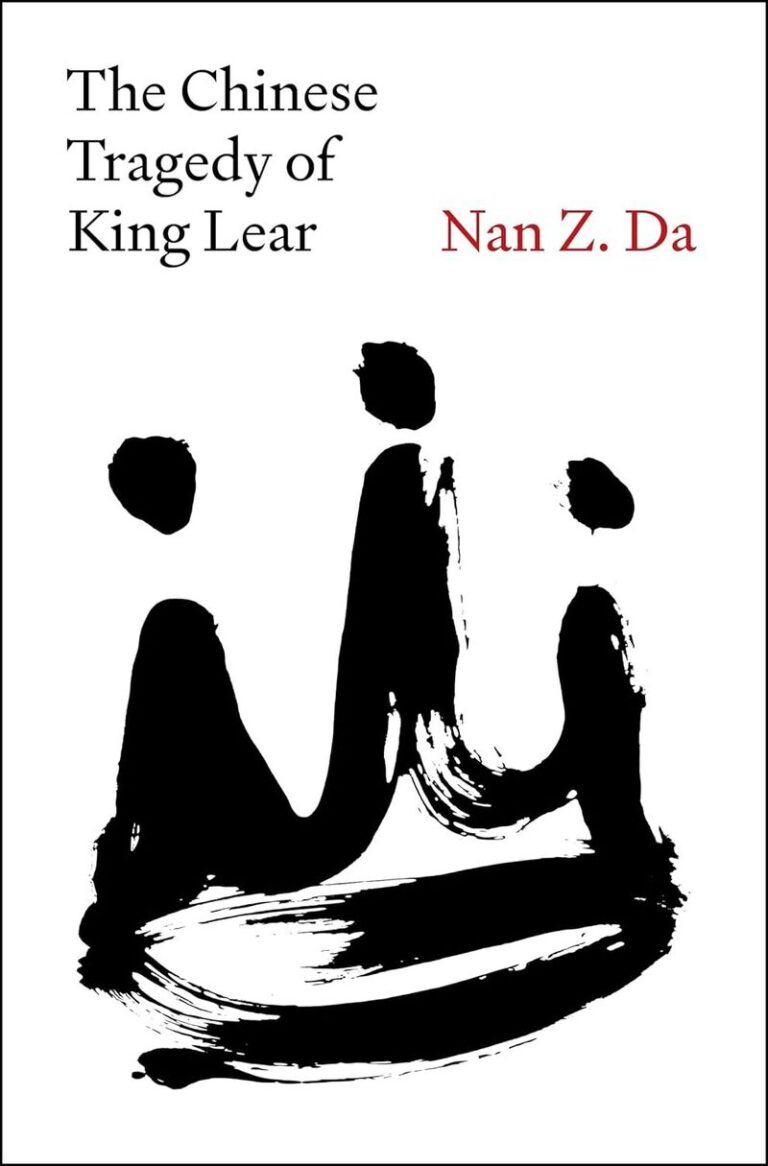
“The Chinese Tragedy of King Lear” by Nan Z Da
Nan Z Da has been teaching Shakespeare’s play King Lear, she says, for more than six years. One cannot help but envy her students.

Nan Z Da has been teaching Shakespeare’s play King Lear, she says, for more than six years. One cannot help but envy her students.
The marketing blurb for Amitav Acharya’s most recent book From Southeast Asia to Indo-Pacific begins, rather portentiously, “Southeast Asia was created by geopolitics, and it might die with it.” The book itself, thank goodness, is a considerably more measured (and clearly-written) overview of how Southeast Asia and ASEAN came to be more or less synonymous…
Ali Banisadr: The Alchemist is a new publication and exhibition organised by the Katonah Museum of Art and the first major museum survey of Iranian-born artist Ali Banisadr. Covering twenty years of the artist’s practice, the exhibition and catalogue offer a fresh perspective on the artist’s career across the mediums of painting, drawing and printmaking.
The IT sector seems to be concerned with the flow of information across nations. However, it can also be about the flow of emotions. Labour around technology is not only about programming; it can also be about emotional exhaustion. In The Future of Futurity: Affective Capitalism and Potentiality in a Global City, anthropologists Poornima Mankekar…
The noun “Partition” (with a capital “P”) has, in South Asia and perhaps globally, come to mean the 1947 split of India and Pakistan, a climactic event that still roils, if not poison, domestic and international politics.
Aatish Taseer, with roots in England, India, Pakistan, and the USA, appears to be a member of the globalized elite, able to call multiple nations his own. For Taseer, however, there is only one country he calls home. A self-described “Indian writer”, Taseer, for much of his adult life, has distanced himself from his absentee,…
For many middle and high school students across the United States, the book Farewell to Manzanar has been their introduction to one of the darkest times in American history. Jean Wakatsuki Houston’s memoir tells of her childhood years in what was called the Manzanar War Relocation Center but in reality was a concentration camp. From…

Bali 1952: Through the Lens of Liu Kang documents a seven-week trip to Java and Bali in 1952 by four China-born and Shanghai-trained Singapore artists—Chen Wen Hsi, Chen Chong Swee, Cheong Soo Pieng and Liu Kang—to sketch and paint tropical beauty.
That Before Colonization can be read in several ways is to its favour, but also makes it hard to review. It takes aim at the way international relations (referred to by the field’s formal initials IR) has tended to go about its business; it is also a refreshingly straightforward discussion of, as in the subtitle,…

This year marks the 50th anniversary of the fall of Saigon and what is now celebrated in Vietnam as the unification of the country. Outside of Vietnam, this anniversary is tinted with stories of exile, of loss and trauma, of surviving in a new country and culture, where Vietnamese voices often go unheard. The Cleaving…
In his book Tianjin Cosmopolis, Pierre Singaravélou remarks that “The history of modernity is a history of possible futures as much as a study of the processes of modernization.” Thanks to a new translation from the original French, English readers now have a chance to consider one possible future of China that never came to…
All cities have histories, but some seem to have histories that attract particular interest, or play an outsized role in shaping their character. Tokyo is, perhaps, one such: there are numerous books examining its past (for example: Tokyo Before Tokyo by Timon Screech or Anna Sherman’s The Bells of Old Tokyo) and even a podcasts-cum-walking…

Russia came late to Japan, but devoted considerable energies to grappling with one of the world’s great intelligence challenges and penetrating the insular Asian nation once the Japanese shifted in the latter half of the 19th century from a policy of restricted contact with the outside world to one of imperial competition with Moscow and…
Ancient India is a new publication and exhibition by the British Museum that explores the shared origins of Hindu, Buddhist and Jain devotional art in figurative imagery of India’s ancient nature spirits. These three of the world’s major religions originated in India and gradually spread to other regions of the world. Between 200 BCE and…
Globalization has polarized people into nativists and cosmopolites. Nowhere is that truer than in India. The nativist reaction in India to profound technological, commercial and social changes of today takes refuge in the myth of an unchanging, hermetically sealed, and eternal civilization. Audrey Truschke’s 600-page survey of five millennia of history shows how misguided this…