“Away from Chaos: The Middle East and the Challenge to the West” by Gilles Kepel
The first takeaway from Gilles Kepel’s new book Away from Chaos is the immense complexity of Middle East politics.
The first takeaway from Gilles Kepel’s new book Away from Chaos is the immense complexity of Middle East politics.
There will, one imagines, be quite a few books written about Hong Kong’s year of protests, from journalistic retellings from the front-lines, memoirs from influential figures, and attempts to tie the protests to a broader “New Cold War” narrative. There have already been a few.
Just around the corner from Rome’s Pantheon, on the Via di Sant’Ignazio, is the famed Biblioteca Casanatense. Among its precious books and manuscripts is an album of 76 striking watercolours made in Goa around 1540, the work of an anonymous Indian painter for an unknown Portuguese patron.
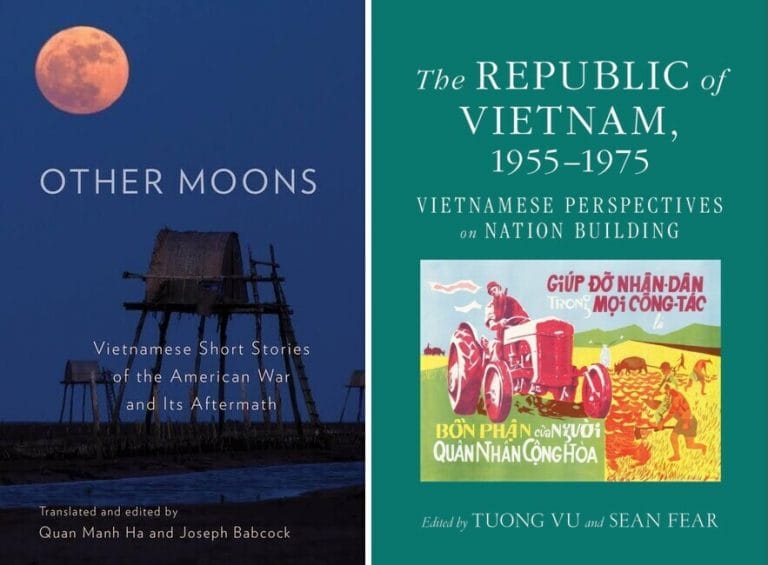
For my generation, born after the “Renovation” reform of Đổi Mới in 1986, “The War”—as most Vietnamese call what almost everyone else calls the Vietnam War—only exists in history books.
Eugenia Cheng, author of the cleverly-titled x + y: A Mathematician’s Manifesto for Rethinking Gender, is—goes Wikipedia—“a British mathematician, concert pianist, and an honorary fellow of pure mathematics at the University of Sheffield. Her mathematical interests include higher-dimensional category theory, and as a pianist she specialises in lieder and art song.” Her current gig is…
When Mary Morris is awarded a sabbatical year from teaching at Sarah Lawrence College, she planned to travel with her husband and adult daughter. A travel writer and novelist, Morris enjoys nothing more than roaming around other countries. But then a freak accident on the ice rink shattered her ankle; her dreams of traveling for…
Writer and editor Mu Shiying declared 1934 the Year of the Magazine, marking a dramatic rise in Chinese pictorial magazines, modeled on American publications like Life and Vanity Fair.
There can be a fun-house mirror quality to the history of Japan’s relations with Russia: the events are recognizable, but come with unexpected bulges and pinches.
The first thing you need to recognize when you are reading an English translation of Sun Tzu’s The Art of War is that you are dealing with what former US Defense Secretary Donald Rumsfeld called “known unknowns”. Scholars are not certain about when the book was written (estimates range between 770 BCE and 221 BCE),…
It’s a well-worn assertion, even a cliché, that art and spirituality are inextricably linked. A concrete representation of the subject for religious meditation is, we could say, a visible aid to devotion: not so much the object itself, but what it symbolizes, which is important to the viewer (or listener if it’s music).
Thomas Bowrey left London for India as a child in 1668; his father had died of the plague in 1665, a tragedy compounded by the Great Fire the next year. Shipping him off to India was not the worst thing a mother could do in such circumstances. Bowrey arrived in Fort St George, Madras after…
On a map, Taiwan does not seem very remarkable as a small island off the coast of China. But despite being smaller than the Netherlands and neighboring countries, Taiwan features Northeast Asia’s highest mountains and a rich biodiversity. In Two Trees Make A Forest: In Search of My Family’s Past Among Taiwan’s Mountains and Coasts,…
Despite the apparent global ubiquity of coffee culture, tea, rather than coffee, is the most popular beverage apart from water. Yet as the authors of Tea is for Everyone: Making Chinese Tea Accessible explain, Chinese tea is still not very well known outside Asia, despite tea having originated there.
Amid the plethora of China memoirs by Western writers over the years, this new one set in Shanghai from 1978 to 1979 stands out a little because it takes place during a time of transition in China. But Anne E McLaren’s Slow Train to Democracy is more than just a record of her time in…
During a one-year sojourn in London in the 1970s, my secondary school O-level history curriculum covered about a century from mid-1700s on. A decade into a discussion of the Napoleonic Wars, the history master (for such he was called) mentioned, almost in passing (and, in retrospect, probably for my benefit), that after marching through a…