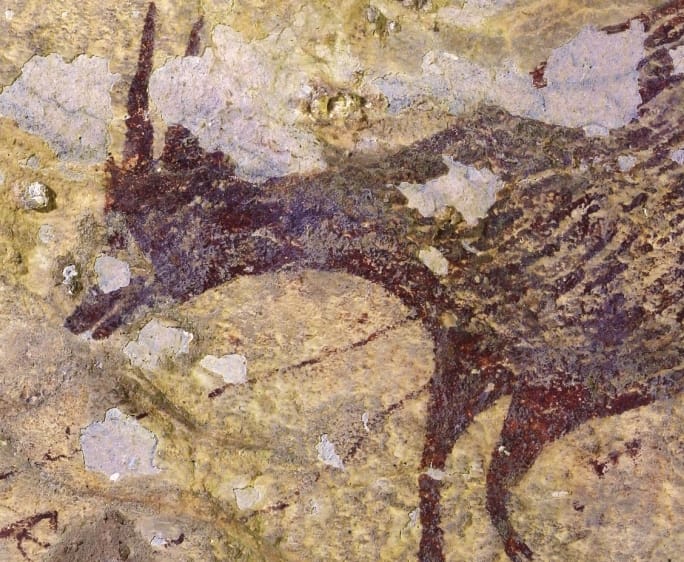
“Early Southeast Asia: From First Humans to First Civilizations” by Charles Higham
Quite a lot of archaeological water, to say nothing of history writing, has flowed under the bridge since Early Southeast Asia’s first edition in 2014.

Quite a lot of archaeological water, to say nothing of history writing, has flowed under the bridge since Early Southeast Asia’s first edition in 2014.
The recently-opened exhibition at Hong Kong’s Palace Museum, “The Origins of Chinese Civilisation”, has a serious purpose, but one suspects that most visitors focus on the objects, as well they might.
Bartle Bull’s objective in the very readable Land Between the Rivers is to demonstrate that the modern country of Iraq is not a mere colonial creation but rather has a historical reality going back millennia.
India has inspired William Dalrymple for well-on thirty years, resulting in a number of eminently readable books, including White Mughals—an analysis of east-west inter-cultural conflicts), Return of a King (a portrait of military disaster); and The Anarchy, an exposé of colonial exploitation. In his latest book, The Golden Road, Dalrymple for the first time tackles…
After reading David Chaffetz’s newest book, you’d think that the horse—not oil—has been humanity’s most important strategic commodity. As David writes in his book Raiders, Rulers and Traders: The Horse and the Rise of Empires, societies in Central Asia grew powerful on the backs of strong herds of horses, giving them a military and an…
In 330 BC, Alexander the Great conquers the city of Persepolis, the ceremonial capital of the Persian Empire. His troops later burn it to the ground, capping centuries of tensions between the Hellenistic Greeks and Macedonians and the Persians.
No animal has had as profound an impact on human history as the horse. The journey begins in prehistory, with a small, shy animal that humans hunted for food. Hunters domesticated the horse in order to ensure a supply of meat and, later, mare’s milk, which is more nutritious than cow’s milk. This was a…
Since around the turn of the new millennium, an explosion of science, archaeology and historical research have come together to establish the centrality of the steppe in world history: the place whence hail both Indo-Europeans and the wheel, a region that spawned empire after empire, from the Xiongnu to the Mongols. That “the region lying…
There are any number of serious and worthy reasons to write a book on Alexander the Great, and author and historian Rachel Kousser gives several—including that Alexander’s world was more “globally connected” and “integrated” than our own and how “Alexander’s story does not just give us a different perspective on the past; it also helps…
“Where does one begin unravelling the history of India and its peoples,” asks Alan Machado (Prabhu) in the first paragraph of his new book Discovering India Anew. At the beginning, he says.
Where does one begin to tell a story that spans many thousands of years, a story whose origins are obscured by stubborn mists that will not lift and enduring myths that will not shift under the weight of ages of telling Discovering India Anew reconstructs the history of Indian peoples, taking off from where the…
For two centuries, the Xiongnu people—a vast nomadic empire that covered modern-day Siberia, Inner Mongolia, Gansu and Xinjiang—were one of the Han Dynasty’s fiercest rivals. They raided the wealthy and prosperous Chinese, and even forced the Han to treat them as equals—much to the chagrin of those in the imperial court.

The centrality of Central Asian nomads to world history has, after decades of neglect, more recently become something of a truism. If you’re not up on your Scythians, Saka, kurgans, Xiongnu, deer stones, Pazyryks and the like, there are better places to start than Petya Andreeva’s Fantastic Fauna from China to Crimea, an analysis of…
For almost seven centuries, two powers dominated the region we now call the Middle East: Rome and Persia. From the west: The Roman Republic, later the Roman Empire, later the Byzantine Empire. From the East: The Parthian Empire, later replaced by the Sassanian Empire. The two ancient superpowers spent centuries fighting for influence, paying each…
Over the course of two centuries (between 133 BCE and 89 CE), China’s Han empire fought a series of conflicts with a confederation of nomadic steppe peoples known as Xiongnu. As Scott Forbes Crawford notes in his fast-moving, readable narrative history The Han-Xiongnu War, the Han and Xiongnu were east Asian “superpowers” whose struggle for…