“In the early summer of 1819, a British hunting party was heading through thick jungle near Aurangabad when the tiger they were tracking disappeared into the chasm of a deep ravine.” With that romantic and somewhat Indiana Jones-like opening, William Dalrymple begins his Foreword to this new and updated edition of Benoy K Behl’s classic The Ajanta Caves: Ancient Buddhist Paintings of India.
Ancient History
The Book of Esther, one of the historical books in the Torah and the Old Testament, is known as a story of community, discrimination, and human ingenuity. It’s core to the Jewish holiday of Purim, with singing, feasting, and other merriment. And it’s unique as one of the few books in the Bible that doesn’t mention God. At all.
Iran is certainly enjoying a moment through a series of international exhibitions. In 2021, the V&A Museum had “Epic Iran” whose tickets sold out upon release. In Los Angeles, the Getty Villa had “Persia: Ancient Iran and the Classical World”. In 2023, the British Museum has now added, “Luxury and Power: Persia to Greece”.
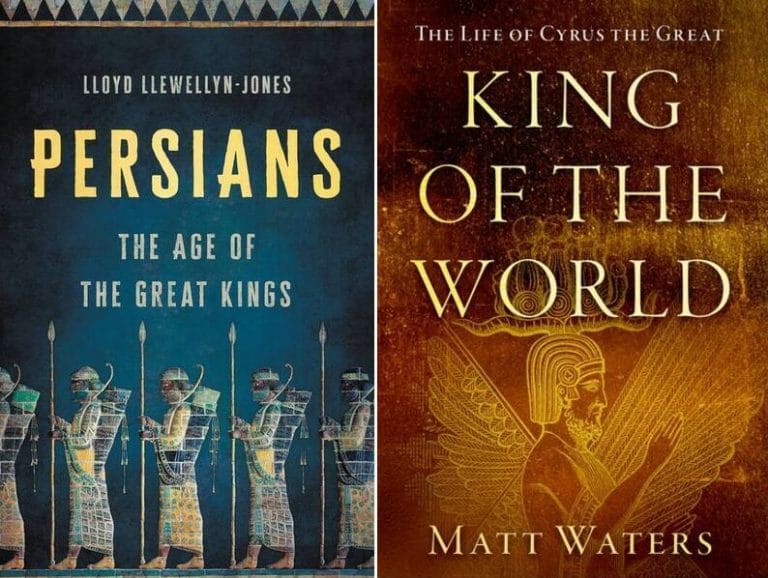
On the Jewish festival of Purim, revelers are encouraged to get so drunk that they cannot distinguish between Mordechai and Haman, the hero and the villain of the Book of Esther. Sobriety is required to appreciate Llewellyn-Jones’s erudite and encyclopedic retelling of the story. By piling detail upon detail, Llewellyn-Jones brings to life the sumptuous feasts and intrigues of the court of Susa, the seat of Persia’s great kings. While a veritable renaissance in the study of ancient Persia has been going on for a while, this is the first time a scholar has used the Jewish Bible as a primary source. The Book of Esther is easily dismissed as a trite, orientalizing fairytale. What if it turns out the author wrote from direct experience of the great king’s court?
The ancient Greeks wrote extensively about their distaste for the opulence of the Persians of the Achemenid empire. However, archaeological evidence suggests that the Athenians were not themselves immune from luxury and even incorporated modes of Eastern opulence within their own cultural repertoire.
Ashoka the Great (3rd century BCE) of the ancient Indian Mauryan dynasty (4th to 2nd century BCE) remains something of a mystery. He was emperor of one of the largest and richest kingdoms of the ancient times that covered Afghanistan, Pakistan, and northern parts of India. However, he was forgotten in India (while continuing to be revered in China and Southeast Asia, thanks to his appearance in Buddhist narratives) until the 19th century British scholars researching Indian antiquity discovered him as texts and inscriptions in the previously unreadable Brahmi script came to be newly deciphered.
Christopher Beckwith likes to shake up the staid world of archeologists, philologists and historians with big claims. In his Empires of the Silk Road, he argued the debt of world civilization to unfamiliar peoples from inner Asia, changing a Euro-centric or Sino-Centric approach to history into steppe-centricity. The Scythian Empire takes this one step forward by attributing many of the contributions from the steppe to a single people, the Scythians. In Beckwith’s telling, the Wusun, the Xiongnu, the Yuezhi, the Tokharians and the Soghdians are all Scythians, as are the Medes.
A half-century and more ago, when I was growing up, there was a comic book series in the United States called “Classics Illustrated” which retold novels, myths and—my own favorites—history in a format normally reserved for Spiderman. These were probably not the most accurate introductions to Marco Polo or Caesar, but they stirred the imagination.
The Sasanians ruled an empire stretching from the Mediterranean to the Aral Sea. Under them, the Zoroastrian religion developed its most subtle metaphysics. Greek philosophers flocked to their capital in Ctesiphon, while in Babylon, the Jewish Talmud ripened. Iranian painting, metalwork and music were received enthusiastically in China and India.
In the strategy game Civilization VI, where players choose world leaders to be their avatar, Qin Shihuang, the First Emperor of China, has one goal in mind: building wonders (like the Great Wall of China). His workers can build wonders faster and more cheaply, and he hates leaders that build more wonders than he does.

You must be logged in to post a comment.