“Koan Khmer” by Bunkong Tuon
Bunkong Tuon’s debut novel Koan Khmer is a coming of age story of a young Cambodian immigrant, Samnong Sok, who ultimately finds himself on a writer’s journey, not unlike the author himself.

Bunkong Tuon’s debut novel Koan Khmer is a coming of age story of a young Cambodian immigrant, Samnong Sok, who ultimately finds himself on a writer’s journey, not unlike the author himself.

Memoirs from Cambodian and of Cambodians remain rare, at least in English. A Cambodian Odyssey by Haing S Ngor came out almost forty years ago and became a bestseller a few years after the Oscar-award winning film, The Killing Fields. It is hard to think of many since. Until now with Chantha Nguon’s new memoir,…
From 1975 to 1979, while Cambodia was ruled by the brutal Communist Party of Kampuchea (Khmer Rouge) regime, torture, starvation, rape, and forced labor contributed to the death of at least a fifth of the country’s population. Despite the severity of these abuses, civil war and international interference prevented investigation until 2004, when protracted negotiations…

Half a year on from the publication of India: A History in Objects, the British Museum and Thames & Hudson have released a new volume of the same vibrant format on Southeast Asia, an endeavor at least as ambitious as that for the Subcontinent: “it is hardly possible to be comprehensive,” as Alexandra Green modestly…

Art consultant Nicholas Coffill gathered, sourced, and annotated over 300 photographs from around 100 Cambodian and foreign photographers in a unique retrospective of Cambodia’s visual history, presented in Photography in Cambodia: 1866 to the Present.

Tonlé Sap is one of Southeast Asia’s, if not one of the world’s, natural wonders. Between the dry and wet seasons, the lake expands almost six times in size to cover an area the size of Kuwait. The flows are so strong that the Tonlé Sap river actually reverses course, with water from the lake…

According to Cambodian lore, the ocean was once ruled by the king of the Naga empire. The Naga were an amphibious people who made their home between land and water. A prince discovered this underworld when he traveled to an island and met its princess on the shore. Naturally, they fell in love. After the…

Paris in the late 1940s was a time of rebuilding. It was also central to the nascent Communist party in Cambodia. Justin Clark’s new novel, The Zero Season, captures this period in a style reminiscent of Graham Greene with its political tension, complicated love story, and colorful settings.

“The Three Women of Chuck’s Donuts” was published in The New Yorker in early 2020, generating great interest for Anthony Veasna So’s forthcoming collection of stories, Afterparties. But months before his book came out, So died suddenly from an overdose. “The Three Women of Chuck’s Donuts” kicks off this collection and tries to answer a…

Cambodian-American poet Monica Sok recalls transgeneration trauma in her debut collection, A Nail the Evening Hangs On. Born in Pennsylvania to parents who have sought refuge in the United States, Sok retraces the contours of a difficult and important conversation on identity. She succeeds in using her Americanness to question her sense of belonging in…

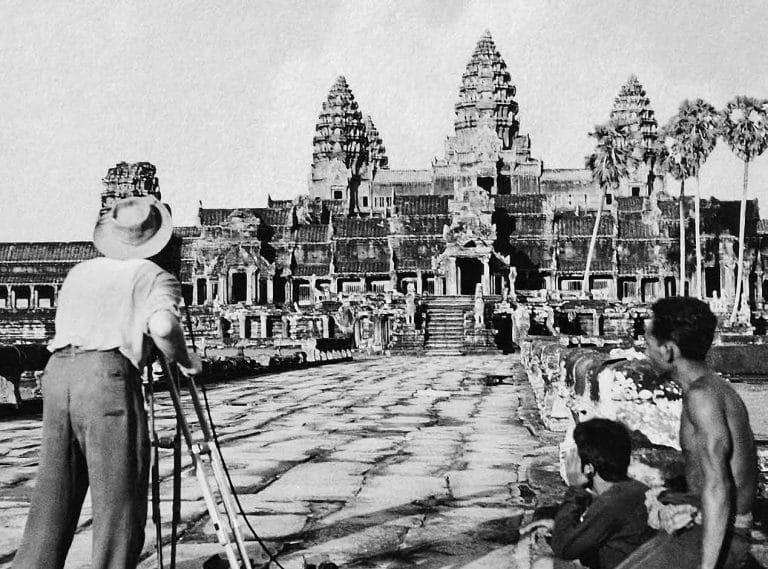
The amount of ink spilled on the 12th-century temple complex Angkor Wat might not fill Tonlé Sap Lake, but it sometimes feels like it might. This Khmer Empire monument dedicated to Vishnu is a UNESCO world cultural site, a global must-see on tourists’ bucket lists—and is the only archaeological monument featured on a national flag….

In his first novel in six years, astrophysicist turned essayist and best-selling novelist Alan Lightman, has directed his literary attention away from science and the heavens toward a place quite unexpected. Three Flames is an intimate portrait of three generations of a Cambodian rural family.

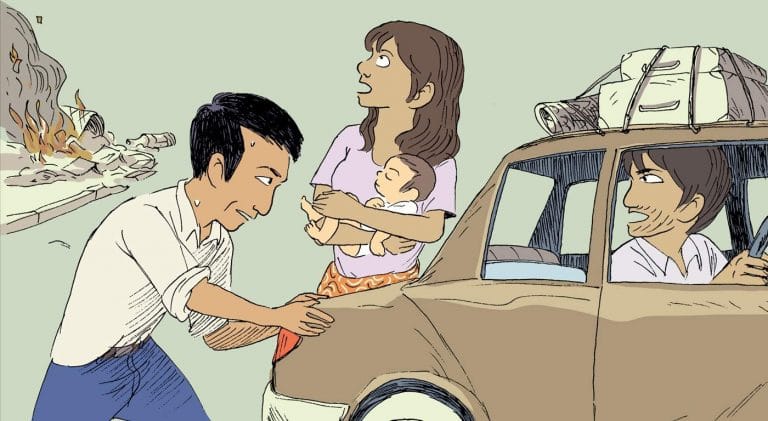
Year of the Rabbit is a graphic memoir that follows the journey of Lina, Khim, their son Chan, and their extended family members, as the Khmer Rouge take over Phnom Penh. Graphic in format, graphic in content, it is a story of resilience and hope, a profound testimony to one of the greatest tragedies of…

A rare and precious glimpse of pre-Khmer Rouge literature, Suon Sorin’s recently translated novel is set during Norodom Sihanouk’s Cambodia. Originally published in 1961, it harks back to the late colonial and post-colonial eras.

When psychedelic rock music came to Southeast Asia via American GIs during the Vietnam War, it greatly influenced the music scene in Cambodia. Cambodian Rock Band, a new play running in Chicago through May 12 celebrates this resulting music that not only abruptly went away in 1975, but for the most part hasn’t been performed…