2021: The Year in Translation from Chinese
A round-up of reviews of works in translation from Chinese, including fiction, story collections, poetry, biographies, classics and philosophy.

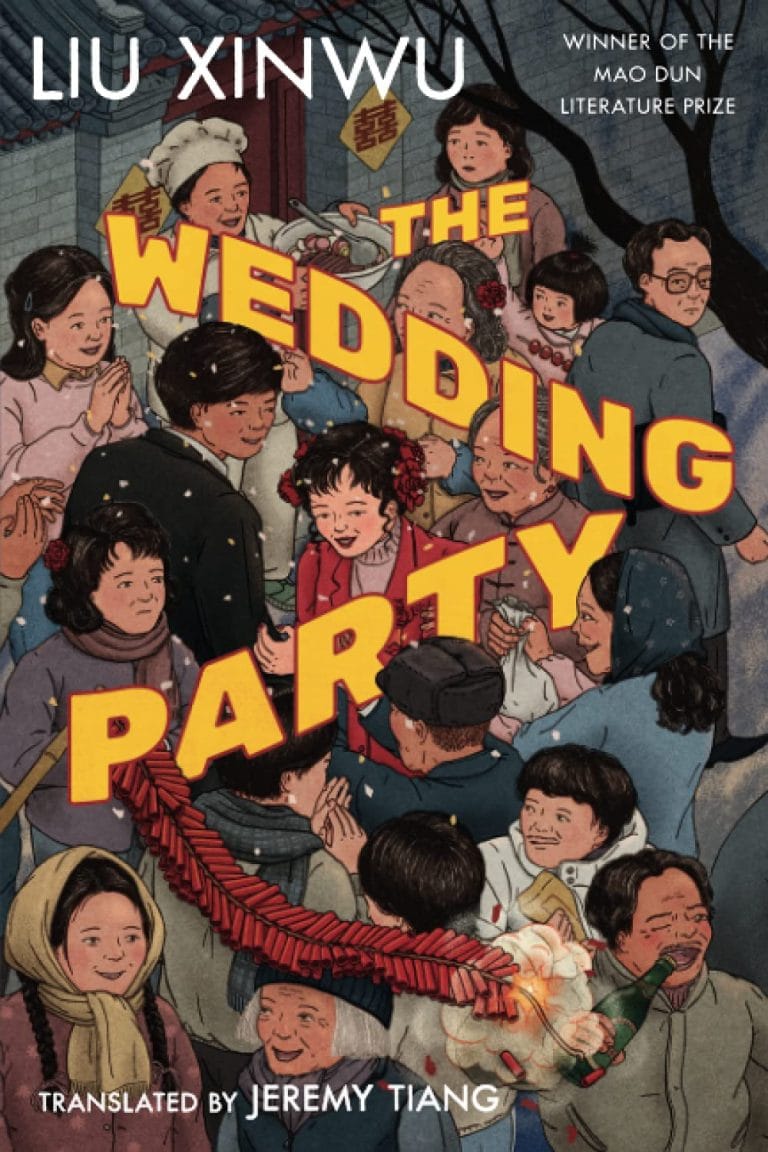
It is somewhat inexplicable that it has taken more than 35 years for Liu Xinwu’s The Wedding Party to show up in English. The book was serialized in 1984 and published the next year, winning the Mao Dun Prize and adapted into an 8-episode series for television. Popularity can be the result of hitting a…
In his new (but posthumous) memoir, Shanghai Jewish refugee Paul Hoffmann writes about his three most tumultuous experiences. One was enduring six months of Nazi Vienna, the other the terror inflicted by Sargent Kano Ghoya in the Shanghai Jewish Ghetto, and the third life under the new Chinese regime from 1949-1952. Much has been written…
Shang Qin (1930–2010) is widely considered one of the most influential and original modern Chinese poets. His critical acclaim was earned not only as a modern master of the prose poem but also as one of Taiwan’s leading surrealist poets. This book is the largest selection of his poetry available in English.
At the beginning of More Than One Child, Shen Yang writes, “I broke a law simply by being born.” She was her parents’ second daughter, and she is referring to the family planning laws which until recently saw China’s One-Child Policy strictly enforced. Her childhood was thus essentially intertwined with politics, but her memoir of…
Recent research in China and Korea has revealed that the tale of a prince who is turned into a calf originated in China, as early as the late sixth century when it was written up as a jataka tale. The Chinese version that circulated in Korea most likely also was composed in China. While these…
Following a long period of exile in the Western suburbs, Berlin’s Asian collections have returned to the spotlight. Since this autumn, they are on permanent display at the Humboldt Forum, a controversial new museum located in the heart of the German capital. The Forum, named after the Prussian polymaths Alexander and Wilhelm von Humboldt, is…
Historian RG Collingwood once wrote that “We study history in order to see more clearly into the situation in which we are called upon to act.” Few people see US-China relations with greater clarity than Cheng Li, who worked as a physician during the Cultural Revolution before earning his PhD in Political Science at Princeton….
Filled with memorabilia, photos and interviews, Berlin-based artist, critic and writer Xiaowen Zhu’s bilingual book Oriental Silk documents a Chinese-American family’s migration story. Tracing Ken Wong’s family past and cultural journeys, from his parents’ childhoods in China to their eventual relocation to the US and ultimately a flourishing business, Zhu reveals the dreams, hopes and…
Under the Song Dynasty, China experienced rapid commercial growth and monetization of the economy. In the same period, the austere ethical turn that led to neo-Confucianism was becoming increasingly prevalent in the imperial bureaucracy and literati culture. Tracing the influences of these trends in Chinese intellectual history, All Mine! explores the varied ways in which…
Back in the early 1990s, when I was trying to pitch the idea of including Vladivostok-listed stocks in Asian emerging markets funds, I was told by one Hong Kong fund manager that “Asia stops at the Amur River.” Three decades or so on, that aphorism might still serve to summarize the findings contained in Franck…

At a time when many classics are being rewritten with Asian characters in Asian settings, it was perhaps inevitable that Treasure Island would be recast as a Qing dynasty tale involving two notorious pirates, Zheng Yi Sao and Cheung Po Tsai, set in the South China Sea and Ha Long Bay. CB Lee’s A Clash…

“The Europeans raise all the cattle, but the Chinese get all the milk.” This joke, told in colonial Singapore, was indicative of the importance of the Chinese diaspora throughout Southeast Asia. Chinese migrants were miners, laborers, merchants and traders: the foundation of many colonial cities throughout Asia–while also making sure that their own communities back…
There are, in a very general sense, two kinds of travel memoir. In the first, writers take you on a journey somewhere they know very well. They share with you their deep understanding of the place—its people, its history and its geography. The authors’ physical journey is for the most part a literary scaffold upon…
Many Western entrepreneurs and businesses have foundered in trying to set up shop in China. Different expectations, different ways of doing business, different institutions and platforms—all come together to remove any pretensions that one can easily transplant a foreign business model into the Chinese market.