“Trinity, Trinity, Trinity” by Erika Kobayashi
Erika Kobayashi’s recently-translated Trinity, Trinity, Trinity is the latest in a long, rich, and complicated history of atomic literature from Japan.
There is a word in Japanese—komorebi—that refers to the way sun shines through the trees, casting a sea of soft, dark shadows scattered with gleams of light, a phenomenon reflected in the title of Riku Onda’s most recently-translated psychological thriller Fish Swimming in Dappled Sunlight.

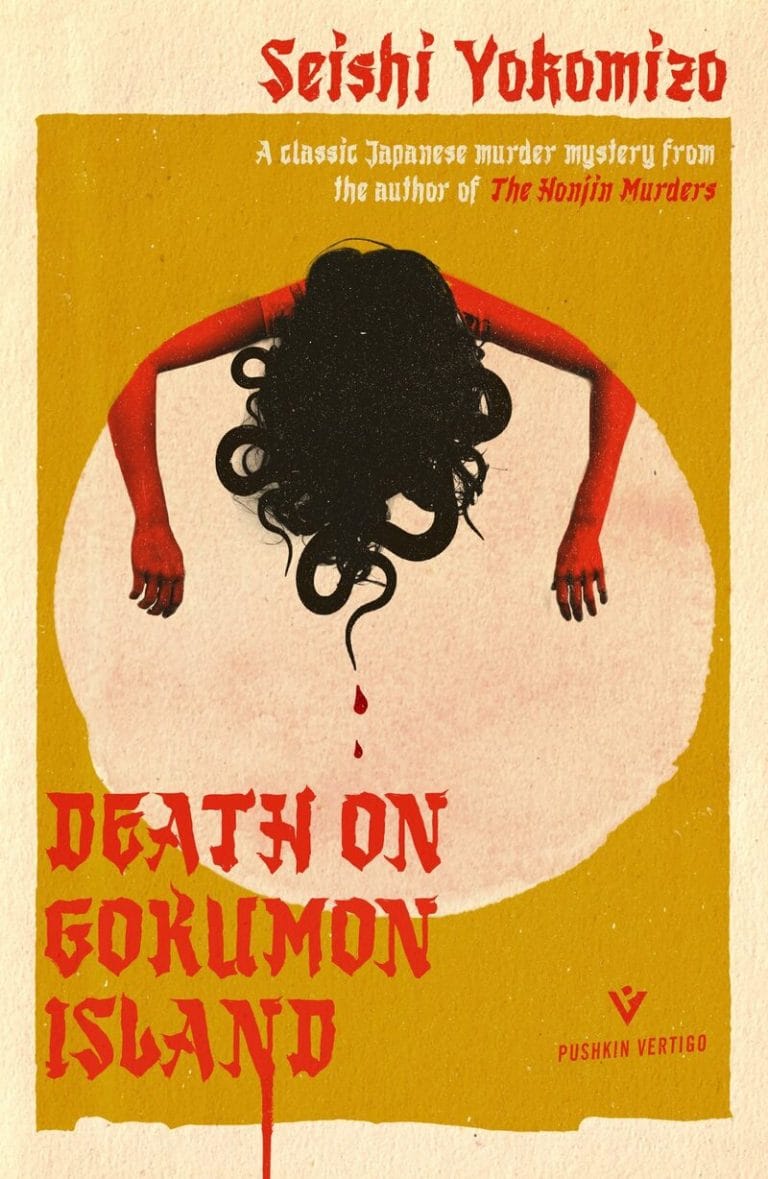
It was in the late 1930s that private detective Kosuke Kindaichi solved The Honjin Murders, the brutal killing of a newlywed couple in Okayama. Military service has prevented him from investigating another case since. Death on Gokumon Island, the second book in the Detective Kindaichi Mystery series by Seishi Yokomizo, begins just after the Second…
Solo Dance is a novel about identity. Yingmei Zhao is in the fourth grade when she develops a crush on a girl in her class. In the years that follow, she realizes her life in Taiwan isn’t going to look like everyone else’s. She won’t marry. She won’t start a family. When sexual assault shatters…

Rolled omelet, fried mackerel, chicken skewers, vegetable takiawase are just a few of the signature menu items at Namiki-ya, the place for the best appetizers and latest local gossip in Kikuno. Despite the convivial atmosphere they maintain in their restaurant, the eponymous Namiki family are coming off a tragic loss of a few years earlier—their…

Hakkenden is a classic work of Japanese literature: the story of the eight warriors, born from Princess Fuse and the dog Yatsufusa, has been adapted to manga, movies and anime. And its tropes continue to pop up in Japanese popular culture today.
In 1985, a character in a now-iconic cartoon by Alison Bechdel proposed three standards for a worthwhile story. It needs at least two women. They must have at least one conversation with each other. And that conversation must be about something other than men. One of the many issues raised by what is now known…
In an unnamed country, an immigrant family has taken refuge for reasons never quite explained. The narrator’s wife has returned home to give birth to the couple’s second child. The narrator and his son are left to their own devices, poised at the edge of a sinister forest full of whispers and imps that may…
Young adult novels often highlight teenagers’ angst with identity issues. While this phenomenon may seem American with its focus on ethnic identity, there are other diasporas in other places. Chesil’s debut novel, The Color of the Sky is the Shape of the Heart, in an English translation by Takami Nieda, tells such a story set…

Woman Running in the Mountains opens with Takiko Odaka waking to labor pains like “a voice calling Takiko’s name in her sleep.” Her parents have urged her to abort the child of a fleeting affair. She has chosen to raise the child on her own, never even informing the baby’s father.

On the southwestern Japanese island of Shikoku, there is a village populated almost entirely by dolls. More than 300 doll likenesses stand-in for the people who have died or moved away from Nagoro. Like many of Japan’s rural villages and even smaller cities, Nagoro has all but disappeared.
Jun’ichirō Tanizaki is one of the most highly-regarded authors of modern Japanese literature. Longing and Other Stories collects three works from the first decade of his career, all originally published from 1916 to 1921.
Cats have a storied pedigree in Japanese literature. One of modern Japanese literature’s first classics, I Am a Cat by Natsume Soseki, is a parody of Meiji-era Japanese society from a cat’s point of view. (2021 saw the English-language release of a faithful manga adaptation by Chiroru Kobato, translated by Zach Davisson.) Thirty years later,…
With the demand for books describing the rise of China and regional dynamics in Asia, more and more translations of works from Asian thinkers have been making it into English. Back in 2015, Shiraishi Takashi, professor and prominent foreign policy commentator in the daily newspapers of Japan, gave a series of influential lectures that were…

The narrator of Kou Machida’s Rip It Up is repulsive. In his introduction, translator Daniel Joseph describes him as a “toxic shit heel”. He is sexist; one woman characterizes him as “defilement incarnate”. He constantly insults other people, calling them “morons”, “idiots” and “dumbasses”.