“99 Nights in Logar” by Jamil Jan Kochai
Strongly influenced by One Thousand and One Nights, Jamil Jan Kochai’s new novel is a cornucopia of modern and ancient stories set in the war-torn heartlands of Afghanistan.
Pitchaya Sudbanthad’s story of Bangkok is the most complete and engrossing tale of this megacity of fifteen million souls ever portrayed in a single publication. His debut novel Bangkok Wakes to Rain is as much an ode to the metropolis’s extremes as it is to the wide-ranging and singular characters that animate its streets and…
Despite the not-entirely-rare memoirs, novels, and narratives about Jewish refugees in Shanghai during World War II, it remains a little-known corner of history. Juliet Conlin’s new novel tells a story of two of them.
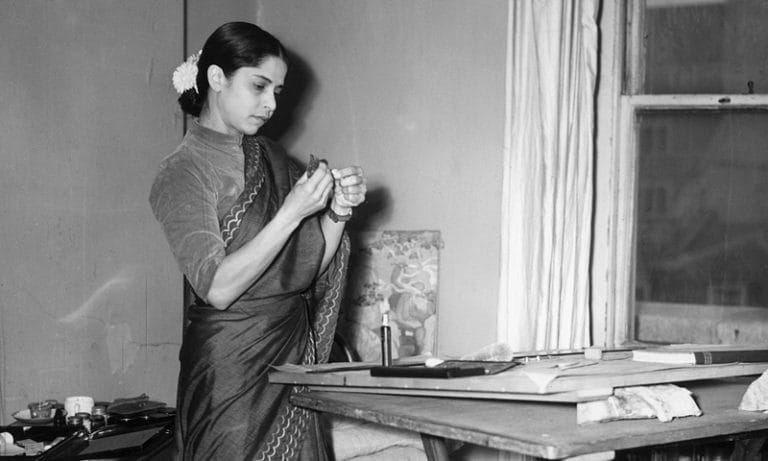
Krishna Sobti, the grande dame of Hindi literature (as she is often called in India), passed away in January this year. She was an unusual writer, writing as a woman and publishing some of her work under a masculine name. Her writing in Hindi is inflected with Urdu and Punjabi ways of speaking and makes…

Since the cinema that served as modern Hong Kong’s introduction to the world was such a hodgepodge of triad gangsters, crooked cops, ghosts, prostitutes and clueless romantics—sometimes all in the same film—one should hardly be surprised when a literary anthology shows the same genre-busting proclivities. Hong Kong Noir, the latest in a lengthy list of…
Fans of political skulduggery will appreciate this satirical tale of double-dealing, media manipulation and murder among the ruling classes of West Bengal.
The Kuunmong, to give this book its Korean title, is described by its new translator as “the most elegant of Korea’s literary novels and one of the most beloved masterpieces of Korean literature.”

These aren’t bedtime stories. Indeed, reading them before bed might not be a good idea at all.
Oba Yozo, the central character and anti-hero of Dazai Osamu’s Ningen Shikkaku, is as familiar to Japanese readers as Holden Caulfield is to English readers. The Catcher in the Rye still sells a million copies per year, in dozens of languages, while in Japanese only a few novels, notably Natsume Soseki’s Kokoro, routinely outsell Ningen…
Although Ak Welsapar is Turkmen, and one of the few Central Asian writers to have any international presence, The Revenge of the Foxes—his latest novel (or, given its length, perhaps novella) to appear in English—was written in, and translated from, Russian. It shows: Russian influence is very clear and, the nationality of the protagonist and…

Malaysian-Chinese Yangsze Choo’s best-selling debut historical novel, The Ghost Bride was set in late 19th century Malaya with an immediately compelling premise: a young Chinese girl in is married off to a ghost.
Belonging and inclusion are the themes which bind together this offering of short stories and poems from The Whole Kahani, a collective of award-winning female writers of British-Asian origin. The preface, written by Preti Taneja, acclaimed author of We That Are Young, outlines the mission statement of the collective, whose name translates as “the full…

In 2011, Susan Conley’s candid memoir, The Foremost Good Fortune, took readers to Beijing around the time of the 2008 Olympics. Conley’s concise and poetic prose showed a side of Beijing few expats experience: the fears of a new cancer diagnosis while trying to navigate a new city with her husband and two young sons….

The Japanese are fascinated by cats, and it’s not difficult to find shrines dedicated to them. There are cats that live in train stations (one, at least, has a uniform and a “job”) and cat cafés, where people go to pet them and hang out with them. We are all familiar with the maneki-neko, the…

In 1931, a time of economic and social turmoil in America, The Epic of America by the historian John Truslow Adams was published. In it, Adams coined the term “American Dream”, which embodied for him the differences between the old and new worlds of Europe and America.