“Find Tom in Time: Ming Dynasty China” by Fatti Burke
Tom is a young boy who is “ordinary most of the time”—that is, unless he’s visiting his grandmother Bea, an archaeologist whose artifacts have the power to transport Tom back into time.

Tom is a young boy who is “ordinary most of the time”—that is, unless he’s visiting his grandmother Bea, an archaeologist whose artifacts have the power to transport Tom back into time.

Laura Moretti’s Pleasure in Profit begins and ends with the image of a bookshop in 17th-century Kyoto: Now step back in time, to seventeenth-century Japan. Imagine yourself on Teramachi Street, in the heart of Kyoto.

From about 1765 to 1840 Japanese finding themselves in Edo might have been amused by skimming over a few senryū, short satirical or comical poems which made fun of the pretensions of the administrative capital.

The gold of the Scythians exploded into the world of museum goers when Leningrad’s Hermitage Museum sent these treasures touring to London and New York in 1975. An equally noteworthy exhibition, Masters of the Steppe, took place in 2017 at the British Museum. This copiously-illustrated volume enables readers to revisit that exhibition, and to ponder…
Retired Captain Pao Yang was a Hmong airman trained by the US Air Force and CIA to fly T-28D aircraft for the US Secret War in Laos. However, his plane was shot down during a mission in June 1972. Yang survived, but enemy forces captured him and sent him to a POW camp in northeastern…

In his perennially wonderful (if now dated—the abridged version was issued by its author in 1922 based on the 12-volume full one) Golden Bough: A Study in Magic and Religion, Sir James Frazer tells us that magic was the precursor to religion. Van Schaik uses Frazer’s analysis as an example of what has by now…

Made in Hong Kong seeks to reframe the city’s role in the modern history of US foreign policy and globalization by focusing on a group of “mobile, pragmatic, and adaptive” Chinese elites author Peter E Hamilton calls kuashang, or “straddling merchants”. An academic study of families whose profitable relationships straddled the US, colonial Hong Kong…

A hero in Japan, Beate Sirota is hardly a household name in her home country of the United States. Jeff Gottesfeld’s No Steps Behind: Beate Sirota Gordon’s Battle for Women’s Rights in Japan is a new picture book illustrated by Sheilla Witanto that tells Beate’s story and how she brought change to Japan after World…

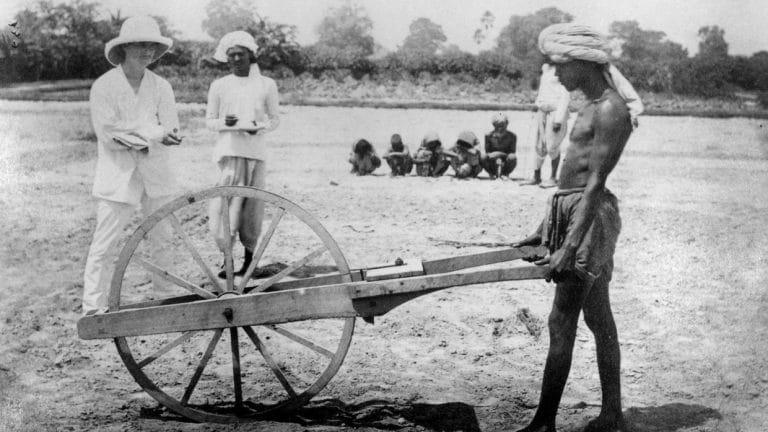
In 1933, Maurice Wilson—First World War hero, drifting veteran, and amateur aviator, lands in the aerodrome at Purnea in British India. His goal is to be the first man to climb Mt Everest. And nothing—not his complete lack of climbing experience, the lack of official permission, and the efforts of British civil servants—will stop him.

The horse is a beautiful animal, so it is fitting that an art historian should take us through the history of India on horseback. Yashaswini Chandra describes animals and the men and women who rode them, their grooms, their saddlery, even the grand tombs of horse dealers turned sultans. We are left with an ever…

George F Kennan believed that in examining the history of the 20th century, all the lines of inquiry led back to the First World War. Westerners tend to view the First World War through the narrow but compelling lens of the Western Front, but the war was truly global, in part because Britain, France, and…

Indology—a field of study about India’s history and culture associated with 19th-century British and German figures—had an interesting German-Dutch predecessor, Jacob Haafner (1754-1809). The man reached India as the servant of the VOC (or the Dutch East India Company) after having lived in South Africa and Java for a while. His travel-writing about India, vituperative…

The Code of Civilization might at first seem to be another in the line of books which includes Francis Fukuyama’s The End of History and Samuel P Huntington’s The Clash of Civilizations that attempt an overarching view of world history with an aim to model the present and predict the future. This time, however, the…

Among the most colorful and characteristic participants in the caravan trade between India and Central Asia were the Afghan horse dealers, pictured here in the Fraser Album at the V&A. They brought horses from Bukhara across the Hindu Kush to livestock fairs in the Punjab. Their caravans carried Indian cloths for the return trip. Jagjeet…

Most book milestones are measured in time—six months to deadline!—or word count. For Nicholas Kitto, author of Trading Places: A Photographic Journey through China’s Former Treaty Ports, the pertinent metric was step count: in the process of searching out the subjects for his photographs, Kitto walked 2,784,010 steps in the course of fifty-one different journeys…