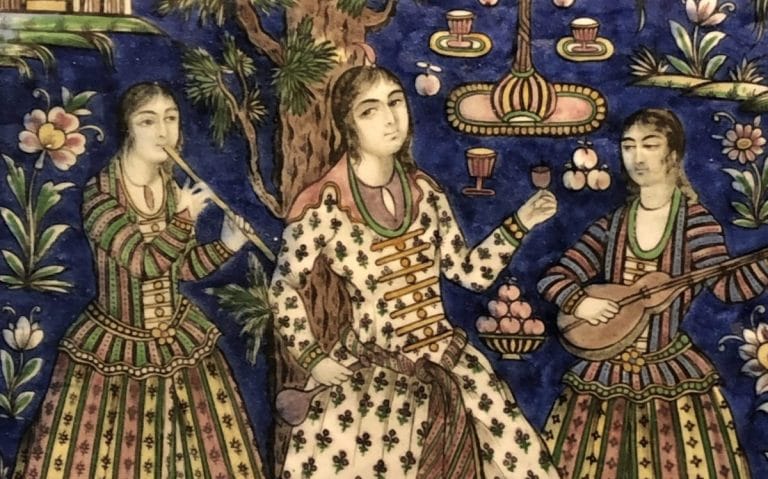
“The Emperor Who Never Was: Dara Shukoh in Mughal India” by Supriya Gandhi
Indians continue to engage with the Mughal Empire in a way they don’t with any other dynasty.

Indians continue to engage with the Mughal Empire in a way they don’t with any other dynasty.

Lew Paper’s new book In the Cauldron charts the diplomatic road to Pearl Harbor, mostly through the eyes of the then-US Ambassador to Japan Joseph Grew. Paper portrays Grew as a voice crying in the wilderness, showing the way to peace when everyone around him in official circles in both Japan and the United States…

In 1935, Ruth Day paid a six-week visit to her mother and step-father who were at that time living in Shanghai. When she returned, she published a short book on the trip. The book had a run of just 200 copies and seems to have quickly disappeared—but at least one copy found its way to…

Literary allusions to Babylon and Assyria are often not very complimentary, and they are most certainly based on common misconceptions.

The 1980 death of Hong Kong police officer John MacLennan shook the territory and made international news, eventually driving the Hong Kong courts to decriminalize homosexuality in 1991.

Myanmar or Burma? Thant Myint-U begins this timely and important book unraveling the basic question of what to call this country.

Toward the end of his life, Algernon Blackwood famously reminisced that “I used to tell strange, wild, improbable tales…” The tale of the friendship between Lu Xun and Uchiyama Kanzō would have met Blackwood’s standard—a look at Shanghai during those times, now nearly 100 years ago, suggests why.

As China and the West look at decoupling, it’s worth remembering that the world has been through this several times since they first coupled three-quarters of the way through the 16th century. That’s when the Manila Galleon connected Asia and the Americas, a trade that was, to mix metaphors, oiled by silver.

Only a few pieces of Chinese classical instrumental music have come close to entering the standard orchestral repertory. The 1939 “Yellow River Cantata” with lyrics by Guang Weiran set to music by Xian Xinghai, and the “Yellow River Concerto” later derived from it, is one of these.

Earnshaw Books, an independent publisher specializing in China matters, has recently issued two books featuring westerners sojourning in China over a period of a century and a half. Frances Wood, a respected scholar of Chinese history, presents the account of Aeneas Anderson, who served as a valet to Lord Macartney when the latter led an…

British writer EH Carr in his classic text on international relations, The Twenty Years’ Crisis: 1919 to 1939, argues that ideas of peace and cooperation between nations cannot stand up to the realities of international instability and competition. In Carr’s time the League of Nations was ineffectual in preventing a return to war in Europe….

Some books are next to impossible to review. Silk Roads is one: encyclopedic in scope and structure, made up of several dozen short essays by almost as many different authors, each lavishly illustrated with indescribable photos of objects and places.
Human rights violations have always been part of Asian American studies. From Chinese immigration restrictions, the incarceration of Japanese Americans, yellow peril characterizations, and recent acts of deportation and Islamophobia, Asian Americans have consistently functioned as subordinated “subjects” of human rights violations. The Subject(s) of Human Rights brings together scholars from North America and Asia…
The Yijing (I Ching), or Scripture of Change, is traditionally considered the first and most profound of the Chinese classics. Originally a divination manual based on trigrams and hexagrams, by the beginning of the first millennium it had acquired written explanations and a series of appendices attributed to Confucius, which transformed it into a work…
This new catalogue describes the holdings of the so-called Pandit Collection held at the Royal Library, Copenhagen. A diverse collection of more than 1,200 Sanskrit texts, it comprises codices ranging in length from several hundred folios to a single folio, or a manuscript fragment, often produced by educated (or in other cases by less educated)…