“Revolution Goes East: Imperial Japan and Soviet Communism” by Tatiana Linkhoeva
There can be a fun-house mirror quality to the history of Japan’s relations with Russia: the events are recognizable, but come with unexpected bulges and pinches.
There can be a fun-house mirror quality to the history of Japan’s relations with Russia: the events are recognizable, but come with unexpected bulges and pinches.
It’s a well-worn assertion, even a cliché, that art and spirituality are inextricably linked. A concrete representation of the subject for religious meditation is, we could say, a visible aid to devotion: not so much the object itself, but what it symbolizes, which is important to the viewer (or listener if it’s music).
This thoroughly researched book provides the first comprehensive history of how a UNESCO World Heritage Site on the Central China Plain, Longmen’s caves and the Buddhist statuary of Luoyang, was rediscovered in the twentieth and twenty-first centuries.
Thomas Bowrey left London for India as a child in 1668; his father had died of the plague in 1665, a tragedy compounded by the Great Fire the next year. Shipping him off to India was not the worst thing a mother could do in such circumstances. Bowrey arrived in Fort St George, Madras after…
Amid the plethora of China memoirs by Western writers over the years, this new one set in Shanghai from 1978 to 1979 stands out a little because it takes place during a time of transition in China. But Anne E McLaren’s Slow Train to Democracy is more than just a record of her time in…
During a one-year sojourn in London in the 1970s, my secondary school O-level history curriculum covered about a century from mid-1700s on. A decade into a discussion of the Napoleonic Wars, the history master (for such he was called) mentioned, almost in passing (and, in retrospect, probably for my benefit), that after marching through a…
The Korean War began 70 years ago. In the United States, it is known as the “forgotten war”. Not so in China. In his new book Attack at Chosin, Professor Xiaobing Li, a prolific historian who teaches at the University of Central Oklahoma, and who once served in China’s People’s Liberation Army (PLA), explores the…
The Sino-Russian relationship is often seen by the West (for which, read the USA) as a sort of counterpoint to Sino-American relations with Russia ready to step in when the US takes a step back. Sören Ubansky’s recent book is one of the periodic but salutary reminders that China and Russia’s mutual dealings are not…
The world-weary Giuseppe Lampedusa introduced us to the cynical formulation “for everything to remain as it was, it’s necessary for everything to change.” Empires rise and fall, sometimes swiftly. The papers in Short Term Empires in World History, delivered at a conference held in Germany in 2017, raise the issue of continuity and discontinuity in…
In the summer of 1953, a massive drought hit the Chinese province of Zhejiang. Villagers took the disaster as a sign that deities were angry at officials for converting temples for secular uses and destroying ritual items, including statues and dragon boats. To placate the gods, villagers rose up to try to take back religious…
“And he gathered them together in a place called in the Hebrew tongue Armageddon” (Revelation 16:16). Armageddon. The word sends shivers up the spine; it’s the place where, according to the imaginative interpretation of some, the final battle between the forces of good and evil will be fought. It’s mentioned twelve times in the Old…
The title of Roberto Carmack’s book is a bit misleading, as is the book’s cover, which shows two helmeted and uniformed soldiers in battle. The book is part of the Modern War Studies series, but its focus is on the administrative, institutional and ideological aspects of war in the Kazakh Republic of the Soviet Union…
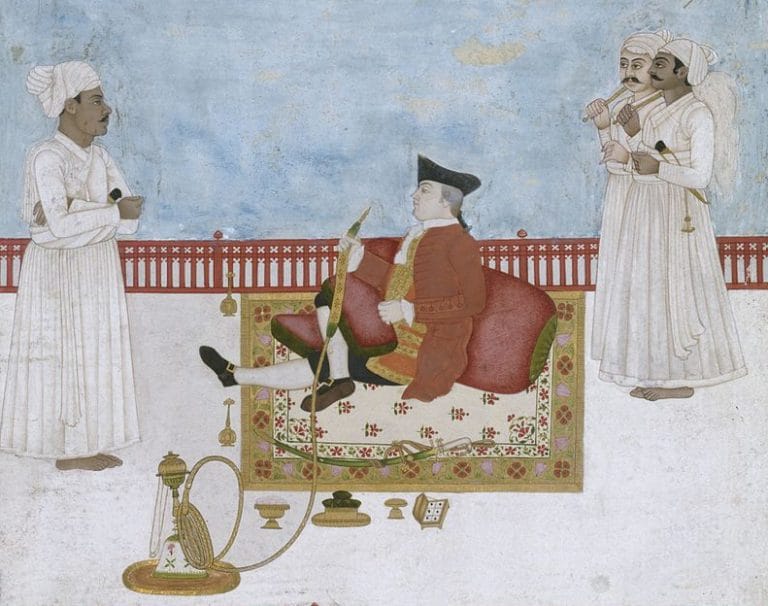
Growing up in the United States can leave one with a curious idea of history. Revolutions are about independence, civil wars are about countries splitting apart, and colonies are about colonists. So what kind of a “colony” was, say, India?

India has suffered much from stereotyping, particularly at the hands of Western historians. It has been dismissed as being almost stagnant until Western encroachments somehow woke it up, and it’s been regarded as isolated from surrounding territories, somehow evolving on its own first as “a self-generated Hindu and Sanskritic civilization”, as Richard M Eaton puts…
“Historians”, wrote Simon Schama, “are painfully aware of their inability ever to reconstruct a dead world in its completeness however thorough or revealing their documentation,” but Amy Stanley succeeds as well as anyone could hope in her masterfully told and painstakingly researched evocation of an ordinary Japanese woman’s life in Edo on the eve of…