“Saha” by Cho Nam-joo
Set in a disturbing dystopia, Saha, Korean author Cho Nam-joo’s latest work following the wildly successful Kim Jiyoung, Born 1982, tells the story of the bottom rung of a dark society.
Set in a disturbing dystopia, Saha, Korean author Cho Nam-joo’s latest work following the wildly successful Kim Jiyoung, Born 1982, tells the story of the bottom rung of a dark society.
Lee Geum-yi has published more than fifty books in her native South Korea, many of which have been adapted to film and stage, as well as into a number of languages. But it’s only now that one has been translated into English. That book is The Picture Bride, a story set mainly in a Korean…

One of Korea’s most renowned 20th century authors, Pak Kyongni often wrote stories set in the aftermath of the war and during the several military dictatorships. Pak passed away in 2008, but her work has been revived in English with a recent collection in translation, The Age of Doubt. These seven stories are all set…
On the morning of his 43rd birthday, celebrated artist Lee Hanjo wakes up hungover and alone. His loving devoted wife is gone, only leaving behind the draft of a novel. To Hanjo’s horror, the book tells the story of an artist in his early 40s and his affair with a possibly underage girl. This manuscript…
Had it been set in an English-speaking country, Seo Su-Jin’s story about Korean language teachers in her home country of South Korea might be considered an addition to the campus novel genre. But in Korean Teachers, Seo’s debut novel translated into English by Elizabeth Buehler, education is portrayed as a service industry—with customer satisfaction as…
Gu Byeong-mo’s The Old Woman with the Knife is ostensibly a violent slasher novel about an aging assassin, known in the novel as a “Disease Controller” trying to end her storied career on her own terms. But wrapped in this visceral package, the book dives into the reality of an aging woman in a society…
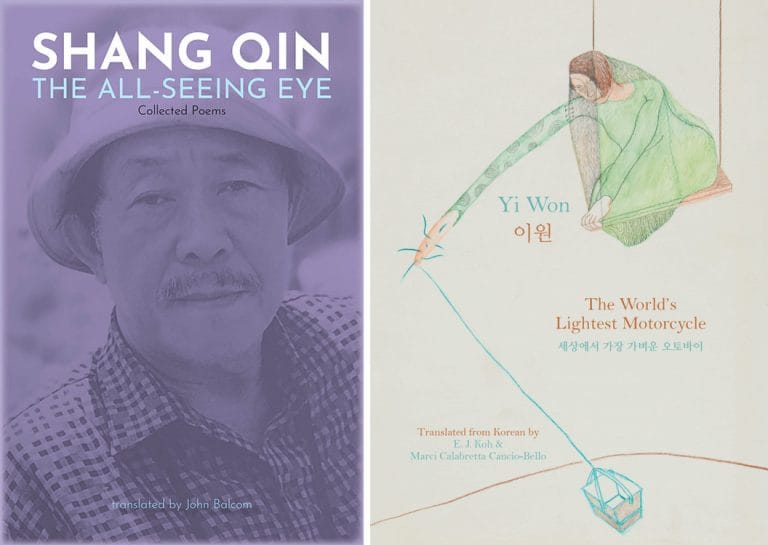
Surrealism is usually connected with the visual arts: Salvador Dali’s limp watches or René Magritte’s rainstorm of bowler-hatted businessmen. Whilst surrealist writing is perhaps not as well-known, French poet André Breton declared in his 1924 Surrealist Manifestos that in surrealism “the agonizing question of possibility does not arise,” and that “the man who cannot visualize…
The Kuunmong, to give this book its Korean title, is described by its new translator as “the most elegant of Korea’s literary novels and one of the most beloved masterpieces of Korean literature.”

Meeting with My Brother is prefaced by an illuminating introduction by professor and translator Heinz Insu Fenkl in which he provides a literary and personal background to Korean author Yi Mun-Yol and Korean literature in general.