Sing Me a Circle: Love, Loss and a Home in Time, Samina Najmi (Trio House Press, October 2025)

“All points on a circle are always the same distance from the center.” These exquisite personal essays trace the orbit of Pakistani-American author Samina Najmi as she reflects on events, people, and places that shape her traditional childhood in Pakistan and continue to inspire her as she pursues her dreams of education and travel, enlarging her vision and experience of the world.

Pakistani writer Faiqa Mansab’s second novel The Sufi Storyteller is a South Asian take on stories about stories blended with a murder mystery. It opens with a murder in the library which doubles up as the office of the protagonist Layla, an expert on women and their role in storytelling traditions teaching at a university in Illinois. The naked dead body is that of a woman, has bruises on her throat, and is dressed in a red cloak. The problem is that this is the second dead body Layla has stumbled upon. As Layla searches her memory about the previous victim, she begins to realise that there is a pattern and perhaps some one is after her.

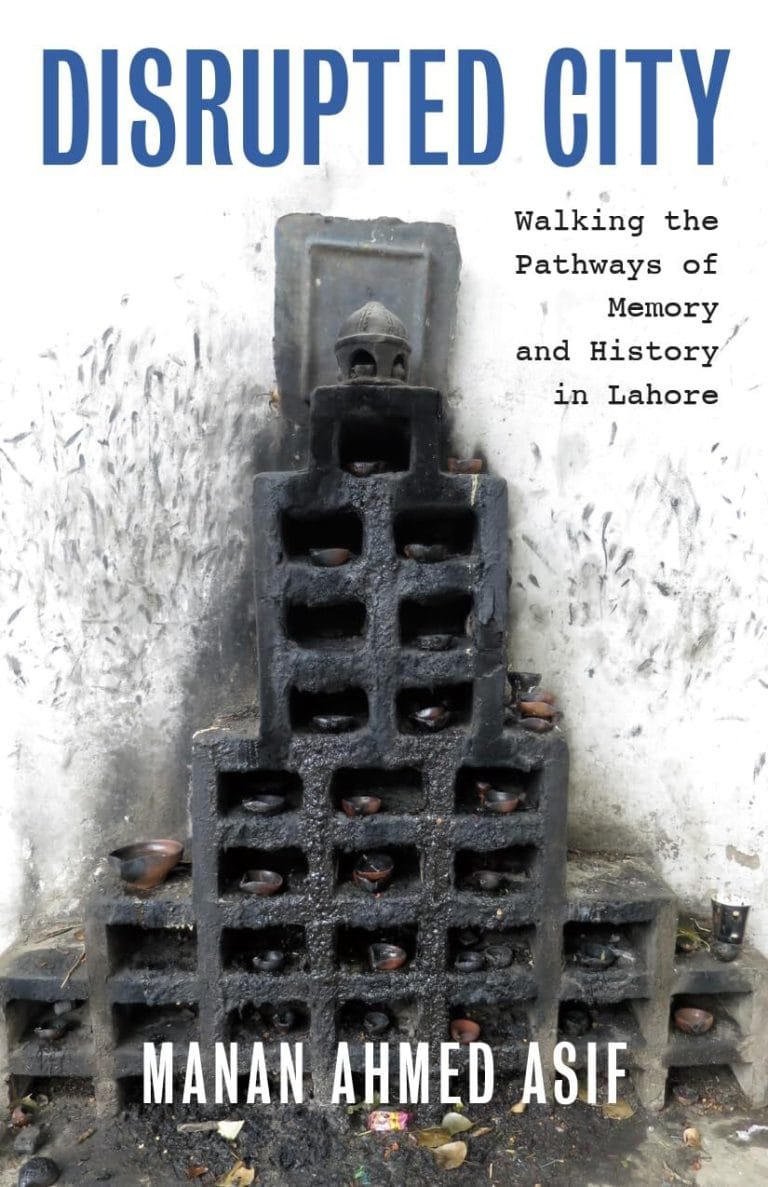
History has scarred South Asian cities in very concrete ways. The most well known of these have been carrying the burdens of colonisation and communalism, and, after independence, a rewriting of their histories that are governed by ideologies of nationalism. Lahore, in Pakistan, is one such city. In his book Disrupted City: Walking the Pathways of Memory and History in Lahore, historian Manan Ahmed Asif shows one evocative way to attempt urban history and narrative for South Asian cities.

Pakistan’s history since independence is… complicated. Partition wrecked the economy, leaving all the economic infrastructure in India. Democracy was weak, as the military launched multiple coups to overthrow the civilian government. The country was split into an unsustainable two halves—with one declaring independence as Bangladesh by the 70s.

Pakistan’s politics is so complicated that it can be hard to determine either a trajectory or even a throughline. If Tahir Kamran’s enormously-detailed Chequered Past, Uncertain Future is any indication, this is not due to any failure of imagination. Kamran is focused mostly on the country’s often fraught relationship with democracy, but leaves one with much the same impression about foreign and domestic policy and issues of Pakistani identity.

South Asian fiction based on the Partition of 1947 is generally concerned with specific incidents of trauma and violence. Urdu writer Ali Akbar Natiq’s Naulakhi Kothi, recently translated into English by Naima Rashid, adds a different dimension to the existing ways of narrating fiction. Its story begins several years before the partition and ends several years later, thereby using partition to frame a much longer narrative.