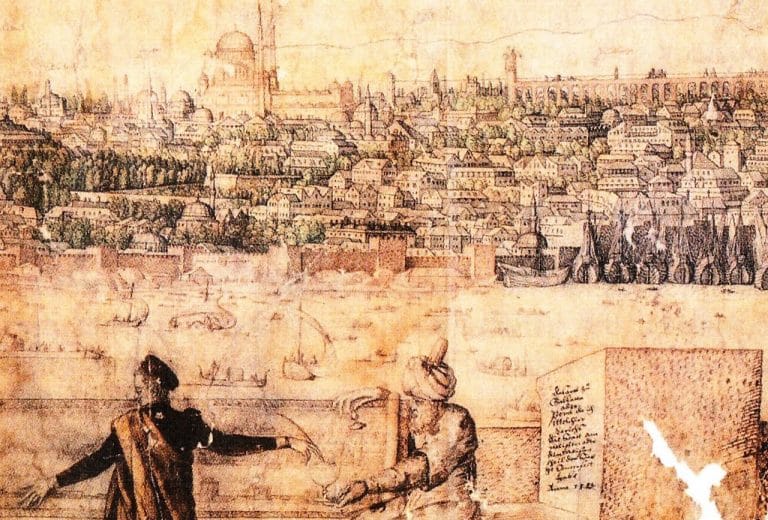
“Shadowless” by Hasan Ali Toptaş
The misdirection starts with the novel’s cover. Hasan Ali Toptas’s Shadowless is, in spite of its title, full of shadows.

The misdirection starts with the novel’s cover. Hasan Ali Toptas’s Shadowless is, in spite of its title, full of shadows.

In 2015, Indonesian-born Singaporean author Clarissa Goenawan won the prestigious Bath Novel Award for unpublished and self-published novelists for her novel Rainbirds, which—some two years later—is now seeing the light of day.

Exploring identity in a multi-ethnic community through fiction can be a sensitive subject. The importance people place on identity is often a prickly topic these days—especially in multi-religious, multiracial communities like that of Singapore’s five and a half million citizens. In November 2017, the Singaporean Institute of Policy Studies presented evidence that for the first…

If you go into most bookshops in the States for example, there’s a cottage industry of books on the US and China, the US and the Middle East, you go to the UK, there’s a sort of similar cottage industry of books on the UK and France, and France and Germany. But there’s very little…

There is nostalgia for a gentler time as well as bloody depictions of real-life historical events in this genre-crossing work by author and publishing stalwart Ashok Chopra.

Canada’s answer to—whom? Jason Bourne?—is a lesbian forensic accountant of Chinese extraction by the name of Ava Lee. But in The Imam of Tawi-Tawi, her tenth outing, Ava isn’t this time tracking down missing millions but has instead been sucked into the global “War on Terror”.

White Chrysanthemum memorializes Korean comfort women—women forced into sexual slavery by Japanese occupying forces during World War Two. In her debut novel, London-based Korean-American writer Mary Lynn Bracht explores the effects of these women’s abductions on their families and on wider society, and celebrates the power of women to survive horrific circumstances.

Here we have planted the British flag among the ruins of the ancient capital of Singapura, the City of the Lion! Here we will advance the interests of the East India Company and raise the Malay people to their former glory. Sir Stamford Raffles is the man most often associated with Singapore’s colonization, and…

This is an ably edited and exciting collection from the intersection on the globe where East meets West, an area often neglected in surveys of world literature—there are few translations of works from Georgia available in English.

Yasutaka Tsutsui, born in 1934, is less well-known outside of Japan than other contemporary Japanese writers.

On November 18th of this year, a blaze killed nineteen people in a textile manufacturing district of Beijing. Most of the victims were migrant workers, scores of whom continue to live peripheral lives in makeshift, pop-up neighborhoods on the outskirts of major cities across China. In response to the tragedy, the city government instituted a…

For a number of logistic, commercial and territorial reasons, books rarely circulate much outside the market they were published in. Asian-published books can as a result often, regardless of merit, end up largely unknown outside a relatively small domestic market, something that goes in spades when the book was originally published in a language other…

Yuki Means Happiness combines, among other elements, two love stories—one of romantic love, the other of a woman’s love for a child not her own —an exploration of divergent cultural expectations, a warning about the terrifying ease with which we can do damage to each other, in particular, the ease with which parents can do…

Can the present save the past? Can the living save the dead? As South Korean author Han Kang revealed in a 2016 interview with the London-based magazine The White Review, these questions interested her during her twenties, only to resurface years later when drafting her novel Human Acts about the 1980 Gwangju Uprising and its…

Author Sangeeta Bandyopadhyay tackles the ultimate taboo in this clever novel which uses the metaphor of a mother abandoning her child to explore the artist’s struggle to fulfill the responsibilities of life as well as the demands of creativity.