1421: The Year China Discovered the World by Gavin Menzies
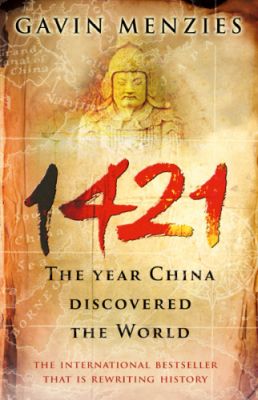
As a work of historical fiction, 1421: The Year China Discovered the World would have been thought-provoking and a good yarn: intrepid Chinese admirals sailing the seven seas, meeting exotic alien peoples, boldly going where no civilized man had gone before in a sort of a 15th century Star Trek.
But, unfortunately, the book is presented as a collection of statements of fact.
According to author Gavin Menzies, 15th century Ming fleets sailed around the Cape of Good Hope, up the coast of Africa, across the Atlantic, down the coast of South America, through the Magellan Straits, down to Antarctica, over to Australia, around to Massachusetts, up to Greenland (where for some reason they attacked the hapless Norse inhabitants), leaving colonies, inter-marriage and shipwrecks in their wake.
It would be nice if there were some evidence. I searched in vain for a potsherd, reliable carbon-14 date (these, Menzies tells us, are still being done), inscription, anything. Even when Menzies claims to have seen the evidence, he does not reproduce it. In one telling passage, he tells of his discovery of an inscription in Cape Verde in an unrecognizable script. Does he send it to the British Museum? A university? No. Noting that it looks like scripts on Indian banknotes, he sends it to the Bank of India, who pronounce that “it looks like Malayalam.” Well, good: so it should be decipherable. Are we provided with a translation? No. Is the inscription reproduced in the book? No.
In short, Menzies seems to have considerable difficulty with what one would consider normal historical and archaeological investigation and evaluation. He seems to take every inscription and written report at face value, without regard for possible hyperbole, politics, propaganda, superstition or ignorance. If there is an inscription saying that Zheng He visited “3000 countries”, then it must be true. If there is a report of a local myth about “yellow people” settling in the community or “boats like houses” sailing by, then this must have happened.
The book has a number of factual errors, which even I can identify, such as claiming that the Chinese picked up some mylodons (extinct giant sloths) when they stopped by Patagonia.
Menzies standard of proof typically runs as follows: identify some cultural feature (the evidence for which is usually far from solid), claim that the 1421 voyages are the “only” explanation, while at the same time ignoring (or being ignorant of) other similar cultural features that would tend to provide alternate explanations or contradict his. One distressing example: after quoting Verranzano’s description of a visit up past what is now New England, Menzies says: “Verranzano was comparing elegant people with brass-coloured skin to the much darker and more uncouth people he had met farther south. He referred twice to “... their clothes—dresses rather than the furs and animal skins worn by the people he had encountered previously”. In other words, relatively civilized people with light skins could not possibly be indigenous.
This is at best intellectually sloppy. But large sections of the book are just whimsy: “When the Chinese met the people of Mexico it is highly probable that they would have been shown Palenque, the finest Mayan city.” I admit, this is perhaps the worst example in the book, so it is slightly unfair to quote it, but nevertheless, it is hard to take the book seriously when Menzies has the Chinese inventing the group tour as well as paper money.
All of this is rather unfortunate, because Menzies is an engaging writer. He takes valid points which deserve elaboration—e.g. that the study of history has for too long been Eurocentric and that there are undoubtedly many cross-cultural contacts that we do not yet know about—and pushes them to make what I consider to be “political” points, e.g. that Columbus did not “discover” America and Cook did not “discover” Australia. But we already knew that.
He seems to have largely missed the point. There is considerable evidence of both trans-Pacific and trans-Atlantic pre-Columbian contact in the Americas. However, while these incidences are fascinating, the historical question is, regardless of who got to point X first, what happened next? Now of course, it was not Columbus’s voyage that started the development we now call the Age of Exploration which in turn lead to an era of global expansion and trade that ultimately ushered in the modern age. But his landfall in the New World in 1492 (even if, contrary to Menzies’s assertions, he didn’t know where he was) is a convenient and not entirely inaccurate place to put the main historical milestone.
And it was Captain Cook that started, for better or worse, the developments that led to the modern nations of Australia and New Zealand.
If Zheng He and Co. really did visit the Americas and Australia, it was a historical dead-end. Perhaps as a result, Menzies also seems to want to demonstrate that the only reason the latter-day Western explorers set out on their voyages was that they already had accurate charts based on the Chinese “discoveries” and so already knew where they were going, and that therefore the explorers were not as “great” as we thought they are, that they did not just set sail into the unknown. But we knew that already, too.
I need to say that the Chinese voyages Menzies posits are (probably) not impossible; after all, prehistoric Malay peoples sailed all the way to Madagascar and settled there; Polynesians found that speck of land we now call Easter Island, Thor Heyderdahl crossed oceans on bundles of reeds. In addition, it seems quite possible that Chinese geographical knowledge found its way into the maps or at least the thinking of 15th century European explorers, along with similar information from the Arabs, Phoenicians, etc. plus a certain amount of mythology, logic and guesswork.
However, Menzies’s proofs have a circular quality to them. He first posits that the Chinese did sail to the Americas and charted them. These charts play an important part in the argument, since there is no direct evidence of Chinese landfall in any of the places he mentions. These charts, he claims (again without direct evidence) traveled to Europe where there were then used by Western mapmakers. To demonstrate this, he takes Western maps, which he claims show actual geographical elements (as opposed to conjecture) that the Europeans could not possibly have known about (he claims) from their own prior experience or any other source of information close to hand, leaving the Chinese charts as the only possible source. Thus the Western charts become the evidence for the Chinese charts which he first used to explain the Western charts.
As I say, this is all most unfortunate. As our knowledge expands, it seems clear that pre-modern peoples knew a lot more than we have generally given them credit for, and that there were many cross-cultural contacts that we do not yet know about.
While one can understand Menzies’s enthusiasm for the big story, the truth is ultimately more interesting.