“The Illustrated History of the Jodhpur Flying Club” by Peter Vacher
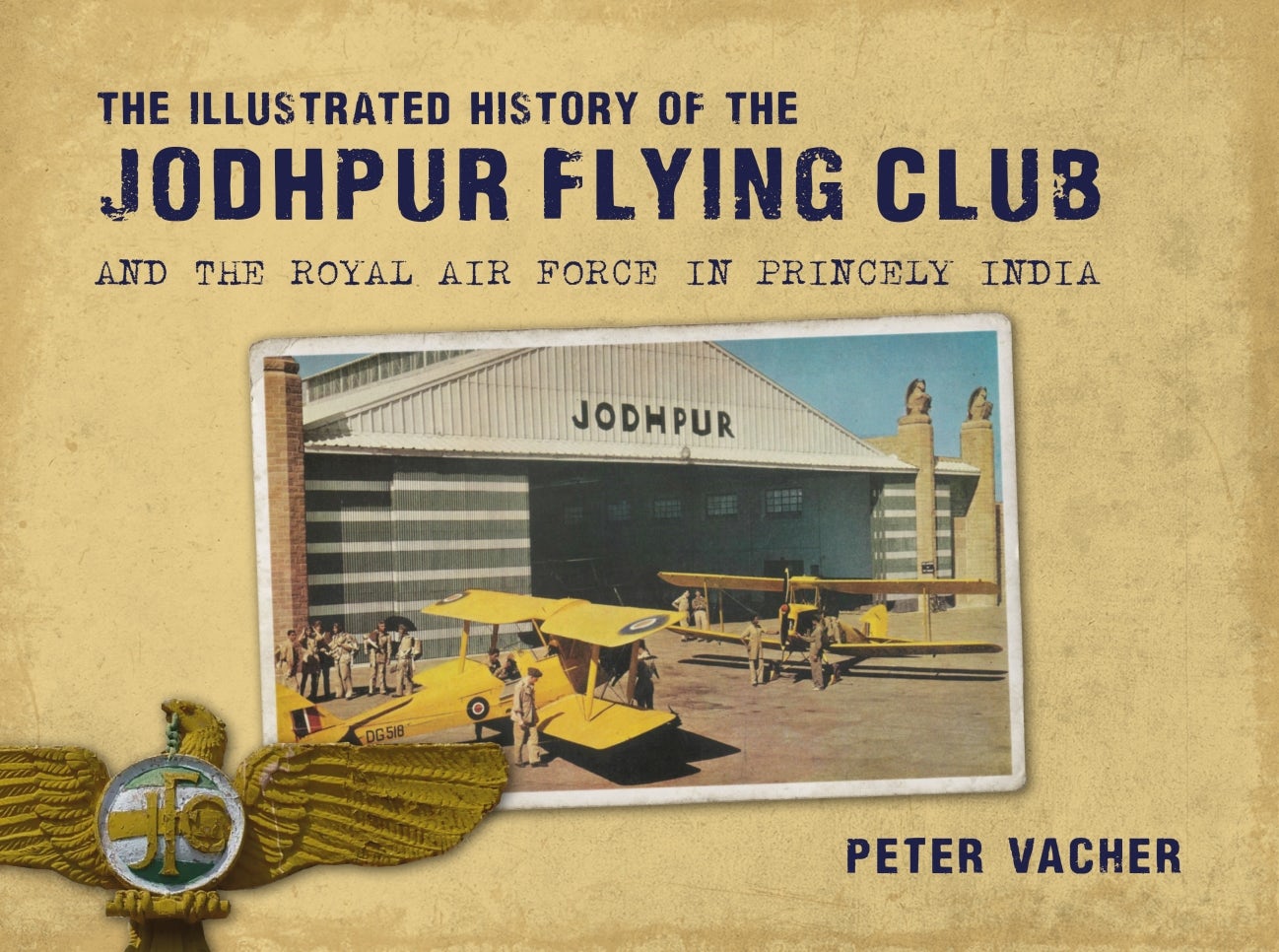
The name Jodhpur itself conjures for many the full colour of the Raj at its height: polo grounds and palaces, and impeccably-tailored riding trousers—jodhpurs—a word exported into the English language. In Peter Vacher’s richly-illustrated and deeply-researched book, that familiar imagery is joined by something less-widely appreciated but no less consequential: aviation. The result is a book that reveals how a princely desert state became one of the most important air hubs in Asia between the World Wars, and later a critical node in the Allied war effort in South-East Asia.
This is a handsome, confident volume: part institutional history, part imperial aviation chronicle, part gallery of eccentric personalities. Nearly half the book is visual material, drawn from logbooks, photographs, programmes, and official correspondence, making the book as much an archival exhibition as a narrative history. Photos—especially invoices, letters, aircraft, and aviator teams—plus appendices provide granular detail for those “trainspotters” keen to immerse themselves in the minutiae. Yet the book never feels like a scrapbook. Vacher’s prose is clear, affectionate and paced with the assurance of someone who knows this technical world intimately (he has a passion for restoring vintage planes) but writes for the general-interest reader.Umaid Singh was an engaged, technically competent aviator.
At the centre of the story stands His Highness Maharaja Umaid Singh of Jodhpur, a ruler whose instincts combined duty and modernity with a keen appetite for pleasure. Umaid Singh first built a landing strip in 1924, followed by a modern aerodrome by 1932—placing Jodhpur on the international aviation map before Delhi itself.
When the chauffeurs heard the Tiger’s engine approaching in the dark they would switch on their headlights. His Highness would land, with the help of the Rolls Royces’ large headlights, then would follow the cars back to the tarmac and hangar. Worked like a charm!
Imperial Airways, KLM and Air France all made regular stopovers there en route between Europe and the Far East.As the Maharaja’s grandson, the present Maharaja Gaj Singh II, notes in the foreword, the project owed its survival to painstaking archival recovery: “My eternal thanks to Peter Vacher for sifting through the termite-infested flying club records and retrieving Jodhpur’s flying legacy.”The book’s great strength lies in how it frames Umaid Singh not as a decorative princely sponsor but as an engaged, technically competent aviator. He trained at RAF Cranwell and insisted that aviation in Jodhpur be run to professional standards. That insistence led directly to the appointment of the book’s second central figure: Geoffrey Godwin, an ex-RAF instructor with a colourful Southern African background whose job title “pilot instructor” barely captures his contribution. Godwin ran the club, trained dozens of royal household members and state officials, handled correspondence, evaluated aircraft purchases, enforced safety standards, and later became indispensable to the RAF training effort during the war. Together, Umaid Singh and Godwin formed a symbiotic partnership.Vacher situates this partnership within a broader imperial and technological context. He makes a crucial point early on:During the 1914-1918 war the aeroplane had made its military debut but was hardly a decisive weapon. By 1945 it had dictated the outcome of six years of battle.
Between those two moments lay an extraordinary period of improvisation and acceleration, when aircraft design, navigation and air law were evolving at ever-increasing airspeed. Nowhere, Vacher argues persuasively, was enthusiasm for aviation greater than among India’s princes, who competed to have the latest “state of the art” aircraft.Umaid Singh decreed that all male members of the court should learn to fly, though not all were enamoured of the idea of going up in these crates of “wood and string”.By the mid-1930s Jodhpur had become a favoured stopover for the great pioneers of long-distance flight.
The book delights in detail. Preparations for the Flying Club’s opening in November 1931 were lavish: Rolls-Royces and Hispano-Suizas for VIPs, English and Indian kitchens operating side by side, Burma Shell providing fuel gratis, polo teams arriving for weeks of sport and revelry. Flying displays included flour-bag “bombing runs”, aerobatics, and “crazy flying”. Umaid Singh himself reassured sceptics with characteristic confidence, declaring that flying was