“Cultural Mavericks: The Business and Politics of Independent Bookselling in China” by Zheng Liu
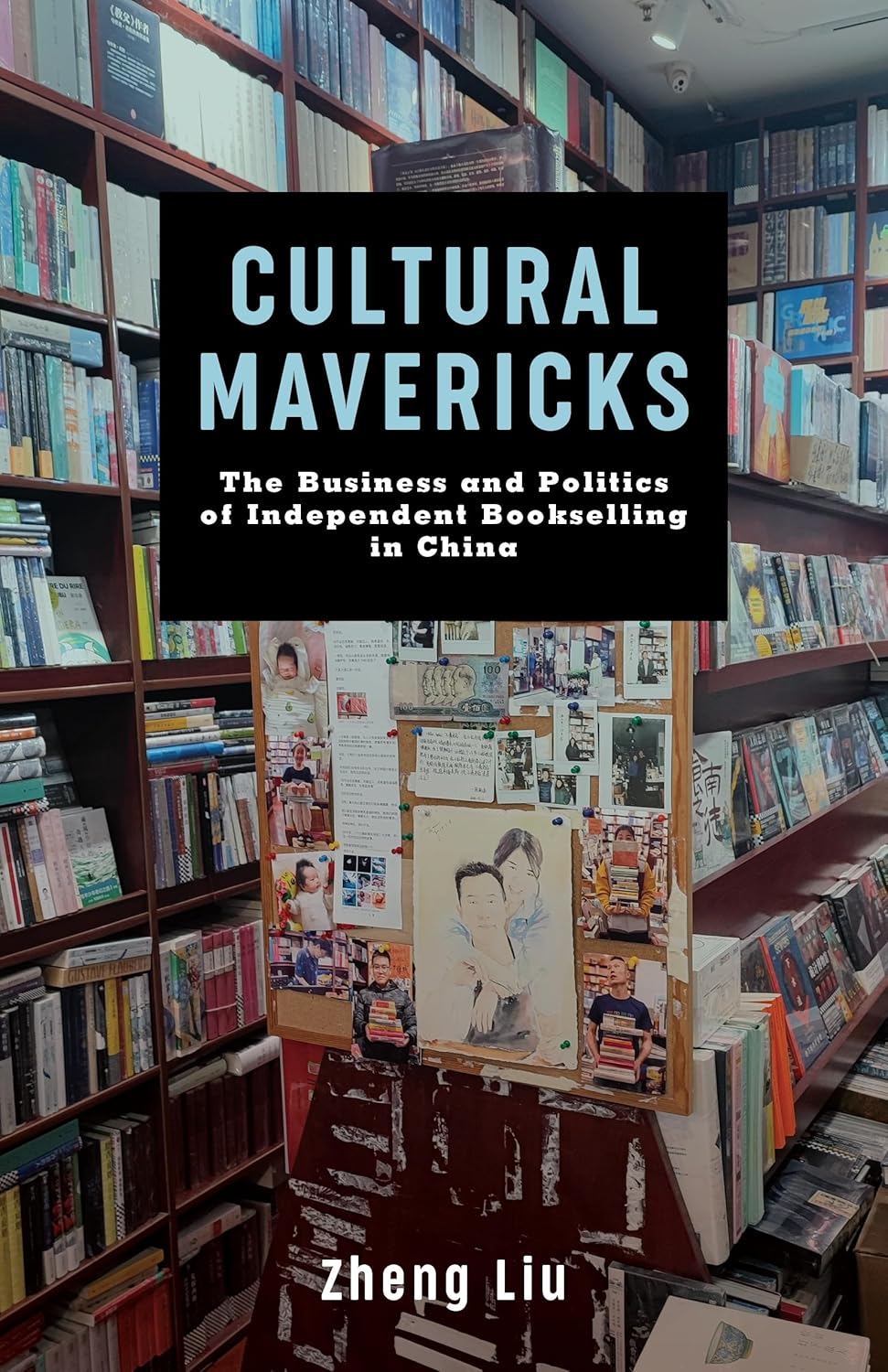
Cultural Mavericks traces the rise of independent bookselling in China over the last twenty years. That such a rise should merit a two-hundred-page academic study is, at first glance, counter-intuitive; this, after all, has been an era in which online bookstores and other digital reading solutions have, in the west, made independent bookselling seem an increasingly quixotic endeavour, while in China the Xi Jinping era has seen tightening controls over media, publishing and intellectual freedom.
In Cultural Mavericks, sociologist Zheng Liu largely eschews direct discussion of the political constraints around China’s publishing and bookselling industry. Her concern is not primarily with censorship or dissent, but with how a new generation of booksellers has managed to construct viable businesses—and distinctive cultural identities—within the shifting terrain of China’s post-2000s cultural economy.
The book is founded in scrupulous qualitative research. Over the course of a decade, Zheng spoke to over one-hundred interviewees, including sixty-three owners or managers of independent bookstores, as well as scrutinising trade reports, government policy, marketing materials and media coverage of independent bookselling.
She begins by formulating a definition of an “independent bookstore”, or duli shudian in Chinese. For western readers, the term likely conjures a fairly specific image: a small, slightly chaotic shop owned and run by a dedicated, literary-minded proprietor whose devotion to books exceeds their aptitude for commerce (see the movies Notting Hill or You’ve Got Mail for romanticised portrayals of this type of bookstore).
A central argument of the book is that Chinese independent bookstores do not conform to this Western model. In the Chinese context, Zheng argues, independence is less a matter of ownership or chain vs independent than of self-positioning: an emphasis on autonomy in book selection, on intellectual seriousness, on a cultivated sense of individuality—and on being a distinctive alternative to the state-run Xinhua bookstores.
In a central chapter of the book, Zheng outlines these culturally adapted strategies, which include the prioritising of scholarly books (and accompanying rejection of “popular” texts available freely elsewhere); hosting of events; and thinking carefully about how to decorate the stores. One store cited in Nanjing has its signage in both French and Chinese: Librairie Avant Garde; another, named “Hugo Bookshop” has a sign decorated with images of western authors, and the slogan “Thinking independently – Reading the classic[s]”. The author mentions that she lost count of the number of bookshops that featured photos of Oscar Wilde and Ernest Hemingway.
Perhaps most interesting among these strategies is what she terms “political framing”: the practice by which bookstores cultivate an image of intellectual seriousness and relative independence through careful signalling rather than overt dissent. In the Chinese context, this can involve stocking titles that gesture toward liberal or cosmopolitan intellectual culture (particularly Orwell’s 1984), hosting discussions with academics and public intellectuals, or presenting the shop itself as a space for thoughtful exchange distinct from both the standardised atmosphere of the state-owned Xinhua chain.
Zheng notes that a small number of stores engage more directly with politically sensitive material, but argues that, for most booksellers, such positioning functions less as explicit opposition to the state than as a means of differentiation within a crowded market. Zheng did interview one bookseller who had been hosting a popular lecture series that had resulted in some controversy; after being asked to cancel an event featuring a politically sensitive speaker, the bookseller decided to end the series altogether. Such stories illuminate the self-policing that occurs routinely in mainland China’s cultural and literary spheres.
Zheng also notes that, over the course of the decade-long research process, technology has become an increasingly essential tool for booksellers in reaching customers. One bookstore owner, for example, has seven mobile phones to run seven separate WeChat accounts marketing his store. As she notes, “Digital technology is transforming businesses of all sizes by redefining both the methods and the boundaries of doing business beyond mere e-commerce and digitalization.”
Though an academic work, Zheng’s book is readable and lucid, and could easily have been far less rigorous and dispassionate and far more polemical. It offers a well-researched portrait of a very specific aspect of China’s contemporary cultural life; we need more of these kinds of books on China.