“America, but Bigger” by Mark Kawar
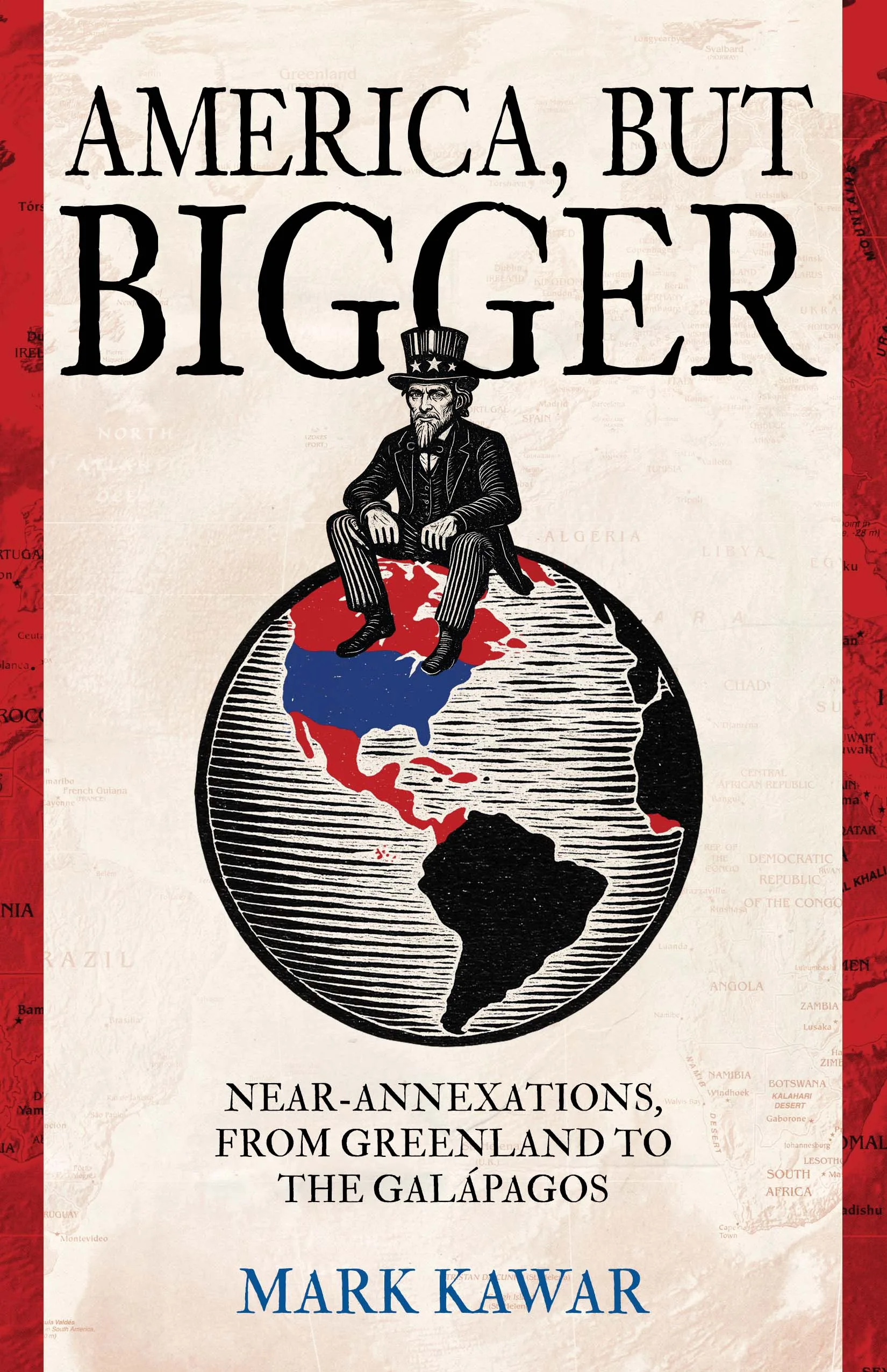
That the US is “imperialistic”, if not necessarily “imperial”, has been a point of political rhetoric my entire life. That, however, the US constitutes and maintains an actual empire is an idea of somewhat more recent vintage; whether or not Daniel Immerwahr was the first to make the point in How to Hide an Empire: A History of the Greater United States, the case he made was largely incontrovertible.
In America but Bigger, Mark Kawar makes the further point (if it needed to be made) that the US is not an empire by accident but by intention, for there was a lot of other territory it might have annexed had it had the cards fallen somewhat differently. He writes of
the might-have-beens: the annexation attempts that would have changed the size, culture, politics, and demographics of the country—dramatically or minutely—if they had succeeded.
Some of these, and indeed the major ones (Canada and Mexico for the most part), readers might already know about: certainly, I remember “54°40′ or fight!” from high school history class.
By number, if not necessarily area (pace the Philippines, which is largely its own story and has been told elsewhere), a large portion of the possible annexations were in Asia. Few of these—again with the exception of the Philippines—were ever very serious or, indeed, very significant.
The US had desultory designs on Polynesia for some four decades in the first half of the 19th century. The French proved more resolute and ended up getting it. Next up were the Bonin islands (now the Ogasawara Islands, belonging to Japan). After having been rebuffed by both the locals and the American government with respect to the Ryukus, Commander Matthew Perry eyed the Bonins, as yet uninhabited, but no one seemed keen but him.
Kawar has a chapter—how could he not?—on the “guano islands”:
The Guano Islands Act allowed the U.S. government or any American citizen to claim any island in the world if it had guano deposits, so long as another government didn’t possess it. At the president’s discretion, these claimed islands would “be considered as appertaining to the United States.
Guano, used for fertiliser, was considered a strategic resource. Most of the action was in the Caribbean, but some islands were in the Pacific: “Twelve guano ships were wrecked on Baker Island in the central Pacific between 1860 and 1871, killing three people.” And some further afield still:
In June 1876, an American identified only as “Mr. Roberts” arrived on the Lacepede Islands west of Australia. He raised the Stars and Stripes there and began to mine guano. The American consul in Melbourne, S.P. Lord, supported this claim, but Washington did not, since the Guano Islands Act only applies to islands outside another nation’s control. “‘He came, he saw, he conquered’ not,” mocked an Australian newspaper.
The idea that the target of American action had to be “outside another nation’s control” now seems almost quaint.
The US had its own “white Rajah” in Borneo, a Joseph Torrey, less well-known than the infamous Brooke family in Sarawak; less successful as well: the tenure of the Rajah of Ambong and Marudu was measured in months.
This and other potential annexations seem more like historical anecdotes than expressions of concerted manifest destiny. The rulers of Hawai’i tried, for much of the 19th century, to expand—unsuccessful—outside the Hawaiian Islands (as far as Fiji and Vanuatu). Had they succeeded (a rather major “what if …?”), the American annexation of Hawai’i might have encompassed most of the Pacific, or at least more of it.
An American claimed Wrangel and some other smaller Siberian islands in the 1880s and
The U.S. Geological Survey in 1906 recorded Wrangel, Herald, Jeannette, Henrietta, and Bennett islands as all being part of the District of Alaska, based on the earlier claims by De Long and Hooper.
The islands were very remote and largely ice-bound (Kawar says that these might have been the first islands discovered on foot). In 1916, Russia definitively claimed them and in 1924, the USSR ejected the few Americans on Wrangel. In 1920, there was talk about leasing Kamchatka to an American company.
Kawar includes places like the Philippines and Micronesia which were under concerted American suzerainty for a time. It is conceivable that some (like Guam) might have remained so forever. But Guam now seems like an anomaly; as Immerwahr pointed out, the US now has other ways of projecting power.
America but Bigger is written with a light hand with numerous short chapters, and reads as a collection of historical anecdotes, some rather shocking, others near misses, with some bordering on the absurd. One of the might-have-beens—or might-still-be, as Kawar notes in the very first sentence of the book—is Greenland. The book, then, is not of mere historical interest. But while America’s current foreign policy might seem shocking or, as some might have it, a return to fin-de-siecle worldviews, those in Asia and the Global South generally might sense an intact throughline.