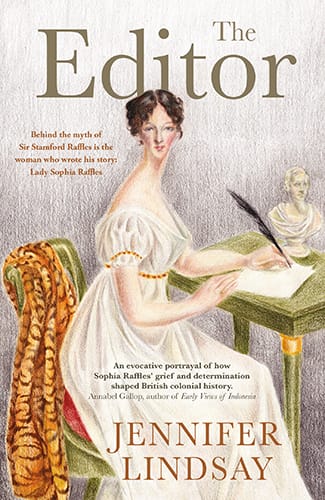
“The Editor” by Jennifer Lindsay
In 1819, Singapore came under the control of the English East India Company, under murky circumstances involving its rivalrous local officials acting without authority from London, exploiting divisions amongst the existing royal family, and ignoring claims that the island fell within the Dutch sphere of influence. Whichever version of history one believes, it is clear that Sir Thomas Raffles played a very large part in the founding of Singapore as a British colony: for most of the last two centuries he has been remembered as its sole founder. Why? After his death, his widow, Lady Sophia Raffles, compiled Memoir of the Life and Public Services of Sir Thomas Stamford Raffles.
Sophia intended the Memoir as a political defence of her late husband; she wanted to clear his name of charges of corruption and insubordination laid by his rivals, and to have the foundation of Singapore credited entirely to him. The Memoir was well-received; it laid the groundwork for Raffles’s subsequent veneration as a hero of the British Empire.
Jennifer Lindsay, an award-winning translator from Indonesia into English, as well as an editor, essayist and columnist, has novelised this in her debut The Editor. Her novel follows Sophia, who referred to herself throughout the Memoir, as “the editor”, as she struggles to compile the memoir she’s editing. It opens with Raffles’s death, in 1826, and closes with Sophia holding a printed copy of her book, in 1830. In the four years between, she has surmounted doubt that she’s up to the task of producing any memoir at all, faced painful truths and even more painful memories. overcome the temptation to give up her editorial work, been harassed for money by mean-spirited officials and come to a new understanding of her husband, her marriage and herself.
If The Editor is partly about a widow using her late husband’s life as a path to finding out about her own, it is also an exploration of questions about who gets to make history and why, and about the relationships between biography, fiction and truth.
I too (full disclosure) have written a novel featuring Sophia Raffles: Olivia & Sophia. Mine closes with Sophia planning her memoir, and barely glances at the writing and editing processes. Still, I was naturally more than usually interested to discover how another author had handled much of the same biographical material.
Lindsay skillfully marshals complicated historical and political information, and a teeming cast of characters, into a clear narrative which never overwhelms with detail. The novel is not confined to Sophia’s point of view; the reader is given access to the thoughts of most of the people she consults about the Memoir, or who visit her while she’s compiling it. This results in a variety of perspectives on Raffles, as well as on Sophia herself. The third-party perspectives on Raffles can be critical, suggesting that Sophia is often concerned more for her husband and his reputation, than for the truth.
When it comes to motive, Lindsay uses a novelist’s privilege to invent, or to extrapolate, to fill in the gaps of what cannot now be known. Sophia had initially hoped her late husband’s cousin, also Thomas Raffles, a churchman, would undertake the compilation of the Memoir. He refused, pleading that he was too busy. I much enjoyed Lindsay’s alternative, and humorous, explanation that Thomas Raffles the churchman was jealous of his own reputation, possibly too of his cousin, whom, he thought, was perhaps unworthy of a written record for posterity: “It was men of God’s work who should be remembered, not for their own sake, but for the work they do.”
If Cousin Thomas can be self-deceiving, perhaps so too can Sophia. She left Raffles’s first wife, Olivia, out of her memoir. Olivia already had an illegitimate daughter when she married Raffles. Lindsay has Raffles’s sister tell Sophia that her brother had not known of this daughter. Thus, Sophia is allowed to worry that Olivia had deceived Raffles, and kept a huge secret from him—and what kind of woman would do that? Clearly not a nice one. But what if Tom did know? Was he “besotted and gullible or besotted and forgiving”? Sophia is unsure, but either way, she now realizes that:
Her life with Tom was her life. She must continue with the Memoir not only to make Tom’s life count, but hers too. She now had no guilt about leaving Olivia out.
Whatever story Sophia is telling herself, she is surely here simply jealous? But the poor woman had worse to face than jealousy of her husband’s dead first wife: four of hers and Raffles’s five children died in Asia. Lindsay follows Sophia’s practice in the Memoir and quotes directly from Raffle’s heartbreaking letters to various correspondents, to tell them of his and Sophia’s losses. Later, she has Sophia reflect on how her children’s deaths inspired her to continue with the Memoir, when she was tempted to give up:
Working on this Memoir, she had had to learn so much about Tom. Face difficult truths. Yet she had persevered. Why? Had it also been to uphold her own reputation? She had to admit that she enjoyed the public attention of association with her husband. Perhaps there was vanity in this. But in her heart she knew this was not what had kept her going in times of doubt. It was because of the sacrifices made. The terrible sacrifices she had made. It was to show others, and herself, that all this was not for nothing.
“All this was not for nothing” echoes the line quoted earlier: Sophia “must continue with the Memoir not only to make Tom’s life count, but hers too.” If The Editor asks many questions, then perhaps it is guided above all by this question of what makes a life count. Overall, it is a moving tribute to a courageous woman whose life counted not only to the husband whose fame she guaranteed, to herself, and to their children, but also to historians of the British Empire, and to all those interested in women’s roles in shaping male historical narratives.