“The Shadeless Border” by Jiyar Jahan Fard
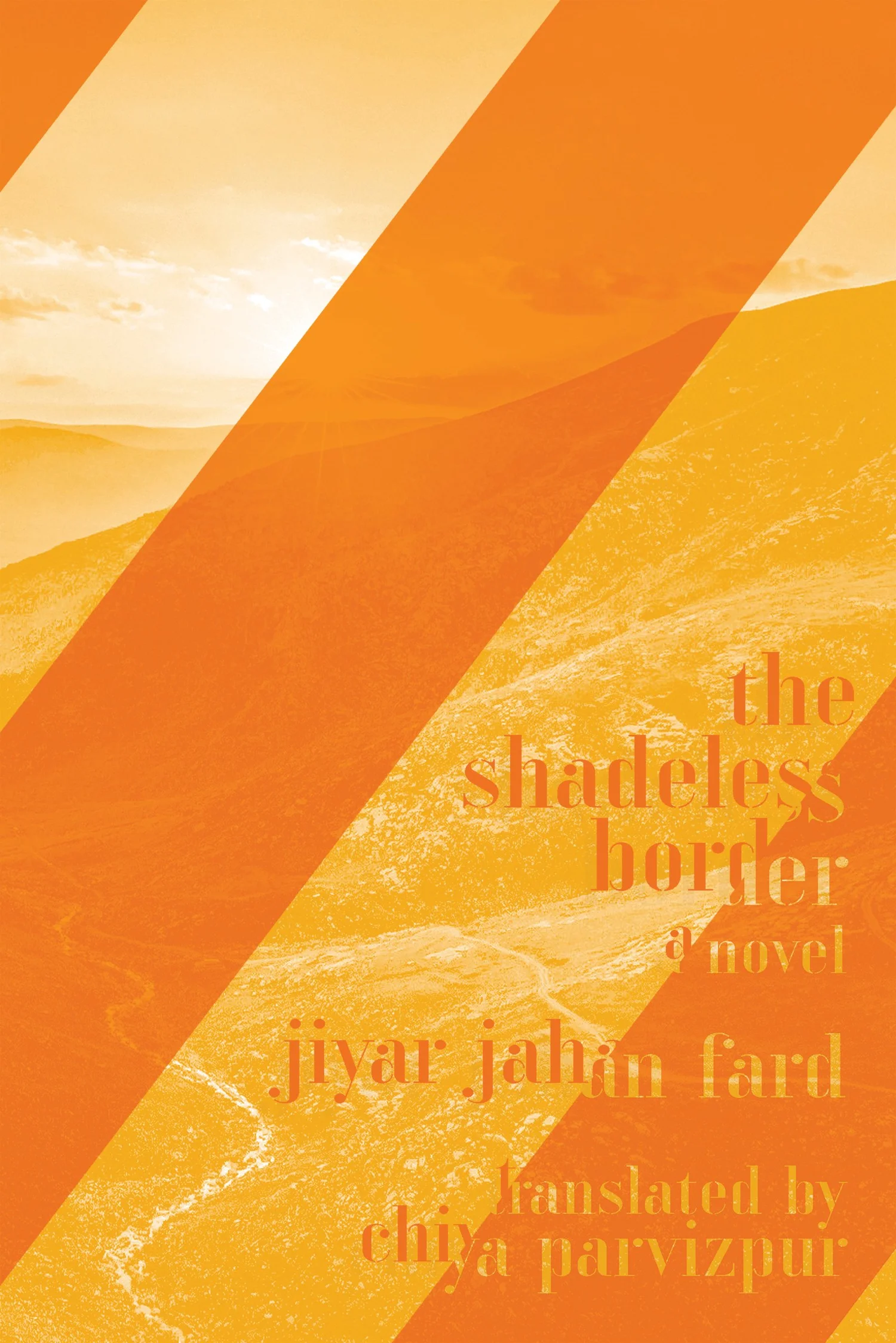
The Yarsanis are a unique ethno-religious group centered in Kermanshah, in Iranian Kurdistan. With estimated adherents surpassing one million, this little-known syncretic religion dates from the 14th century and has elements reminiscent of Zoroanstrianism and other non-Islamic traditions, and is central to The Shadeless Border, Iranian Kurdish writer and folklorist Jiyar Jahan Fard’s first novel to be translated into English. The title refers to the Iran-Iraq border which divides the Kurdish population.
The book begins with a scene that is as tragic as it is absurd. Azad, a Yarsani Kurd and political activist from Khanaqin in Iraqi Kurdistan, dies in the city of Krmashan (Kermanshah) on the Iranian side of the border. His family plans to transport his body back for burial to Iraq where he was born, but Azad’s passport has vanished. A moment meant for grief and mourning quickly curdles into a bureaucratic nightmare. The state, in the form of an Iranian border guard, demands the corpse is identified; even in death, no one is exempt from administrative paperwork.
The captain stuck his head out of the window and called one of his soldiers. “Private, before I stamp that corpse’s passport, go check his identity, take his photo and fingerprints, and come back soon.” Turning back to Barzoo, he said, “Sir, please give me his passport.”
As Azad’s relatives bake in the summer heat, sheltering under a solitary tree, the guards dig in their heels over the missing passport and a grim comedy ensues. Family members can literally see each other across a few meters of dirt, yet that might as well be an ocean from their point of view.
Fard’s style possesses a strange, surreal quality which gives voice to non-human, inanimate objects as narrators in the novel. The genre of the “object narrative” is relatively uncommon in fiction but not without precedent (it is more common in children’s fiction). The initial narrator of The Shaded Border is Azad’s coffin:
The more these people detest death, the more I am in love with it; a thousand times more. Not the death of others, but my own. I long to lay my head down as swiftly as possible, no longer hear the sounds of saddened girls and women.
Other narrators include the village tree and the tembûr, the sacred musical instrument of the Yarsan, carved from the same mulberry tree as the coffin. In lesser hands, such a literary device might feel clumsy, but here it has symbolic power. One half of a tree becomes a box for the dead; the other becomes a vessel for song, faith, and survival. The mulberry tree remarks: “Like the lifeless body, the troubled soul, and the cold coffin, I also rest a little. And so it is that life and death come from the same tree.”
Despite Yarsani Kurdish identity being under threat of erasure by the Iranian regime, objects in the novel carry memories and history that outlives individual humans. Wood remembers what governments try to remove; the tembûr retains voices that state power wants silenced. As the tembûr remarks:
At dawn, under the midday sun, and during melancholic sunsets, I am a companion for the rising, for the living, and for the dead or dying … even in death I shall remain a part of their existence.
This use of inanimate objects as narrators is firmly grounded in Yarsani culture and folklore, just as much as in magical realism. The Yarsani (also called the Ahl-e-Haqq—“People of Truth”) believe in the transmigration of souls, a process that starts with inanimate objects, then plants, then animals before a cycle of 1001 human reincarnations. For this reason, they believe they all have four natures: objects, plants, animals and human beings. The tembûr accompanies every stage of life, death and rebirth. Donbadon (the soul’s rebirth in a new life), literally means “garment shedding”, as doon is the word for life cycle, literally meaning “a garment”. Parvizpur, the translator, provides excellent footnotes to contextualise distinctive Yarsani traditions, such as the tembûr and doon, as well as figures mentioned in the novel such as kolbars (Kurdish border porters).
Fard also uses abstract concepts as narrators. Death steps up to narrate Azad’s earlier life in Khanaqin and the messy aftermath of Saddam Hussein’s fall. Death, a distinct character with a sense of irony, works together with governments, intelligence networks, and local militias to carry out its existential role: “just think about how you would pursue the true meaning of life if I didn’t exist.”
The novel changes direction significantly in its second half and Azad’s wider family members (Shirin, Barzoo, Nadr, Asrin) predominate as narrators, as the novel follows Nadr and Asrin’s journey from Iran and Iraq, across Turkey to become refugees in Europe, When Nadr and Asrin travel to the city of Sna, Iran to meet fellow writers, simple conversations about literature trigger the suspicion of the Iranian authorities. Asrin’s stubborn use of Kurdish, paired with her refusal to be suitably submissive during interrogation, exposes how patriarchal and linguistic authority is tied to state power. She is accused by an Iranian interrogator of promoting “femilism”, by which he means feminism. Later, Nadr and Asrin flee the Kurdish civil war (1994-1998) in Iraq. They make a desperate journey to Europe with their young son, Dalahoo, every new crossing carrying the ghost of past ones, each new country meaning another checkpoint and another corrupt smuggler. When Dalahoo dies along the way, any romantic illusions about exile evaporate. A child born in transit has no “home country” and Dalahoo is eventually buried in Greece, leaving his parents with a grave locked behind a frontier they cannot visit.
The novel ends where it began, with the women from Azad’s extended family being permitted as a favour to mourn for him on separate sides of the bridge on the Iran-Iraq border, as an Iranian officer draws lines to show how close they can get to one another.
The women on both sides, standing opposite one another behind two parallel lines, scratched their faces and wailed. The officer stood in the middle of the bridge, his hand on his gun, and kept an eye on them.
This is an ambitious and panoramic novel, with complex characters, an unusual narrative strategy and an unsettling plot, that vividly depicts a little-known aspect of Kurdish culture. I would venture to say it is perhaps too ambitious, insofar as the depiction of Kurdish persecution is sometimes too didactic, pausing the narrative to deliver historical background, which overshadows the harrowing narrative of Azad’s family. I can sympathise with and understand that Fard wishes the unforgiving border to emblematicise the general Kurdish predicament, as a stateless people divided by many national boundaries, and to connect the suffering of the Yarsani Kurds to that of other Kurds. However, I wished at times that more room had been left for the reader to find their own meaning in the narrative.