“The Five Tastes” by Fuchsia Dunlop
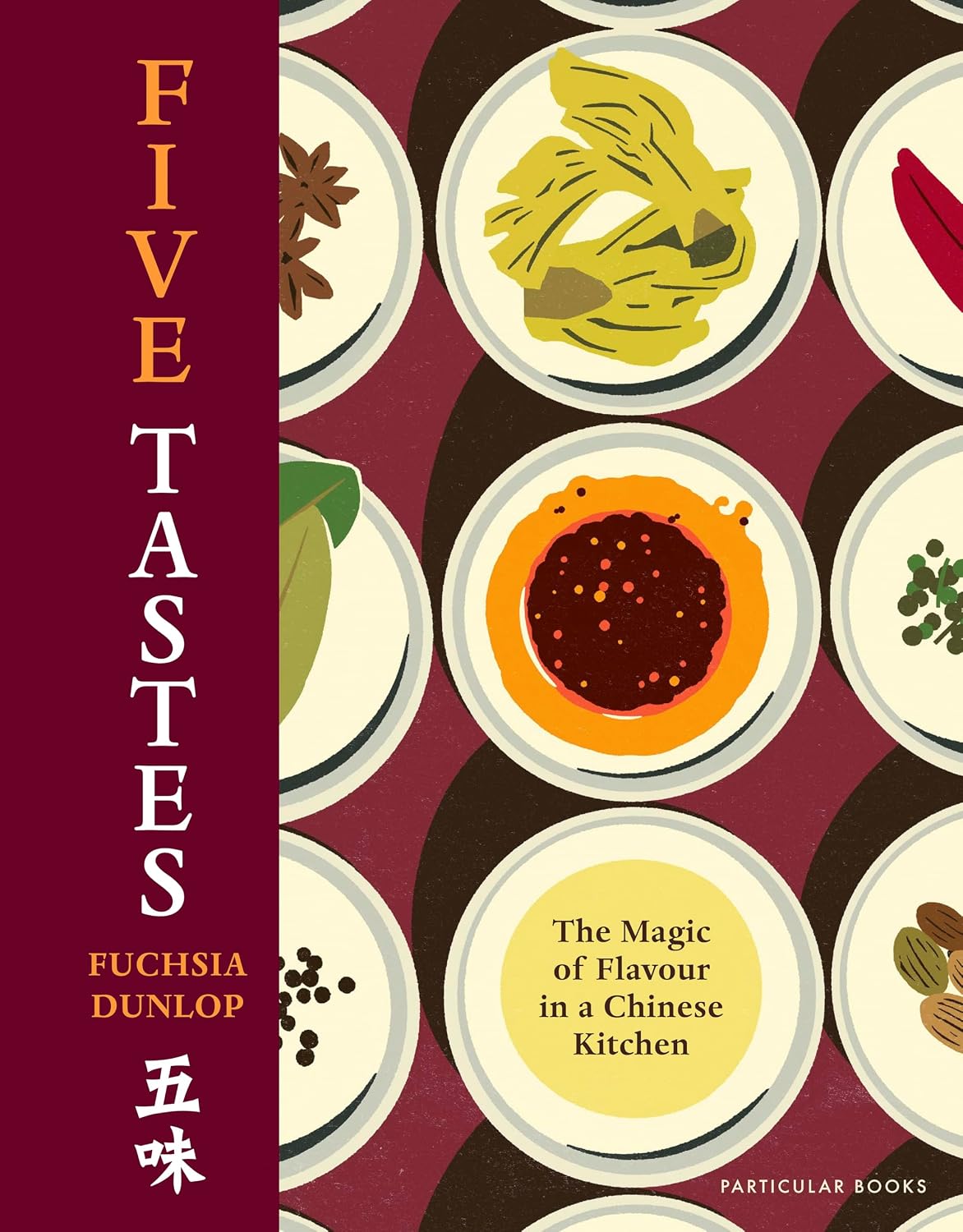
The “five tastes” of the title are the five classic flavors—sweet, sour, salty, bitter, and pungent. Award-winning cookbook author, Fuchsia Dunlop, trained as a chef in Sichuan and speaks fluent Chinese, introduces these at the start of her new book and adds others that have become staples of modern Chinese cooking, includes savory, based on the Japanese umami, the numbing ma from Sichuan pepper, and fragrant as in fish fragrant eggplant, her favorite recipe. Her previous books have mainly been regional cookbooks or memoirs, but her latest cookbook doesn’t adhere to a certain region in China. Five Tastes: Delicious Recipes for Chinese Flavors includes easy-to-follow recipes of Chinese favorites as well as some that are Chinese and Western fusion. Her book is pretty with colourful illustrations and photos, but it also includes side bars that add historical or personal context to the recipes that give the book a memoir-like feel.
The book begins with lists and descriptions of staple ingredients for cooking her recipes, of which the chile pepper seems to be the most important. Sichuan peppers are featured in the first colour photo in the book, although other varieties are also popular in Chinese cuisine.
There are many local and regional varieties of chile, from the “bullets” and “lantern peppers” of Sichuan to the twisty chiles found in Yunnan and Guizhou. Aside from basic fresh and dried chiles, the peppers are processed into spicy oils, pickles and pastes that vary widely between regions.
Most of Dunlop’s previous cookbooks have centered around Sichuan cuisine, but in this new book she writes about other regions, including Hong Kong. This excerpt is especially descriptive:
My friend Rose and I spent the day in and around the Ap Lei Chau seafood market in Hong Kong. Fresh fish glistened on banks of ice, some of them still flapping: silvery croakers with highlights of golden yellow, kite-shaped pomfret like white porcelain tinged with gray, slippery tonguefish. Crabs, lobsters, shellfish, and shrimp lurked in tanks of water. We had lunch in the canteen for the market workers: thin rice noodles in broth with pork chops on top, fried wontons with thousand island sauce and hot French toast in butter and condensed milk, glasses of salted lemon soda.
Her fusion dishes look interesting, including a tagliatelle pasta with mapo ragu and an orecchiette with egg-and-tomato sauce. The bacon and egg fried rice is inspired by Yangchow fried rice and there’s a soup that pays homage to the vegetable soup served at KFC in China.
After decades in China, Dunlop now lives in London, but as she shows in her book, she’s still able to cook her favorite dishes.
Chinese noodles are now an indispensable part of my cooking life in London: I always make sure I have stocks of dried wheat and buckwheat noodles on hand for my (frequent) emergency noodle cravings, and try to keep fresh noodles in the fridge, too. Many noodle dishes can be assembled at speed when you get home late, hungry, and/or drunk, or when you have unexpected guests. A bowl of noodles with, say, a little dish of smacked cucumbers or some blanched greens makes a fabulous and convenient lunch or supper.
She also advises that it’s fine to substitute ingredients or cook vegetarian versions of recipes that call for meat. In her section on meat, she only includes two pork dishes with the rest centered around lamb and beef. The word “meat” in China often refers to pork and Dunlop mentions this in the section where she writes about minorities in China that don’t eat pork, namely the Uyghurs in Xinjiang and the Muslim Hui population all across the country.
At the end of the book, Dunlop includes tips for cooking and a number of sample menus for one to six people. She also has sections on how to buy and store different types of tofu, another staple in her recipes. Her book serves as a great introduction to Chinese cooking but it’s also suitable for more seasoned Chinese chefs who are looking for creative fusion recipes.