“The Invention of Aisa” by Philip Bowring
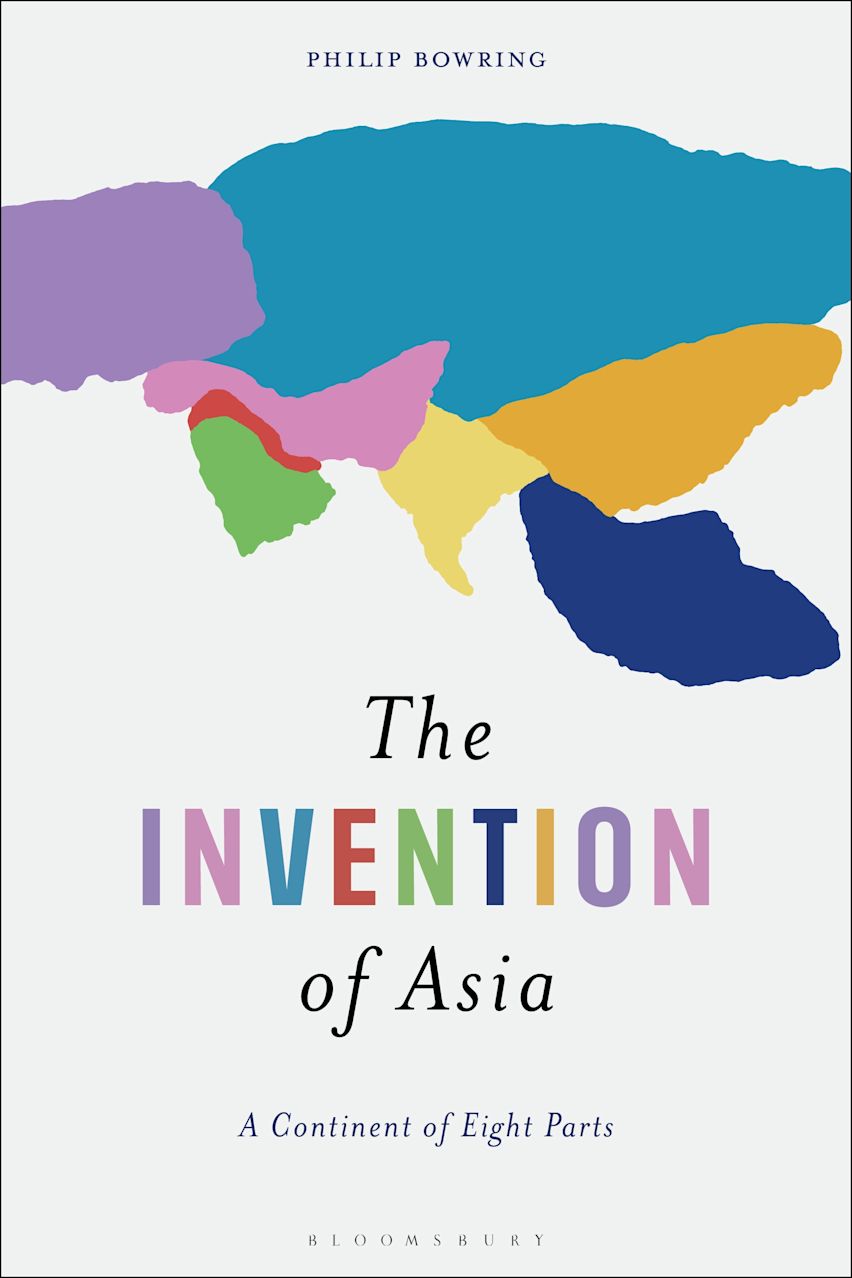
This is an edited extract from The Invention of Asia: A Continent of Eight Parts by Philip Bowring; reprinted with permission from Bloomsbury.
Of all the nouns in the English language—and most others as well— few are as misleading as “Asia”. This word of classical Greek and probably earlier origin now means whatever is in the mind of the speaker, reader or writer at the time. However, certain issues come to mind: Where does it begin and end? Who is included not only in the present but over the 3,500 years or so during which the noun has been known in some form or other?
When humans arrived in a place now called Europe, they would have had scant recognition of any significant changes in scenery after they crossed a narrow waterway—be it the Bosphorus or the Strait of Gibraltar—or across, down or up the river Volga. The widest of these was just a visible thirteen kilometres, making them minor barriers even to early humans, whether they were hunters, gatherers, farmers or fishermen. The Urals, too, were modest compared with, for example, the Alps, which, with the Carpathians, made the Mediterranean basin a “continent” of its own. These in turn were modest compared to the vast, continuous mountain barrier of the Pamir, Himalaya, Altai mountains and the Tibetan plateau plus the Gobi and other deserts that cut off the landmass reaching to the Pacific from that to the Indian and Atlantic oceans. Hence “Europe”, in one way so easily defined by physical geography, was an almost an open house to humans, as it remains. The name “Asia” was invented in what is now called Europe to describe places on and beyond the eastern shore of the Mediterranean. It has come to mean 80 per cent or so of the Continent, the other 20 per cent, called Europe, supposedly equal. There was no such divide in mind when Genghis Khan sent his forces across the Volga, or when in 883 the Anglo-Saxon King Alfred sent alms to Christians in South India in thanks for his victory over the heathen Danes. Alexander’s empire—stretching from the Nile to the Indus—was not seen as ‘European’ any more than the Ottoman Empire—stretching from the Danube to the Nile, the Black Sea and the Atlantic—was seen as Asian.
Asia as a single place is a self-evident absurdity unless one includes the western subcontinent of Europe. Today’s concept of Asia became instilled in global minds by the conquest by the states of the west of the Continent of most of the east. Yet although this particular era of imperialism is largely over, the undifferentiated “Asia” sticks around. In the process, it demeans the sheer scale and variety of the civilizations and empires that the 80 per cent of the continent has seen. It makes a nonsense of the much-heard assertions of “Asian values” or the twenty-first century as the “Asian Century” as though Syria and Korea, Myanmar and Iraq have roughly equal values and prospects, whether compared with each other or with the place called Europe. Other languages do not have their own words for this specific part of the landmass. All use a derivative of the original Greek, whether Romanized as Ya Zhou in Chinese, Assia in Arabic, Aasia in Finnish or Asia in Malay. Asians did not know they were Asian until they were told by Europeans. The use of “Asia” to describe everywhere from the Volga to Japan and Java is also relatively new.
Asia has thus become a refuge for meaningless generalizations, false assumptions of common interests and organizational divisions that make no sense. Even Europe, which makes geographical sense as the western peninsula of the Continent, is a movable feast. There have always been some gaps between the west of this subcontinent, between Western and Eastern Christendom, Slav and non-Slav. That is widening again as the western part has become aligned in many ways with North America while Russia is looking east again, attempting to use its part ‘Asian’ identity and vast land mass to disengage from “Europe” even though most of its population lives west of the Urals. Russia’s recent war in Ukraine may be part of that process. It is not as though ‘Europe’ has a permanent definition as geography clashes with ideology or empire. The “West” now refers to Western Europe, North America and their allies while the “East’ is a land of Slavs stretching, albeit very thinly, to the Pacific, descendants of the Scythians who were previous occupants of much of this space. Europe, east and west, was an almost entirely Christian region but now Christianity has been steadily ebbing for a century or more, while leaving behind a durable legacy of religion-inspired art and music.
To people in the West, the undifferentiated ‘Asia’ has meant different things at different times. There was the Asia of ‘barbarian’ hordes on horseback threatening their settled lands and cities. There was the Asia of fabulous empires of unparalleled riches and millennia of success – India, China, Persia. Later came the Asia of opportunity, for getting rich on the spice trade, for using sea power to monopolize commerce, seize and make fortunes from mines and plantations. Most recently, emergent Asian stock markets became the source of new wealth for brokers and fund managers from London and New York. Then for people from the West there was the Asia of sensual appeal, whether the romance of the untouchable Turkish harem or, more recently, the touchable bar girls of Bangkok. The idea of Asia became silently imposed on ‘Asia’ by the imperialism of Western nations. The division of the Continent into two unequal halves distorts both history and the reality of the world today. Only by looking at the parts of the vast Continent and the forces that have shaped them can we understand the overall history of this major component of the planet.
Of all the nouns in the English language—and most others as well—few are as misleading as “Asia”. This word of classical Greek and probably earlier origin now means whatever is in the mind of the speaker, reader or writer at the time. However, certain issues come to mind: Where does it begin and end? Who is included not only in the present but over the 3,500 years or so during which the noun has been known in some form or other?
Today the use of the word “Asian” is often more confusing than enlightening. “Asians” have migrated to many countries, but in the United States (US), ‘Asian’ refers to people of East Asian background and usually excludes Indians, Iranians, etc. In Britain, on the other hand,‘Asian’ generally refers to people from the subcontinent of India. In the US, Filipinos are often categorized with Koreans and Chinese as “East Asians” even though many prefer to regard themselves as Pacific Islanders or Latinos. Sometimes all “Asians” are just lumped under the catch-all “persons of colour”, though pale skins are the norm in Korea and Iran. Turks are often not seen as Asian “because they don’t look Asian”, or because part of Turkey is in Europe.
The diplomatic and social consequences of varying and shifting interpretations of the word create confusion and division rather than a sense of unity. The force that once bound them together, European imperialism, has ebbed away. States from the various peninsulas are to varying degrees engaged in global strategic competition. Divisions partly account for a collective failure to reduce Western dominance of global institutions. Justifiable critiques of the West fail to lead on to agreement on “Asian” alternatives.