“The Future That Was” by Durba Mitra
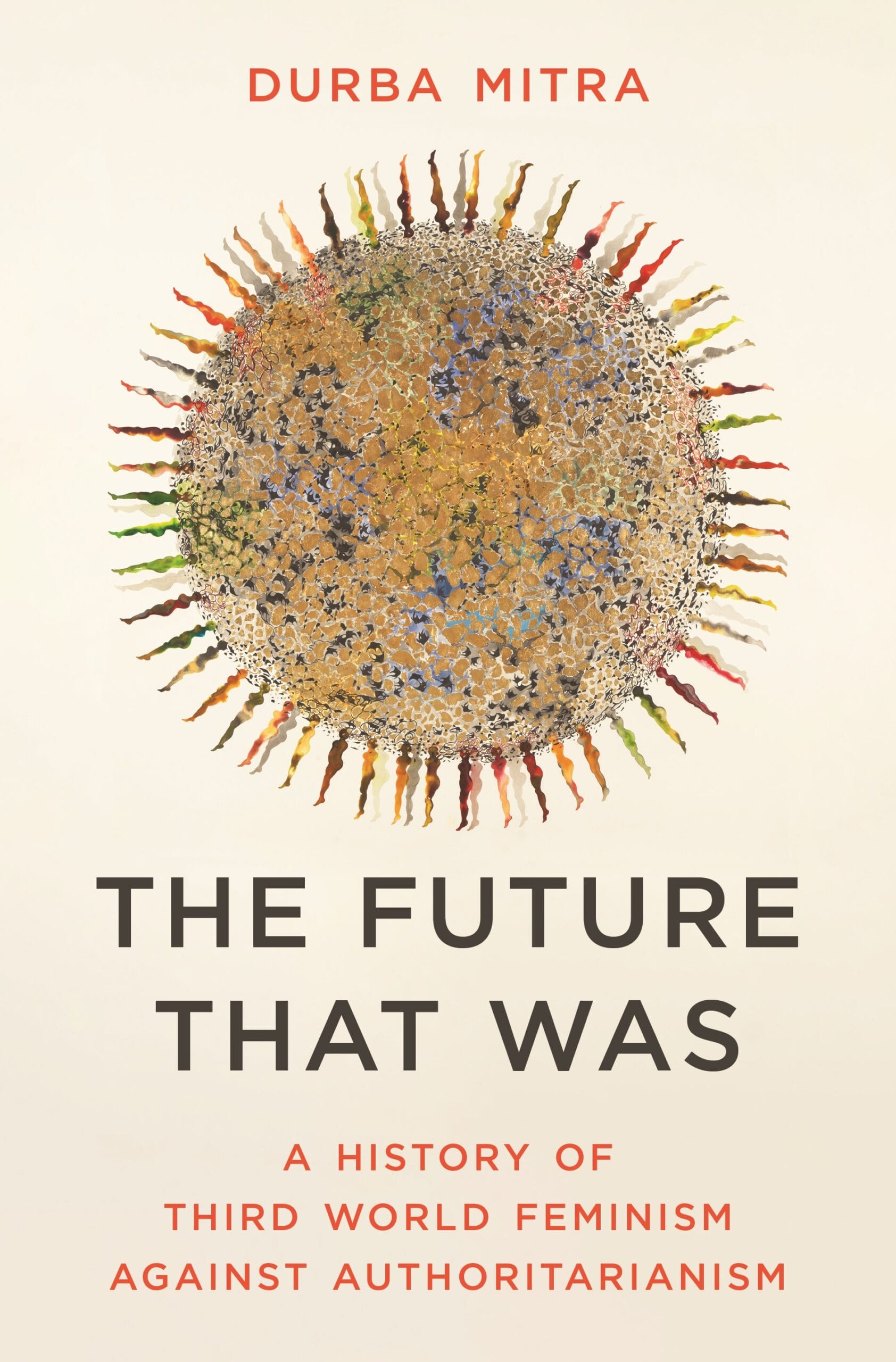
Decolonisation and nation-building were twinned processes in the second half of the 20th century. But for Durba Mitra, author of The Future That Was: A History of Third World Feminism Against Authoritarianism, the age of decolonisation was also marked by the rise of transnational feminisms. Women from Africa, Asia, and the Caribbean challenged authoritarian tendencies within postcolonial nationalist movements, while asserting the legitimacy and urgency of writing and research by and about women. For these women, claims to expertise, based on authoritative research and lived experience, lay at the foundation of the larger battle for rights and survival. “A vast domain of knowledge,” writes Mitra in the final body chapter, “shaped women’s direct action.”
A historian, Mitra focuses on the 1970s to 1990s, a stretch of time immediately before, during, and after the UN Decade for Women (1975-1985). Her book, however, is not organised by chronology or geography. Instead, each chapter of this “history of ideas and knowledge production” focuses on a site or genre that produced knowledge about women and their conditions of life: the conference, the report, the organisation, the book, and the protest. In other words, the book’s chapters map onto the sources consulted by the author. Analysis of individuals and events is thus scattered throughout different chapters.
Multiple chapters, for instance, circle back to analysis of Pakistani feminists who organised, researched, and published in the face of democratic backsliding under the militarist rule of General Zia-ul-Haq. I’ll underscore this Pakistan-related material here to give some texture and specificity to my overview of this ambitious book. Conferences on women and development, hosted by the United Nations and universities, not only brought people together across borders, but also spurred the development of research infrastructures, funded by the UN and by private foundations, prominently including the Ford Foundation. The resulting research about women was often communicated through “status of women reports.” Privileging empirical, social-scientific research and standardised metrics allowing for cross-country comparison, these reports were as constraining as they were liberatory, as they tended to subordinate research about women to the cause of national development.
But as women’s status became a hallmark indicator of national standing, the genre of the report could not be ignored even by a government like Zia’s. He thus suppressed a report authored in 1976 and commissioned his own, which he again suppressed when it defied his expectations. Only in 1997, years after Zia’s death, was a report on the status of women published by the government of Pakistan.
Some years earlier, in 1991, an excerpt from the first suppressed report was included in the anthology Finding Our Way: Readings on Women in Pakistan. Such anthologies, far more than the status of women reports, represent for Mitra the true promise of women writing and publishing about women in decolonising states. It was through such books that women “seized the means of knowledge production and shaped an epistemological revolution for women’s rights and liberation in the late twentieth century.”
But did women ever, truly, seize the means of knowledge production? Is this Marxist metaphor even the right one? Knowledge production does have a material basis, of course, in research funding, academic appointments, and publishing contracts. But Third World women never seized the power of, say, the Ford Foundation to fund or not fund multi-year publishing projects. The achievements of someone like Nighat Said Khan, the Pakistani founder of a feminist organisation with the intentionally generic name of ASR, or Applied Socio-economic Research, is that she had to work within and against a system and a state that disempowered women and devalued knowledge produced by and about women, and she nevertheless made life-changing and field-changing interventions, while also building solidarities across tense national borders.
Throughout her book, Mitra makes bold claims about the far-reaching and revolutionary consequences of feminist knowledge production, while simultaneously confronting the marginalisation and appropriation of such knowledge. In her conclusion, she lifts out three lessons of her research. The first is that Third World feminism, as a project of knowledge production, was a challenge to authoritarianism. The second is that the challenge was all the stronger because the Third World feminist project was transnational and collaborative. These are lessons to be learned from the achievements of Third World feminists. The third is a lesson to be learned from their setbacks. “This history,” writes Mitra,
teaches us how fragile systems of minoritized knowledge were and remain today. Seemingly resilient infrastructures for global research on women have been and continue to be dismantled by increasingly authoritarian states, foundations, reactionary think tanks, and universities in crisis. Through this history, we confront the epistemological limits of feminist research…
I wish that Mitra had been more explicit in analysing the contradictory claims that Third World feminism was both revolutionary and persistently fragile. Third World feminists were empowered, yet they were never in power.
Mitra recently underwent her own painful clash with entrenched power. In 2025, she was denied tenure by Harvard despite the recommendations of the History Department and the Faculty of Arts and Sciences. But Mitra will go on to write, to teach, to speak, perhaps to organise, and her two books, maybe more in the future, will be read and taught and cited, and after all, as Mitra titles her afterword, “we’re still here.”