“Eyes of the Sky” by Syaman Rapongan
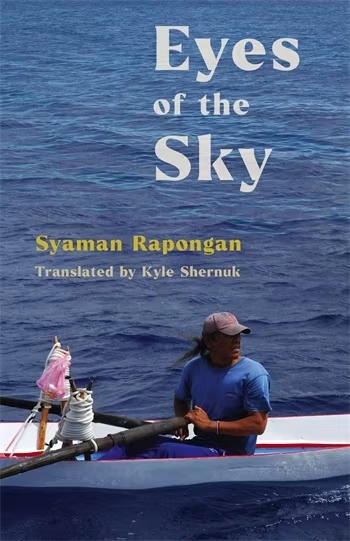
At just 45 square kilometers, Orchid (Lanyu) Island might be tiny but it is a completely different world from nearby Taiwan, to which it belongs and of which it lies east in the Pacific. The island is populated by the indigenous Tao, who live a lifestyle that is tied to the sea. In Eyes of the Sky, Tao author Syaman Rapongan explores this sea-centred culture and his people’s challenges in trying to maintain this identity in modern times.
The Tao, an Austronesian people, are the sole inhabitants of Orchid Island, whose “tatala” sea canoes are one of Taiwan’s most iconic symbols. Despite this, they view Taiwan’s majority Han Taiwanese as foreigners, a sentiment shared with other indigenous Taiwanese peoples, who have lived in Taiwan for over 2,000 years and long before the Han arrived. Of course, most tourists who visit Orchid Island are Han, and the Tao are accustomed to and even welcome this. The Tao have also sent some of their older children to Taiwan to study, as Syapen Omalam, the author’s neighbor and book’s protagonist, did with his daughter, who then stayed there to work. This Han-Tao dynamic is completely different from Taiwan’s main socio-political divide between majority “benshengren” and “waishengren”, both Han groups who arrived during different periods in Taiwan’s past.
The book looks at different periods of Omalam’s life, including memories of his father and Omalam’s childhood. At one point, the narration takes the form of a giant trevally, one of the fish species that swim around Orchid Island, which introduces readers to a rich underwater world of various species including tuna, snapper, dorado, barracuda and flying fish, and their relation with the human Taos who catch them. According to Tao customs, fish that are caught are divided into “rahet”, which can only be eaten by men while “oyod” fish can be consumed by both men and women. The book is not too long, yet the author explores various themes including indigenous culture, marine sustainability, and the relations between the Tao and the majority Han Taiwanese.
The Tao live in six villages on Orchid Island or Pongso no Tao (their name for the island), growing cassava and fishing. Respected in his community for his fishing and canoe-making prowess, Omalam contends with various challenges such as decreasing fishing stocks and raising a grandson whose mother lives and works on Taiwan.
An aging Omalam is no longer the fisherman he once was, having been unable to catch certain types of large fish in the past few years, including his grandson’s favorite. He recounts how his father suffered serious injuries from trying to prevent his canoe from being lost during a strong typhoon, which would have affected his status among his fellow Tao villagers. Tao names change as they grow up, starting off with one name when children and then having titles affixed when they become parents and grandparents. For instance, “Syapen” means “grandfather of” and hence, the narrator’s name means “grandfather of Omalam [his grandson]”.
When Omalam receives news of his daughter’s sudden death in Taiwan, the tragedy forces him to deal with hurtful events in the past that led to their estrangement and reveal to his grandson who his father was. Omalam, his wife, and his grandson also travel to Taiwan to oversee his daughter’s funeral and settle her affairs.
As with almost all indigenous peoples, the Tao’s way of life is increasingly altered by modernity and more intertwined relations with “mainland” Taiwanese, as illustrated by Omalam’s daughter, so it is uncertain how long this can be sustained. Eyes of the Sky is a fascinating glimpse into Taiwan’s only indigenous tribe that lives on an islet in the ocean, and that forms a subculture within a subculture, and which despite seeming simple from afar, is complex and challenging.