“Queen, Warrior, Captain” by Violaine Sebillotte Cuchet
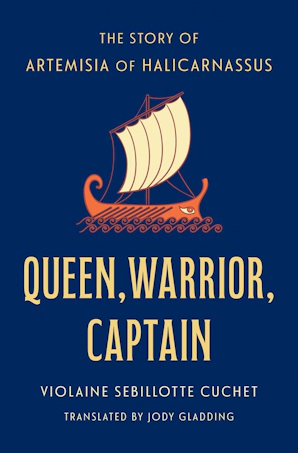
The Greeks invented Asia, or at least gave us the word. But the binaries of Greek/Asian, Greek/Barbarian, as well as man/woman, derive not from antiquity, but from modern discourse. Or rather, modern discourse has amplified and normalized a particular strain of Greek thought that emerged in sixth-century Athens. From the Athenian perspective, a woman should not be a warrior, and a Greek should not be an Asian ruler fighting for the Persians. Thus, the Greek woman commander Artemisia of Halicarnassus, who fought on the side of the Persian ruler Xerxes, should not have existed. But she did.
Violaine Sebillotte Cuchet’s meticulously-researched 2022 book about Artemisia and her social world is now available in an English translation by Jody Gladding. Its approach is one of rigorous historicization. The author begins with Herodotus, whose Histories (440 BCE) detailed Artemisia’s cunning naval manoeuvers in the Battle of Salamis (480 BCE). Herodotus had notoriously loose standards of historical evidence, but he was born in the very city where Artemisia ruled. He would not have and could not have invented Artemisia, given the knowledge and expectations of his audience. But to understand the Artemisia of Herodotus, one must strip away layers and layers of later commentary, from Plutarch to the present. Sebillotte Cuchet does this with systematic precision, while simultaneously introducing ancient sources that corroborate Herodotus’s account of Artemisia by demonstrating its plausibility. Through historical research, “Artemisia’s life ultimately revealed itself to me as quite ordinary, or at least conforming to a well-attested social logic.”
What was “ordinary”, or at least acceptable, in Artemisia’s life story? A woman exhibiting manly courage (andreia), for one thing. The myth of the Amazons provided the Greeks with a template that made Herodotus’s Artemisia immediately recognizable as a type: woman warrior. While courage was associated with manliness, this was because the battlefield—where one displays courage—was associated with men. This association was not a gendered absolute, however. Some females, like Artemisia and the Amazons, participated in warfare, just as some males, including children, the old, and slaves, were barred from participation. To “be a man (anēr) is less the translation of a morphology than a social injunction that is expressed in the imperative mode—‘Be men!’ To be true men is precisely what men, even armed, are not naturally.” Manliness is not innate to one’s sex, it must be proven. And in some cases, a woman could legitimately prove her manliness.
It was the Athenians who recast the Amazons as Barbarians and sexed figures incapable of heroism or manly courage. But it must be reiterated that Athens was not Greece. Much of the Greek world was in fact a Greek-Asian contact zone, where a woman could fight, and where a woman could rule.
The linguistic and cultural particularities of the southwestern region of Asia Minor, where Artemisia lived, allow us to define it, in part, as what modern American historians call a ‘middle ground’: As a multicultural area, it was traversed by multiple power relationships that kept it from being dominated by any single power. To characterize it as “Barbarian” would amount to adopting the Attic perspective, thus depriving this culture—where the Greek language was so widely spoken—of its Greek character. By shifting to the Asia Minor perspective, we find the Greek-speaking world, in turn, to be less Athenian and undoubtedly less masculine.
Queen, Warrior, Captain provincialises Athens, and in doing so, illuminates a range of possibilities for women in Greek antiquity, including elite Athenian women, who also participated in politics. Ultimately, Artemisia was no ordinary woman. A female naval captain was hardly commonplace. But nor was such a figure unthinkable based on gendered expectations of behavior in her times and in her social world, one that straddled Greece and Asia.