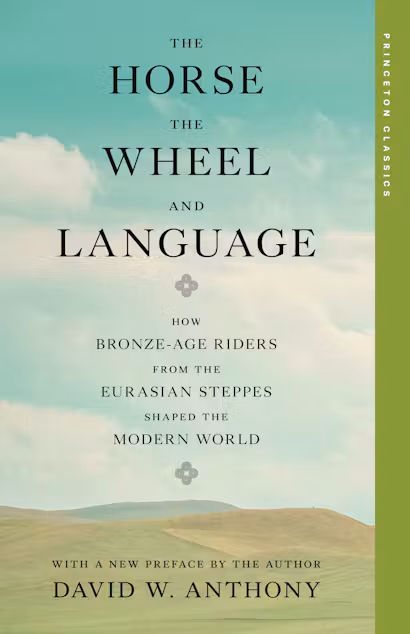
“The Horse, the Wheel, and Language” by David W Anthony
Explaining the origin of the Indo-European group of languages, which are spoken from Ireland to Bengal, as well as in the Americas and Oceania, has kept scholars busy since at least the Renaissance. Like Zeno’s dichotomy paradox, they keep getting closer to a full explanation but never entirely deliver it. Today the notion of an Ur-language called Indo-European, spoken in the Bronze-age (the 4th millennium BCE) is widely accepted. We continue to debate three questions—who spoke this language, where did they speak it, and why did they later disperse across so much of Eurasia?
David Antony first published The Horse, the Wheel and Language in 2007 to great acclaim. He successfully wove together the latest research on the process of historical linguistic change with field work from steppe archeology (the end of the Soviet Union having made that work much more accessible to western scholars). His greatest insight, from which the book takes its title, is that the speakers of Indo-European probably had horses and wheels, because the core vocabulary for these cultural elements is shared by its daughter languages. That’s why a “ratha” in Sanskrit is cognate with a “Rad” in German and “rota” in Latin. Similar cognates can be adduced as proof for the familiarity with horses and pastoralism. That in turn situates the speakers of this language on the Eurasian steppe.
On top of this, fieldwork at Sintashta, in Siberia, shows horse burials with implied rituals that are far too similar to those described in the Rig Veda not to be ascribed to the same people. This comes as close as any explanation to tying the elusive Indo-Europeans down to specific locations. Other archaeological sites at Yamnaya and Androvno provide important supporting clues for Anthony’s theory.
Since 2007, however, there has been a revolution in the science of sequencing ancient DNA, that is, strands of genetic material that can be extracted from human and animal remains, even thousands of years old. Anthony has studied discoveries in this field and has periodically published papers showing that his original thesis is supported on three legs, rather than two: archaeology, linguistics, and now genetics. This emboldens him to answer the final question, which is why did the Indo-Europeans leave the steppe for such distant destinations, making them by far the most widely spread language group in the world?
For many decades scholars of pre-history have debated whether we should speak of cultural diffusion or actual migration—the latter scenario having uncomfortable implications of genocide and extinction. These debates have been won by the proponents of migration, as most recent studies show not only that people with similar DNA were buried in the Altai and in Hungary, but also that many were so closely related as to be members of a clan, probably a ruling one. It’s remarkable to note that the builders of Stonehenge in Britain almost completely disappeared, replaced by people with 90% steppe ancestry. It remains to be understood whether this represented a violent invasion, or possibly a massive influx of new pathogens, as when the Spanish showed up in the Americas.
If the genetic record demonstrates that the Indo-Europeans themselves migrated into Europe and India, what explains their success in doing so? Anthony here reverts to his 2007 thesis that these highly organized pastoralists had both wheeled wagons and horses, which facilitated their movements and potentially gave them a military advantage. In his most recent paper, published with Trautman and others in 2023, he claims that the Indo-Europeans of 3,500 BCE rode horses. The evidence for this is mixed. One can take the softest approach, and claim that they had horses but they did not ride them the way the later Scythians, Avars, Magyars, Turks and Mongols did. Or one can take a harder approach and see the horse already weaponized in this era. Anthony writes, “the beginning of the selection (of equine genes for riding) perhaps indicat[es] the beginning of the domestication process, which was estimated to have started [3,500 BCE].” My problem with this early date is, if the Indo-Europeans had this significant military asset, why do we not see them in the historical record of the literate Middle Eastern peoples for another 2,000 years? Other scholars, including Katherine Kanne, emphasize that the early bronze age horse breeders appear to have been a pacific lot. More study will be required.
Nevertheless Antony is a lucky scholar whose magnum opus has generally aged well. As he writes:
New discoveries in a variety of fields have tended to support and expand the narrative this book provided. Wagons and horses that erased the barriers of distance, a simplified pastoral diet that traveled with herds of cattle, sheep, and goats; institutionalized hierarchy that took an easily replicated and expandable form; guest-host relationships that made both trade and travel easier; poetry performed in a new register and rhythm that was so powerful that it won the pleasure of vain gods; and disease that carried away opposing populations—all these factors combined to push the language of the new patrons past a tipping point that ushered in the very different societies of the Bronze and Iron Ages … Although finished before genetic data was available, the conclusions in this volume have been largely corroborated by these new findings, and it continues to present a compelling picture of the lives of these surprisingly influential ancestors.
Readers new and old will still find this seminal work worth their while to read or re-read.