“All Our Evenings” by Ruthvika Rao
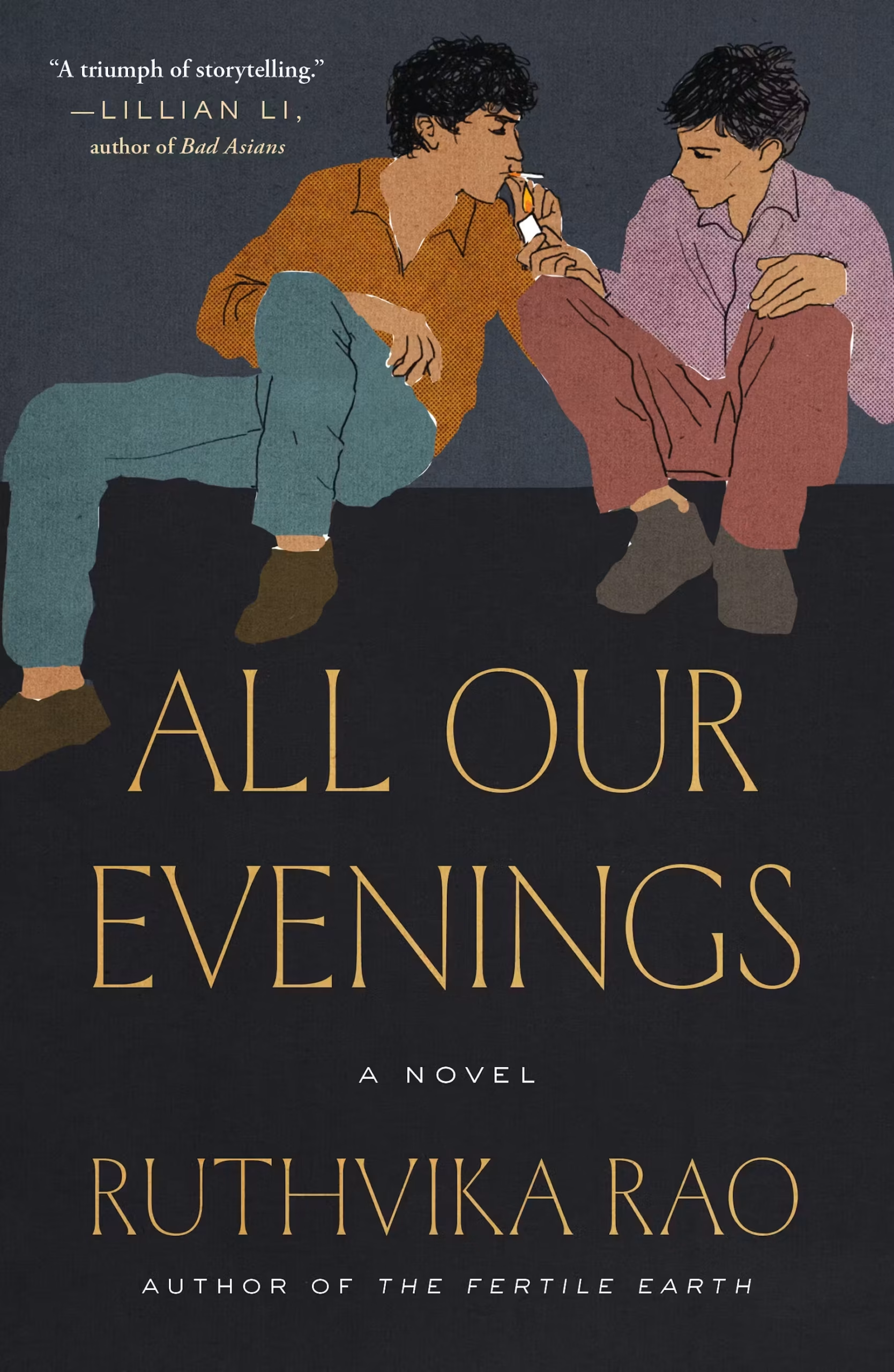
Approaching forty, Arjun works for Hyderabad’s municipal water office, reading meters and answering customer calls. He lives with his parents and has never wanted to marry anyone but Ruhee, his childhood friend. She left Hyderabad with her family after a catastrophic summer. Now a doctor, she has returned and wants to reconnect. Her reappearance takes Arjun back to the 1990s, when he met Ganesh while playing cricket and the three teenagers formed an intense friendship. In All Our Evenings, Ruthvika Rao turns a story of first love, friendship and jealousy into a slow-burning psychological thriller, gradually revealing how little Arjun understands about the summer that changed their lives.
During that summer, the teenagers find refuge from their troubled families in an abandoned neighbourhood house they call the Red House. Arjun falls in love with Ruhee but is also attracted to Ganesh. The boys kiss, while Ganesh and Ruhee begin the relationship Arjun had imagined for himself. He supports them while struggling with jealousy. Meanwhile, an affair between two teachers at Arjun’s school, one of them his father, becomes public and damages his family’s reputation. An act of violence at the Red House eventually separates the teenagers. Years later, Ruhee’s return gives Arjun an opportunity to revisit what happened, but the memories he has carried into adulthood prove less reliable than he might have imagined.
Arjun’s relationships with Ganesh and Ruhee are complicated by his inability to distinguish affection from possession. He wants the three of them to remain together, imagining their friendship as a family, but struggles with the possibility of becoming an outsider within it. Remembering his feelings, he says:
“Family, family I kept thinking. And there was that white hot hatred in the pit of my stomach, in the pit of what felt like my very soul… Ganesh, Ruhee and I. We were a family. All I wanted to do was to protect my family. I had to, because it was my responsibility.”
Arjun’s desire to protect the friendship is genuine, but it also conceals his fear of being excluded from it. His attraction to Ganesh complicates his feelings for Ruhee, making the relationship more than a conventional teenage love triangle.
These relationships also expose inequalities that the teenagers cannot escape. Ganesh tells Arjun that he is an Indigenous orphan from the Gond community, take in by a family that expects him to work rather than attend school. Unlike Arjun and Ruhee, he has little control over his circumstances or his position within the household. The Red House allows the three to imagine a life outside their troubled families, but friendship cannot erase the differences between them , nor does affection lead to understanding . As the story unfolds, the account Ganesh gives him becomes another source of uncertainty.
Rao’s achievement, however, lies in the construction of the mystery. Moving between Arjun’s present and his memories of the summer, the narrative gradually changes the reader’s understanding of events that initially appear familiar. The revelations do not merely provide new information; they cast earlier encounters and relationships in a different light. Arjun’s recollections become increasingly difficult to trust, and the reader is encouraged to question not only what happened but also how he has interpreted it. This controlled withholding of information gives the novel its psychological suspense, making the distinction between remembering an event and understanding it central to the reading experience. References to 1990s popular culture give these memories a particular setting. Recalling a conversation between Ganesh and Ruhee, Arjun realises they have been meeting without him:
From their conversation after we got back on the road, I gathered that they’d been to a movie together. Dil Se. They talked about the train song Chaiyya Chaiyya. They talked about the tragic ending. I realized that, in the past weeks, they’d been meeting without me. They’d even gone to a movie. Why didn’t they ask me? And they weren’t even trying to hide it from me; if they did, it would’ve meant I was a person.
The film and song locate the memory in a recognisable cultural moment, but Arjun notices what the outing says about his place in the friendship. An ordinary conversation becomes painful evidence of his exclusion. Rao uses such seemingly minor encounters to reveal the insecurities beneath the teenagers’ attachment to one another.
At 192 pages, All Our Evenings is a compact novel whose strongest quality is its carefully constructed psychological suspense. Its familiar ingredients of first love, family scandal and teenage rivalry acquire a darker significance as Rao exposes the contradictions beneath the characters’ relationships. Although some revelations are more convincing than others, the shifting narrative sustains the mystery while giving the story’s treatment of desire, class and memory a deeper purpose. The result is a novel in which the past remains unsettled, and the people Arjun believes he understands prove more complicated than his memories allow.