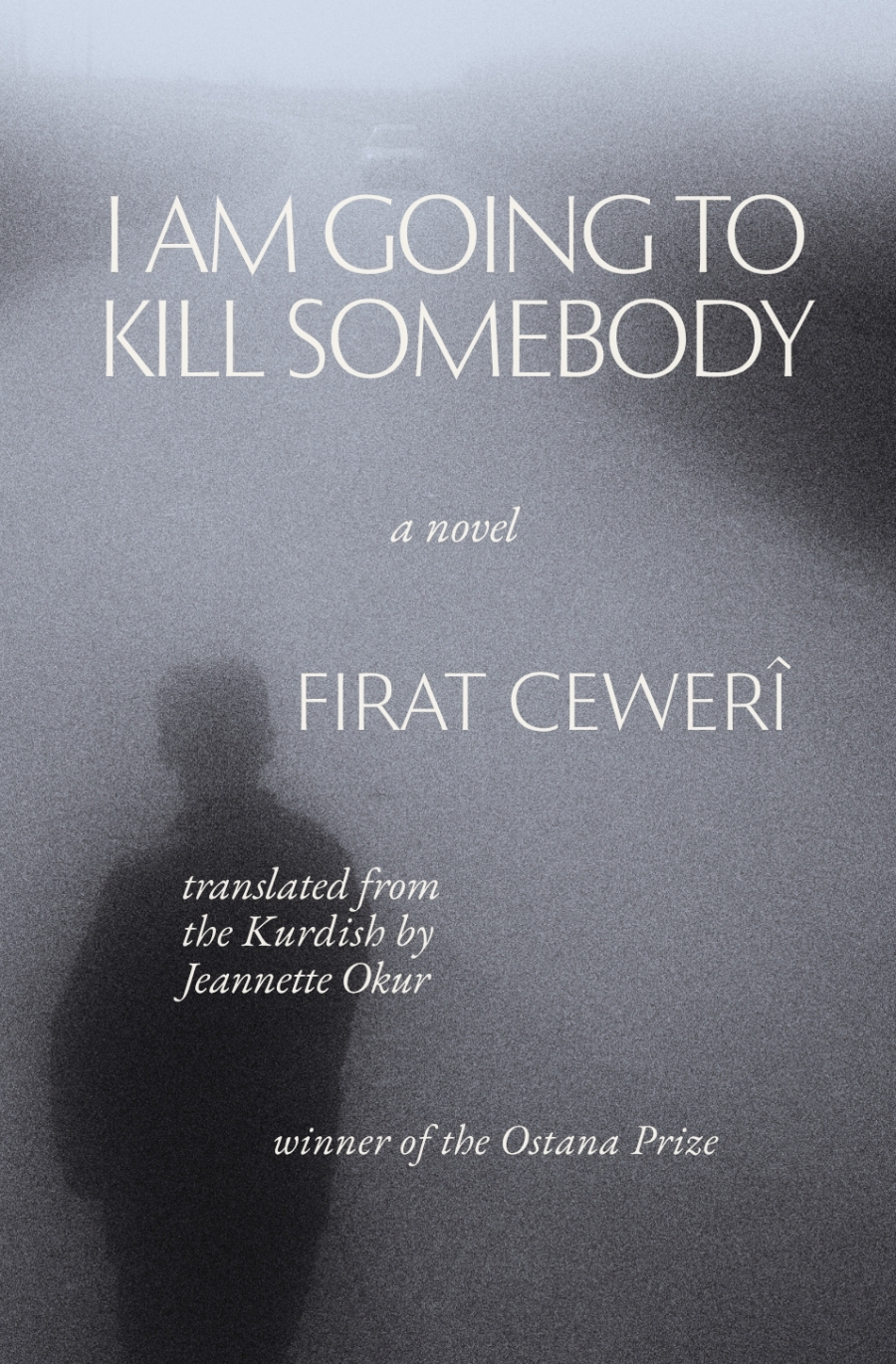
“I Am Going to Kill Somebody” by Firat Cewerî
Temo, is a forty-two-year-old Kurdish man, recently released from a hard, fifteen-year stretch as a political prisoner in Turkey, where he was broken by torture and repeatedly concussed by the guards. He now lives in impoverished isolation with his declining, sickly mother who still calls him “my handsome boy”. Tormented by sleeplessness and nightmares, Temo wakes up one day to a voice telling him:
“You will kill someone today.”
It sends a shiver through my heart but also calms me.
Most would consider this an unnerving, psychotic episode and seek urgent medical attention. However, Temo, after breakfast and contemplating putting his aged mother out of what he regards as her misery, sanguinely pockets a kitchen knife and wanders into the streets to confront his destiny. Temo tells the reader that he is a non-violent person and he “wouldn’t even step on an ant”. But he also believes of his dreams that “every single one has come true.” His freedom is reduced to this horrifying choice and drives his narrative.
I know I’m going to kill someone, but not just anyone. I have to be the one who chooses the victim; I won’t be the one being chosen. My whole life, I’ve never had a choice. I’ve always been the one picked, the one following orders. But the dream I had is going to fix that. It’s going to free me from not being able to decide.
The opening to Firat Cewerî’s gripping, dark and disturbing literary thriller is certainly arresting; primarily set in the noir underworld of an unnamed city in Kurdistan (whose apparent political liberation from Turkey is likely Temo’s feverish imagination), sometime in the 1990s. The novel, published in Kurdish in 2005, and adroitly translated by Jeannette Okur, won the 2024 Ostana International Prize and the author, who has lived in Sweden since the early 1980s, is well known as a novelist, translator and literary editor.
Cewerî is an accomplished stylist and the first part of the novel (which is in two parts) is narrated by Temo. This evocatively depicts his alienated, disillusioned wanderings through the chaotic, morally ambiguous Kurdish city. It is populated by crooks, pimps, hypocrites and liars, where “everyone is screaming”. In this netherworld: “In the name of honor, they’ll kill their own daughters. But for a moment of pleasure, they’ll rape a girl the same age as their own.” Temo acidly recalls: “The city we rose up to save fifteen years ago is now openly selling its daughters to keep itself fed… We were going to value women. They were going to hold the highest place in society.” Meeting a Kurdish prostitute, Temo, decides not to murder her, fearing it will be labelled an honour-killing. However, Temo happily contemplates killing a Russian prostitute, he “won’t kill her on the spot. I’m going to make up for fifteen years of frustration first”.
The first part of the novel is impressive; it requires considerable narrative skill to make Temo not entirely unsympathetic, however traumatised and brain-damaged he may be, as he journeys around the city sizing up potential murder victims. The reader follows Temo with appalled fascination as he is often perceptive. However, there are two main narrators and three principal protagonists in the novel. In contrast, the second part of the novel is narrated entirely by an exiled, unnamed Kurdish celebrity writer, visiting the city from Sweden to give a lecture in Kurdish, sign books and meet his many fans.
I think about my readers for a while… After all these years I was finally going to meet them face to face. I was going to sign their books and talk to them in Kurdish while I did it.
Temo (who describes himself as a “bookworm”) says early on that he and the writer were once very close when young, before the writer chose exile and safety in Europe, while Temo chose Kurdish activism. Temo remarks angrily of the writer’s visit: “He’s spending his time with the local big shots, drinking raki with the mayor and talking to them about literature.” Perhaps unsurprisingly, the writer’s much more privileged position means his narration of the city is more conventional and demonstrates its luxurious, more prosperous side.
Then there is Diana, the working name of a prostitute both Temo and the author meet at different times in the novel and whom they both try to rescue from a life she says that she loathes. Their desire to “save” Diana is the other main driver of the narrative. Diana tells Temo:
I need to escape this life before it swallows me. I’m telling you this because you look kind. You seem like a good person. I think you’re the type who would help someone as desperate as me.
In a lengthy narrative, Diana tells the startling, harrowing story of how she ended up a prostitute to the writer in the second part of the novel, when he asks her about her life. Though she was once a young Kurdish woman living in Germany, she escaped her authoritarian father, who refused to let her leave the house, or go to school for fear of “boyfriends” and she subsequently joins up with Marxist Kurdish guerillas to liberate Turkish Kurdistan.She learns from them that: “Honor does not lie between women’s legs. Real honor is the nation’s honor.” She is subsequently ambushed and captured by the Turkish army, tortured and passed on to vicious Kurdish pimps who rape her and now control her life. Diana is doubly oppressed, by the Turkish state because she is a Kurd and by men because she is a woman. In the novel, Diana acts as the catalyst for both male protagonists to reassess their lives. All three characters’ lives will intersect and entwine in sharp, very unexpected plot twists.
The theme of the novel is the potentially dark relationship between masculinity, violence and maintaining family honour within patriarchal norms. It is often a product of severe adversity and struggle against violent oppression. Temo’s father (who is beaten to death with iron bars by a masked Turkish gang while Temo is in prison) insists Temo must kill a cockerel as a child to become manly:
A man is supposed to be brave! If you can’t even kill a rooster, how are you going to kill a man? … If you can’t kill a rooster today, the whole world will fuck you over tomorrow.
It is women who often bear the brunt of this male obsession with family honour, which serves to police female autonomy and sexuality, as the novel makes clear with Diana’s story and Temo’s own disconcerting remarks:
There’s this thing called family honor in this country. Plenty of young girls are killed for the sake of family honor, but the people selling them never are. Maybe I still care about that kind of honor. Maybe that’s why I think this way.
Cewerî’s aim is to show how deeply rooted family honour lies within the male psyche and its desire for power over women. Temo and the unnamed writer could be seen to share a sentimental, romantic “rescue fantasy” towards Diana, as a beautiful fallen woman whose “lost” honour they believe they can somehow redeem. However, both Temo and the unnamed writer also indicate that perhaps men can move beyond this and recognise a genuine affinity with women and admire them as people. The writer remarks of Diana: