“Persian Parables” by Hamid Dabashi
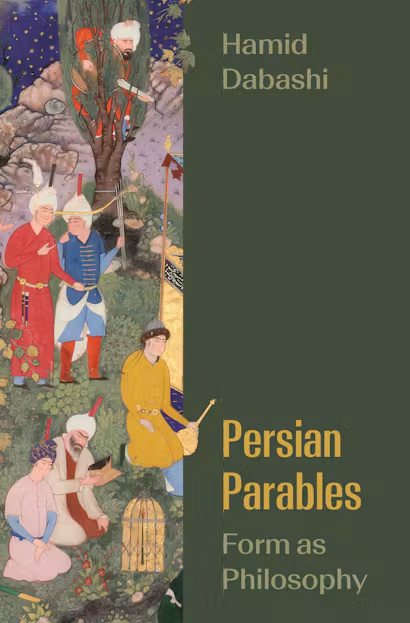
The mirror figures frequently in classical Persian literature. These precious, craft objects, made of highly polished silver, reminded readers of how much reading is really self-discovery. As one 12th century sage put it, “don’t ask for the meaning of my poetry. It is a mirror in which you find yourself.” In Persian Parables Hamid Dabashi takes as a starting point that we should not seek to analyze or paraphrase the parables we read in Persian literature any more than we should melt down the mirror to measure its purity. Beyond that, this wide-ranging book explores many topics, including the nuances of Persian versus Arabic literature, esoteric versus relational philosophy, and trends in contemporary literary criticism.
The Persian poetry of Attar, Rumi, Sa’di and Hafez qualifies eminently as holders of the mirror. The parables they tell, sometimes extensively like Attar and sometimes elliptically like Hafez, form an image in our mind. The parable can be retold many times, but it retains a hermeneutic, almost autonomous existence.
Take the one about the Chinese princess who discourages her suitors with a series of three riddles. This parable persists and flourishes from an 11th-century romantic epic—the Seven Beauties of Nezami—to François Pétis de la Croix’s 1722 Les Mille et Un Jours, Italian Commedia del Arte with Carlo Gozzi, Schiller in Germany, and finally, Puccini’s Turandot. That is not even the end of it—since Puccini’s opera found a new telling by Zhang Yimou in the Forbidden City. Each audience confronting this parable sees its image reflected back to them, as in a mirror.
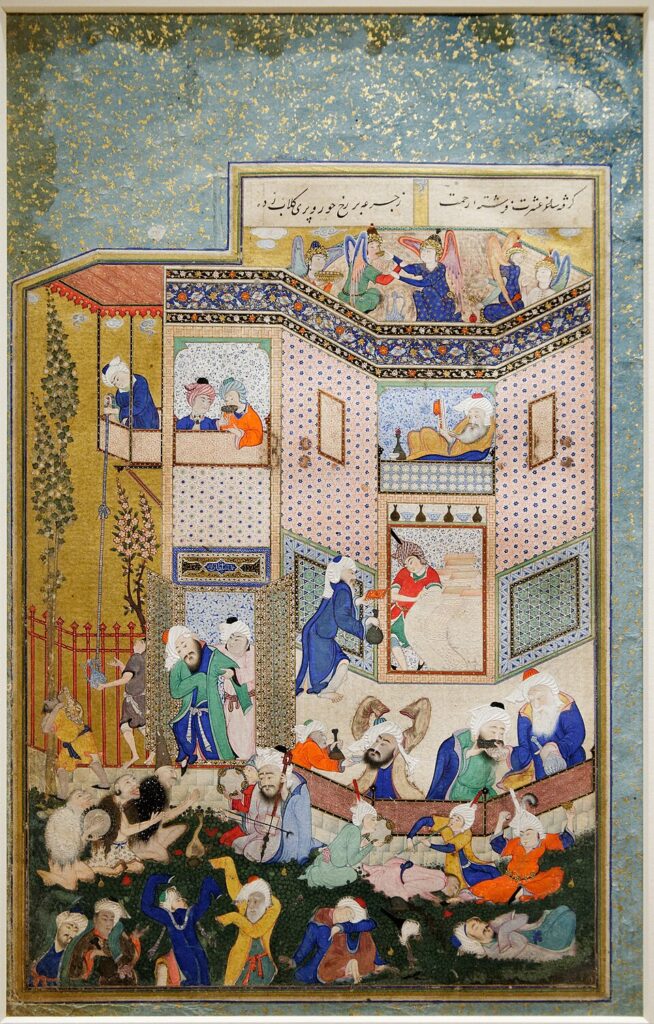
The craft of the artisan is an essential property of the experience—so in the mirror, so in the aesthetic experience. Persian poetry’s close approximation to music, with its assonance, rhythms and rimes, its word play and repetition, constantly creates delight in the listener. Delight improves each time the poem is heard, another similarity to music. Persian prose can relate parables effectively as well, using the same rich vocabulary. Dabashi cites the Persian translation of al-Harriri’s Maqamat, and the books that it inspired, like Sa’di’s Perfumed Garden (Persian title: Bustan). Since both poetry and prose were read aloud, more for pleasure than for the communication of information or instruction, the distinction between the two is much finer than we might think. Dabashi further argues that the paintings that illustrate both poetry and prose manuscripts act as crystalised parables in their own right. He urges us to revisit our experience of these paintings, which do not just repeat what is in the text, but often adds its own playful and whimsical elements.
Dabashi detects a certain persistence in Persian literature’s aptness for parables. He cites examples of 20th-century poets like Nima Yushij and Farukh Farrokhzad, where both striking story-telling and vivid imagistic language are clearly carried over from the Persian classics, even if they use free verse and explore very different topics, like women’s rights in the case of Farrokhzad. The author dismisses the notion that Iranian modernism is a reinterpretation of Kafka or Gabriel García Márquez in Persian, arguing vehemently that Persian literature has not been colonised (his term), and therefore needs to be understood on its own terms. In this respect he may be right, but this very originality compared to western models may explain why Persian authors of the 20th and 21st century do not reach a global audience, unlike their predecessors Hafez and Rumi. On the other hand, Dabashi includes Iranian film in his corpus of parables; they do reach this global audience. Perhaps cinema is simply more universal in its appeal, compared to contemporary Iranian literature in translation.
The author warns us repeatedly not to search for the allegorical or symbolic meaning behind the parables, but rather to accept them as they are: beautiful, memorable, full of teasing paradoxes, ultimately irreducible. This, he claims, is Iran’s contribution to philosophy, a kind of antidote to the Aristotelian traditions, theology, and contemporary analytic teachings alike. “Beyond the four elements… away from the eight principles… there is a hidden secret in the very kernel of the soul.” The parable puts us in touch with this secret through delight and contemplation, not reason. This is a good starting point for understanding Sufism in the Iranian tradition.
One of the strengths of Dabashi’s approach is to treat all literature as contemporary, reflecting the fact that we can appreciate both Rumi and Kafka.
Persian Parables engages in a number of polemics: against 19th century orientalist studies, the western rationalist and analytics traditions, against colonialism, eurocentrism, and even postcritical studies. Readers familiar with the study of literature at the university level will find highly developed arguments, persuasive or not. Readers primarily interested in deepening their understanding of Rumi and Hafez will gain insights without having to agree that postcritical studies are symptomatic of Trump’s America. Dabashi writes with verve and passion, displaying erudition across a range of genres. But his enthusiasm for Persian literature is what he shares most effectively.

You must be logged in to post a comment.