“For Whose Dear Sake Our Fathers Died” by Priya Hajela
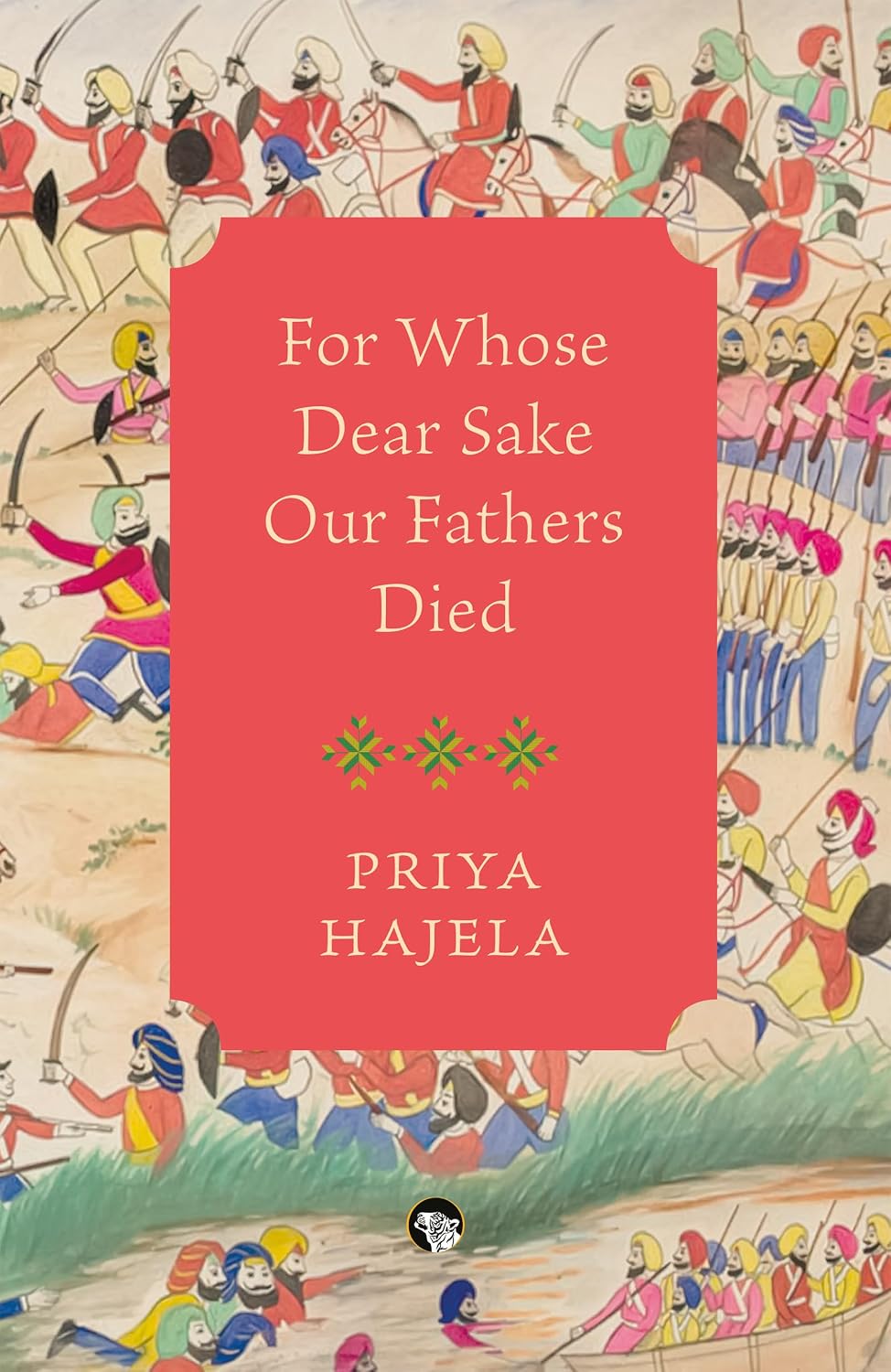
Fiction set in India’s colonial period tends to speak in nationalistic tones: stories of the oppressive nature of the British rule, the ideals of freedom movement, or personal struggles of ordinary, especially marginalised, people as they relate to the sociopolitical upheavals of the times. By and large, these works do not radically alter the narrative of bad blood between coloniser and colonised. Priya Hajela’s For Whose Dear Sake Our Fathers Died departs from this binary to make space for characters whose loyalty lay with the British.
Beant Kaur Uppal narrates the story of her great grandfather, grandfather, father and her brother to her children and grandchildren so that they know who they are through history and memory of their ancestors. The great grandfather fights in the army of Raja Ranjit Singh resisting the attack by the East India Company. The men at the two ends of this genealogy fight against the British: while the grandfather and father serves in the East India Company army, one in suppressing what is now called the Great Rebellion of 1857 and one served in the Piffers (Punjab Irregular Frontier Force) against the Afghans in the 1880s and 90s. Amrik, the youngest, steps away from the family tradition of joining the military and takes up law. During the onset of World War I, he embarks on the journey to Canada on the infamous Komagata Maru ship with hundreds of others to test the claim that British subjects are free to travel and/or immigrate to any of the British territories. The four generations become a way of contrasting where individuals’ loyalties lie and how they make sense of the identity they receive from their forefathers.
This relationship between the English and the Sikhs is still unusual material for fiction and narrating it with the help of one family allows for reflection on the framing of loyalty itself. How does one make sense of the archive in which there are records of Sikhs expecting special treatment from the British because they fought in British wars? Hajela attempts one answer in the voice of Balwant who fights defending the British officers:
Sometimes you have to separate the group from the individual. As a group, the East India Company is evil. They have conquered and pillaged our country… But then there are people like Henry Lawrence… and Colonel Jeremiah Brayser, who I will die for… The British have done more for me than my countrymen. My own mother threw me out of the house after my father’s death.
By the time it’s Amrik’s turn to choose, and he chooses to participate in the freedom struggle, the same Balwant says,
With each generation, our ability to create our own paths reduces. This is not because you’ve been coddled. It is because it takes certain events to align with our lives for us to take risks of the sort your great-grandfather took, that I took that your father took. If those events are not available to you, you will settle into a life of complacency, of the mundane, of the everyday. As countries form and shape-shift, as extraordinary events become rare, the opportunities to live an extraordinary life dwindle. That is when one must look for the extraordinary in the mundane. Your voyage to Canada … seems mundane to the naked eye, but it is extraordinary – and it is your path.
Apart from the opportunity to philosophise the room for personal choices within the larger political condition, the novel is interesting for the relevant research it digs up about these moments in 19th and 20th-century history of India. One is the presence of Sindhis in Hong Kong at the time of World War I who support the travellers’ food and accommodation while they wait for the Komagata Maru to set sail. Another bit is the story of the Lawrence brothers—Sir Henry Lawrence and Sir John Lawrence. The Lawrence Schools in India are named after him; he was the founder. His brother, John, later became Viceroy and Governor General of Punjab. Henry died during the Great Rebellion of 1857. Colonel Jeremiah Brayser was a private soldier in the East India Company. He was responsible for raising what later became the 14th Sikh Regiment in the army.
The rebels held British women and children hostage and also killed them during 1857. One scene looks at them closely through Balwant’s gaze as he strategises their rescue:
It was a group of women seated on straight-backed wooden chairs under a banyan tree. From their clothing and hairstyles they looked to be English, all twelve of them. The women were as stoic as they could be. They sat with an eerie formality, as if waiting for tea service that would never come, their postures rigid with a discipline that made the scene all the more grotesque. Their long dresses were torn in places, once-fine cotton and muslin now stained with dust and grime, collars limp, sleeves shredded. Their hair was dishevelled and hanging long instead of being folded into buns. It was possible that a few had been dragged there by their hair. Their faces were remarkably clear, no tears and no dirty streaks. They were not screaming to be spared because they had given up. With their husbands dead, they had no hope. Most of them were middle-aged wives of career Company men, the same men whose lifeless bodies hung overhead, who had shared breakfast with these women just hours before.
Among the lighter moments in the novel are comments on the British obsession with records and rules. Balwant wonders,
These Englishmen did nothing unexpected, nothing that wasn’t by the book. It was probably that same book that got the rebels as far as they had reached.
Given the scale of time and the number of characters, For Whose Dear Sake Our Fathers Died does not seem to have the space for deeper, more sustained interest in characters. They go in and out of the frame a bit rushed. For instance, Harjit’s death and the years until Amrik grows up escape the need to have enough space for exploration. Priya Hajela’s novel nevertheless deserves attention for drawing attention to a different sort of relationship between the Englishmen and Indians.