“Olenka” by Budi Darma
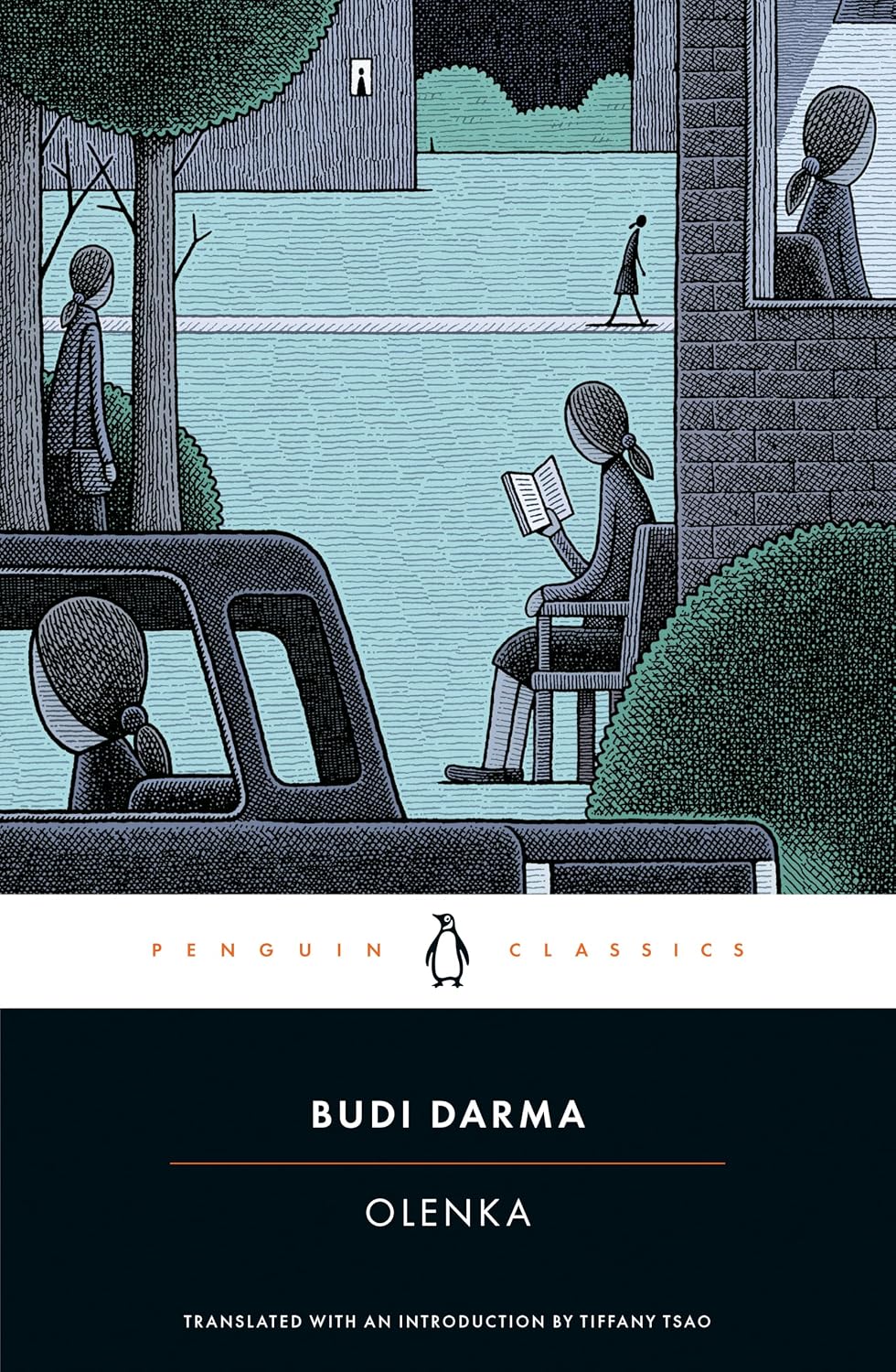
There are three pillows in the short story Fanton Drummond flips open in a convenience store near the Indianapolis bus station, where he’s stuck for the night. Two go under the hero’s head and one goes on top. Some nights he puts two more under his feet. That’s how Fanton sleeps, too, and only one person knows it: the woman he’s been sleeping with. Her husband wrote the story. The New Yorker paid him five thousand dollars.
Fanton is the narrator of Olenka, Budi Darma’s first novel. It came out in Indonesia in 1983 and has finally made it into English. It’s a sly book and at times an exhausting one. Nearly everybody in it is busy turning somebody else into material. The husband puts his wife and her lover into his stories, and the lover’s version of the affair is the novel we’re reading. Olenka herself gets one chance to tell her side, in a letter she sends after she’s left town.
Darma died in 2021. Back home he already had a name for cold, absurdist short stories when a Fulbright scholarship brought him to Indiana University in 1974. He stayed for a doctorate on Jane Austen. Toward the end of 1979, living in an apartment complex called Tulip Tree, he wrote Olenka in less than three weeks. It won the Jakarta Arts Council’s competition for unpublished novels, and later a SEA Write Award. The main characters are all American. Darma later said America was simply where he happened to be living. In Bloomington he also had time to write, which he never seemed to have at home.
Fanton grew up in an orphanage and never had a surname of his own. He got “Drummond” from the couple who adopted him. They died in a car crash, shielding him with their bodies. He’s directed TV commercials and spent a couple of weeks scouting locations for Breaking Away, which was shot in Bloomington. Peter Yates wants him in Hollywood, but he’d rather walk around town. He has the alertness of a man with nothing to do and the vanity to think that whatever he happens to notice has been put there for him.
He meets Olenka in the elevator. Three scruffy kids get off before her floor, and he asks if they’re hers. They aren’t. Their mother has walked out on them, which is what she’s angry about. He starts watching for her around town. She always has a book open and gives him almost nothing. Their first real conversation happens in the woods, where she’s sketching a tree that’s fallen onto a bridge. She calls him by name without turning around. Then she sends him over to the bridge to pace back and forth, because she can’t draw a thing unless she studies the movement around it. She knows he’s been watching her. She’s been watching him, too.
They become lovers. Fanton’s favorite fantasy is of Olenka as a map: “Given the chance, I would roll her up, then unfurl her on a bed or table, on the floor or a grassy field. If I had to, I’d hang her on a wall and point at parts of her body like a geography teacher pointing to cities.” He would trace the roads from one hill or lake to the next, “before shouting, ‘Hey, look! Here’s the road to paradise!'” What a pleasure it must be, after all that time spent trying to get a woman’s attention, to picture her hanging there while you do the talking.
Wayne, the husband, can hardly get a sentence out. He’ll say “envelope” when he means “letter”. Years ago, with Olenka pushing him, he wrote a story called “Olenka” that ran in The Kenyon Review and got into the O Henry anthology. The mayor of Skokie, Illinois, threw him a ceremony. He hasn’t published anything since. He covers the walls with words he hopes will inspire him, while Olenka pays the bills.When he talks about his wife’s other men, the words come easily: “She changes them like changing outfits, wearing them a few times, then tossing them before they wear out.”
Fanton finds him a job shelving books at the university library. The patrons keep asking him questions, which he can’t handle, so Fanton tells him to pretend he’s mute. That pretense is how the man with the pillows ends up in The New Yorker. The same day, two other magazines take stories of his. Fanton and Olenka are in one of those too, as Drumbold and Olga.
Most of the comedy is Fanton trying to stay above Wayne. After sizing Wayne up, he decides: “I was the superior one by far. Never had I attempted to become anyone or anything, but I could have if I’d wanted to.” A few lines later he adds, “I may have been lazy, but I wasn’t a parasite.” He punches him again and again, with Steven, the couple’s withdrawn little boy, looking on. Wayne tells the police he had it coming and lists insults he never actually said. Later, in a bar in Indianapolis, Fanton arm-wrestles a mute man because he reminds him of Wayne. Somewhere in the middle of the match he admits it: “Wayne and I were the same.”
After Olenka disappears, Fanton meets a woman named Mary Carson in that same bus station. Within days he’s proposing to her in Chicago. She turns him down because she can tell he’s really proposing to someone else. Back home he writes her letters and puts each one away for as long as the mail would take. Then he writes her answers. He calls this masturbation. Even in a private fantasy, he observes the postal schedule.
The translator, Tiffany Tsao, is a Chinese-Indonesian novelist who lives in Sydney. She has published four novels of her own, including The Majesties. Her translation of Darma’s People from Bloomington won the PEN Translation Prize. She worked on that book with Darma himself, trading WhatsApp messages with him until he died in 2021. Olenka, she writes in her introduction, was a much more solitary job.
About two-thirds of the way through, a long letter from Olenka reaches Fanton. Her voice is right there from the first line. She had loved a woman she calls Winifred, who told her that her drawings were flawless and that she’d never be an artist. She’d once given Wayne part of her parents’ story, and he turned it into “Olenka,” taking, as she puts it, “my name, my voice, my very breath.” The rifle the girl fires in his story was her father’s.
Then she gets to Steven. Wayne holds up the boy’s dependence on him as proof that she’s an unfit mother. She writes that Steven was conceived when Wayne raped her.
Fanton gets interrupted before he can finish reading. Later he goes for a walk and ends up at the bridge she once drew. You can still see where the tree hit it. He sits on the steps, and only then goes back over the rest of the letter. Whatever Steven thinks of her, she writes, he’ll need her. She’ll have to help him through Wayne.
I’d have been happy if the book ended there. Darma keeps going. Fanton heads to Pennsylvania to propose to Mary Carson a second time and winds up in Washington, DC, sick with what Olenka used to call, after Sartre, nausea. Then there’s a coda. Fanton, now playing the author, admits that Wayne would have known when to stop and he doesn’t. He signs off with a line from the Indonesian poet Chairil Anwar: “My God, in my utter despair, I still call on You.” In her introduction, Tsao reads the coda as a second ending, one meant for the book’s conscience.
Olenka is uneven, and a lot of that is on purpose. The detours that drag come out of the same habit of mind that gives the book its best moments, like Fanton catching his own vanity a beat too late, or Wayne finding his tongue only when he has something cruel to say about his wife. In the afterword Darma tells how it started. A woman held the lift for him at Tulip Tree. Three boys in dirty clothes were with her. They weren’t hers; their mother had left them. He went upstairs, sat down at his typewriter and couldn’t stop. Only back in Indonesia did he realise the name Olenka came from Chekhov’s “The Darling”, a story he’d copied out by hand in Indonesian as a schoolboy in Salatiga. The woman in the lift, he found out later, was called Anka.