“Sea of Treasures” by Jeremy A Simmons
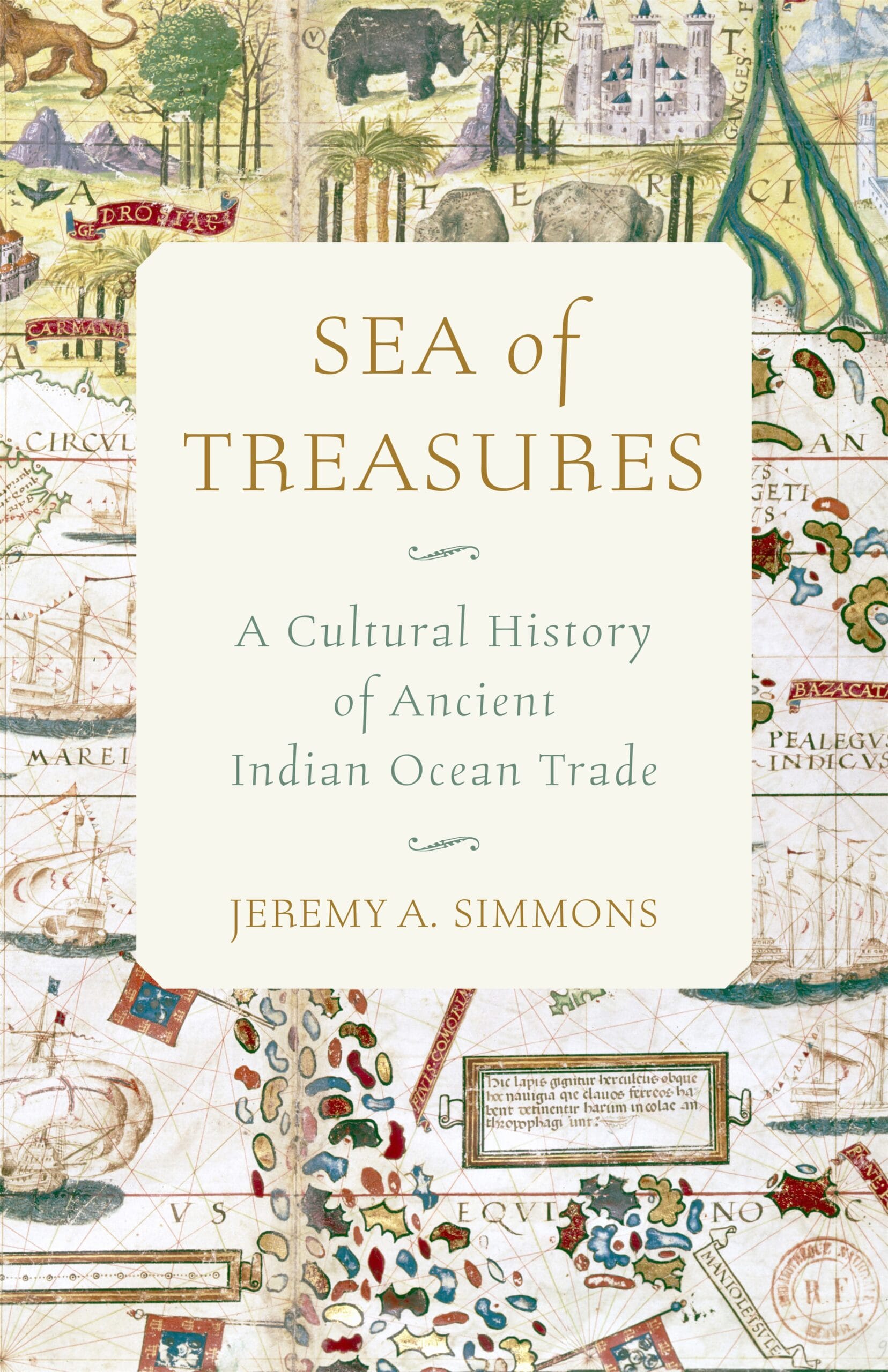
When Alaric laid siege to Rome in 408 CE, the desperate city sued for peace, paying 5,000 pounds of gold, 30,000 pounds of silver … and 3,000 pounds of pepper. That a Visigoth warlord made a commodity from the Malabar Coast central to his demands shows the pervasive role of Asian imports in Roman affairs. Jeremy Simmons’s Sea of Treasure explores the multifarious consequences of this trade in spices and specie.
While pepper had its traditional uses as a flavoring and preservative, the Romans used it in everything from abortifacients to aphrodisiacs. They poured nard oil, derived from a flower native to the Himalayas, onto statues of their gods and into amphoras of wine. They added cinnamon to their perfumes and burned it on funeral pyres. Bay leaves paired well with shellfish, or freshened breath all on their own. Spices even found their way back to India in the form of exported cosmetics.
The Roman state did its part to encourage the flow of goods by expanding the ports, canals and warehouses they inherited from Ptolemaic Egypt. They ensured a return on their investment by enforcing the tetarte tariff of 25 percent on all goods arriving via the Red Sea. However, some Roman statesmen had other concerns. Much of the book focuses on Pliny the Elder’s fretting over the corrupting influence of Eastern goods. Effeminate accoutrements like perfume and pomade were hardly suitable for the progeny of Aeneas. Simmons notes that all that sanctimony might serve to disguise base motives: as access to luxuries spread, the elites tended to discourage habits that undermined the distinction between ruler and ruled. On a more practical level, leaders worried about trade deficits and the flow of currency abroad.
Before explaining what became of that specie, Simmons reorients readers to the variegated polities that comprised South Asia: the Kushans, Western Kṣtrapas, Sātavāhanas, Ikṣvākus, and Guptas. That diverse cast, even those with monetized economies, responded to Roman coins a bit like Greeks and Romans adopting the Phoenician alphabet: as an impetus to creation, but one adapted to local needs. Archeologists have found many coins with neat punctures suggesting their use in jewelry. Others wound up Buddhist temples as votive offerings. While their Occidental contemporaries used Indian spices to terminate pregnancies, South Asian women swallowed small amounts of Roman gold to alter the sex of their babies. And while Roman imports influenced the aesthetics of local rulers’ coinage, counterfeiters took a more direct inspiration, albeit with less than perfect fidelity to the Latin script.
Even by the standard of erudite scholars, words enthrall Simmons. Fittingly, both spice and specie derive from the Latin species, indicating a particular type or class. One might expect a Classicist like Simmons to feature extended quotations in the original Latin and Greek, but he does the same with Italian, Prakrit, and Sanskrit. With port calls in every ancient coastal city from Thule to Taprobane, readers will acquire argot from fields as diverse as navigation, lapidary, metalworking, and archaeology. And while only true logophiles might appreciate the use of “comestible”, “realia”, and “inhumation” in place of “edible”, “object”, and “burial”, the work remains accessible to the general reader.
While Simmons delves into minutiae, he also casts a wide net. He cites dozens of Latin sources beyond Pliny, from the epochal (Cicero, Virgil, Ovid) to the obscure (Apicius, Macrobius, Palladius). He gives almost as much space to Greek and Indian sources, along with Rabbinical and Biblical anecdotes well beyond the Gospels’ frankincense and myrrh. The book’s references range from Kant, Marx, and Gibbon to contemporary sources like the globalization scholar Arjun Appadurai. As for primary sources, by the time Simmons informs readers that over 8,000 Roman coins have been found in India, one half-suspects he has inspected them all. Much like the archaeologists still unearthing denarii and sestertii, diligent readers will appreciate the details hidden away in this book with 181 pages of text followed by 174 pages of appendices, notes, and bibliography.
The real treasure, so to speak, lies how the author reckons with that evidence. The phrase “Indo-Roman trade” appears dozens of times, but Simmons reminds readers that no such thing occurred: countless individual farmers, merchants, craftsmen, and customers all played their roles, without any higher coordination at the level of their respective polities. The textual record does not come from those who carried out the actual harvesting, shipping, processing, and selling, but rather from a rarefied elite. And how much should one trust those voices? Pliny’s disdain for effete consumption belies his familiarity with the decadent goods. Simmons also suggests that Pliny, like many successful authors since, understood what subjects would garner an audience. The record in India presents different challenges: the environment hastened the degradation of written material, forcing scholars to infer the usage of coins from millennia-old wear and tear. How much occurred in the Mediterranean, and how much in the subcontinent? How many coins were melted down after arrival? For that matter, how many found their way back to Rome?
Sea of Treasures refrains from pat answers, instead hewing close to the evidence. But the many details drive home a wider point: different civilizations have always traded goods, ideas, people, beliefs, and technology. Just as Pliny’s anxiety over Eastern influences shows there was never a pure “West” incubating in the Mediterranean, the Prankit and Buddhist sources in this book belie Indian nationalists’ preference for a Sanskrit, Hindu Bharat evolving in splendid isolation before the establishment of the Delhi Sultanate. Simmons distills a panoply of sources to reveal what Adam Smith noted in 1776, that “the propensity to truck, barter, and exchange one thing for another is common to all men.” Then as now, we are all richer for it.