“Sons of Heaven” by Craig Clunas
In modern Chinese, guojia, commonly translated as “country” or “state”, joins guo to jia, “family”. Popular sayings make the connection sound reassuring: “When the family is harmonious, all things prosper”; “The foundation of all under Heaven lies in the state; the foundation of the state lies in the family.” Peace.
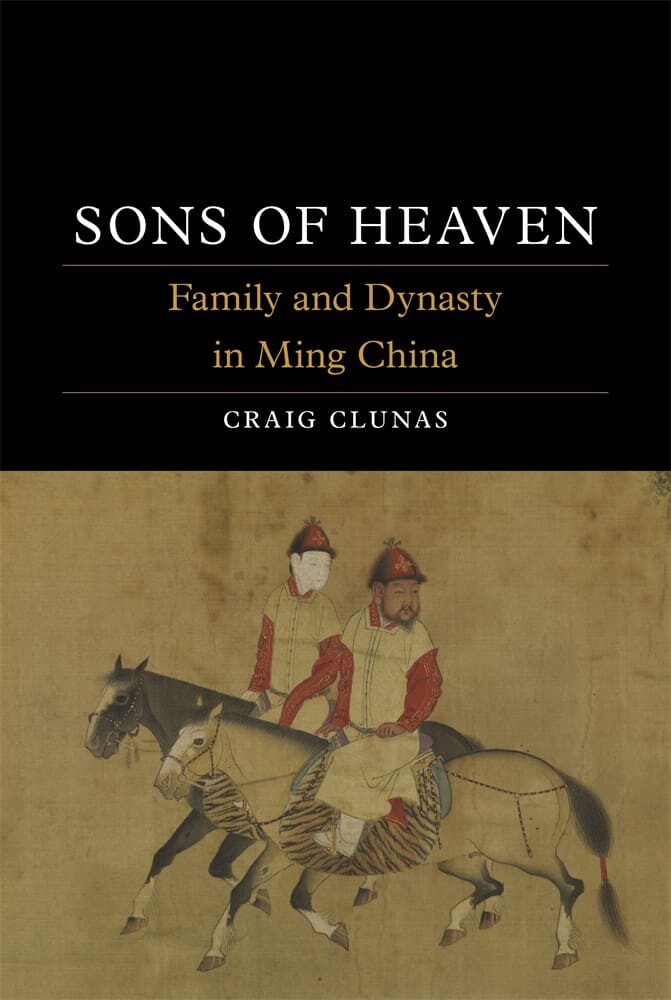
Craig Clunas’s Sons of Heaven: Family and Dynasty in Ming China is an accessible history of the ruling family of Ming China (1368-1644), tracing emperors, empresses, inconvenient number of uncles, and other relatives and associates through marriages, succession struggles, and court life. Drawing on official records alongside private histories and gossip-rich notebooks, it follows the relationships through which a household governed an empire—perhaps a Chinese period version of Succession. Yet the abundance of stories about the protagonists does not necessarily lead to understanding. Clunas cautions that “the imperial family arguably remains something of a historiographical black box.” This is not simply a matter of missing evidence: historical accounts routinely blame the emperors and their relatives for the dynasty’s failures while denying them credit for its successes. He quotes one leading Ming historian’s assessment of its successive rulers, ranging from “murderous” and “doltish” to “debauched” and “ineffectual”. An impressive family résumé, though hardly an explanation for how this apparently disastrous household managed to stay in power for nearly three centuries.
What, then, makes a dynasty? Clunas questions the term’s apparently settled meaning as a succession of emperors, a patriarchal lineage, or a stretch of historical time. Alongside the vertical line of inheritance, he examines the “horizontal dynasty”: wives, mothers, siblings, and relatives by marriage, through whom power was distributed, alliances secured, and membership policed. The dead were never entirely dead; they belonged too. Ancestors retained claims upon their descendants, making ritual obligations part of government. The title “Son of Heaven” placed even the sovereign within a relationship: his authority depended upon Heaven’s favour, while his ancestral obligations bound him to the family’s past.
Clunas asks whether the Great Ming might be understood as a “sociocosmic order”: not merely a state occupying territory or a dynasty unfolding through time, but an interconnected world in which political authority, kinship, ritual, and cosmic relationships formed part of the same hierarchical order. Such a perspective unsettles the modern separation of nature and culture, space and time, without requiring us to abandon the term “dynasty” altogether. To belong to the Ming was thus more than to inhabit a political territory or live under a ruling house; it was to occupy a place within a wider network of relationships and obligations, some extending beyond death.
Those obligations also shaped the historical record. “At the risk of boring the reader wishful to get to the story itself,” Clunas acknowledges, “some account of sources is necessary.” The Ming Shi-lu, or Ming Veritable Records, were generally compiled under a deceased emperor’s son and formally approved by him. Filial piety placed limits on how harshly a father could be judged, encouraging a portrait of a broadly competent ruler. Originally, access was restricted to the highest echelons of court and government, but by the late 16th-century manuscript copies were circulating more widely among educated elites and informing private historical writing. Relations between living fathers and sons had another, rather grimmer safeguard: as Clunas observes, many Ming emperors died too young for such conflicts to develop fully. A family drama, then, but one whose surviving scripts were shaped by obligations to the dead as well as relations among the living.
The imperial family was not simply inherited; it had to be made and continually remade. Zhu Yuanzhang (1328-1398), the Ming founder, bestowed grand titles on his impoverished ancestors, transforming a peasant lineage into an imperial one. He commissioned paintings recalling his youthful hardships while replacing silver-gilt vessels in ancestral temples with solid gold. Humble origins were to be remembered in suitably imperial surroundings. Marriage secured political and military alliances, yet kinship offered little protection against suspicion and violence. All the emperor’s sons were recognised as legitimate offspring, although their claims to succession were far from equal. A spare, however—to borrow the title of Prince Harry’s memoir—did not necessarily accept the job description. When Zhu Di (1360-1424) overthrew his nephew in 1402, the conflict divided sisters and their husbands as well as uncles and nephews. Victory required not only the defeat of living relatives but the rewriting of dynastic time: the nephew’s reign was erased from the official calendar. The victor acquired the past as well as the throne.
The human costs of this political family were distributed with extraordinary unevenness. In Changsha, Hunan, the founder’s son Zhu Zi (1369-1390) and his wife killed themselves after her father and brother were implicated in a supposed faction and Zhu Zi was summoned to court. Marriage had made him politically useful; it also made him vulnerable. The founder I knew from local tales was remembered less for his family troubles than for a bloodbath. In these stories, Zhu Yuanzhang became “Zhu Hongwu”, known by his reign title, the emperor who “washed Hunan in blood”. One version has the devastation followed by the forced resettlement of people from neighbouring Jiangxi to replenish the population. His reputedly appalling face completed the portrait.
Women’s positions were no less unequal. Some could help determine the succession, as competing accounts of Zhu Qizhen’s (1427-1464) accession in 1435 suggest, yet ten palace women were compelled to die with his father and subsequently honoured as consorts. Disputes over kinship also reached beyond the palace. Zhu Houcong (1507-1567), who succeeded a childless cousin in 1521, refused to recognise his predecessor’s father as his ritual father, initiating a prolonged controversy over parental honours and ancestral worship. Across these episodes, Clunas shows how dynastic authority depended upon the continual regulation of ancestry, obligation, and historical memory. Yet the people who sustained that authority—or paid for it—often remain difficult to recover as individuals.
What room, then, remained for affection freely given? Clunas observes how abruptly childhood could give way to imperial adulthood, leaving scarcely an interval for adolescence. Marriage around fifteen could place a teenage emperor at the head of a household of wives and consorts, granting him political power and sexual access before he had much experience of either. His intimate life remained bound by expectations of succession, while his sisters and daughters faced marriages arranged for dynastic purposes. In my high school, romantic relationships were strictly forbidden, sternly labelled “premature romance”, and treated as the greatest threat to success in the university entrance examination. Teachers watched for boys and girls lingering alone together; hormones and curiosity proved less obedient. Could their imperial counterparts choose or sustain an attachment on their own terms? Even a passing, reckless crush—ordinary enough in anyone else—could become a matter of dynastic consequence.
Yet the difficulty lies not only in the constraints imposed upon affection, but in the possibility of knowing it at all. For instance, even my own family’s 20th century history in Changsha, Hunan, remains largely inaccessible to me, let alone its more distant past. Before I first went abroad and experienced something like an awakening, I scarcely recognised what lay behind the fragments I had heard. My mother was orphaned at five. My father, his father, and his grandfather murmured in anguish about the household’s decline and ancestors and relatives who had been “killed”, but preserved little material evidence. What remained was my father’s childhood memory of an instruction: “Burn it all! And run.” Records and wealth had been destroyed by the family’s own hands. They did not want their children to know too much, or to investigate why. While he was alive, my grandfather repeatedly offered an old saying instead: “Neither wealth nor poverty lasts beyond three generations.”
Clunas has noted elsewhere how an abundance of surviving texts can conceal the unevenness of what they preserve. Official accounts served political agendas; private writings could lend gossip the appearance of fact. Neither offers unmediated access to its subjects’ feelings. As he puts it:
No piece of evidence, whether it is a text or an artefact, presents itself to us with absolute innocence.
The popular Ming histories, scandalous tales, unverifiable sources, and modern retellings that first caught my attention offered the pleasures of knowing everyone’s business. Clunas makes me less certain that we do. What, after all, becomes of love when the family is also the state? The evidence may not permit an answer. As Clunas reminds us, “writing has its silences and its exclusions too.”
The book rewards reading for its erudition, narrative skill, and elegant prose. It does what history can do at its finest: make the structures of the past visible in the patterns of the present—the opaque entanglement of family interests with political authority, the manoeuvring for power, and the selective remembrance through which both are justified.