“Path of the Teabowl”
The teabowl–-or chawan in China and Japan—is a unique ceramic art form. It originated in China and is closely associated with the whisking and drinking of a sieved, finely powdered tea which gained popularity in the Song dynasty (960-1279). This type of tea is widely known through its Japanese name, matcha, and is now most closely associated with the Japanese tea ceremony (chanoyu) where it was introduced to Japan during the Kamakura period (1192-1333) by the monk Eisai (1141-1215).
As a receptacle for drinking whipped tea and the role it plays within a formal ceremony, the teabowl remains distinct from other tea utensils, such as teacups. The latter were primarily used later in more casual, everyday contexts for the drinking and enjoyment of steeped tea (sencha) which had become the most popular way of drinking tea in Ming dynasty China (1368-1644). By the nineteenth century, steeped tea had also achieved its peak popularity in Japan and was integrated into daily life.
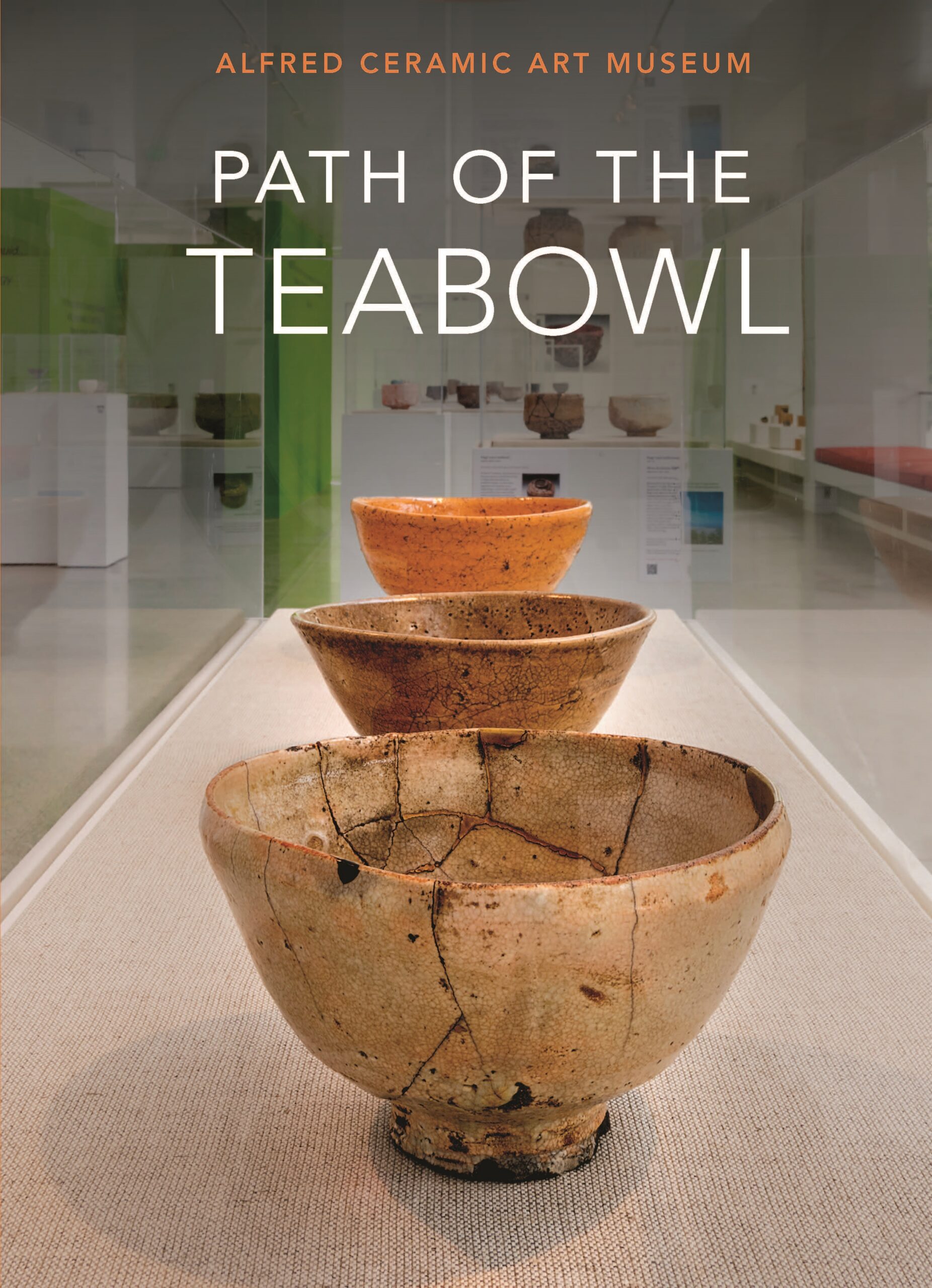
Path of the Teabowl is a companion volume to an exhibition held in 2021 and 2022 at the Alfred Ceramic Art Museum in New York and drew from public and private collections of over one hundred classical and contemporary teabowls made by Japanese, Chinese, Korean, American and European ceramicists. It includes eight informative essays covering the origins of teabowl production in East Asia and more recent global appropriations in addition to an extensive illustrated catalogue of the teabowls that were exhibited. Every teabowl featured in the exhibition has its own entry and most have photographs of them from different angles. Meghen Jones, the editor of the book and curator of the exhibition writes that the reason for the specific focus on the teabowl was to shine “a light on the historical, geographical, stylistic, and conceptual trajectories of this important genre in world ceramics history.” Indeed, the teabowl has constantly evolved for more than 800 years.
In 16th-century Japan, the teabowl was not the most coveted object within the tea ceremony; that honour went to tea leaf storage jars which in turn yield to tea caddies at the turn of the 17th century. But the teabowl ultimately came into its own and now many Chinese, Korean and Japanese teabowls are considered iconic art forms and have been labelled as National Treasures in Japan, something aided by the publication of the multi-volume Taishō meikikan (Taisho-era “Catalogue of Famous Vessels”) from 1921 to 1928 by Takahashi Sōan. In post-war Japan “teabowls came to be seen by many as distinctly Japanese cultural focal points epitomizing the Japanese aesthetic principles and ideology of chanoyu.”
In the 20th-century, Japanese ceramicists viewed the teabowl as iconic for two main reasons: its connections to historical material culture and as an avenue to explore more conceptual ideas.
The essays and illustrated catalogue often positions teabowls made by contemporary makers in dialogue with historical references. The catalogue begins with a sequence of black-glazed bowls with different surface decoration and effects. It starts from a possible Jizhou ware bowl from the Song dynasty and ends with two tenmoku teabowls made by Furutani Noriyuki ca 2017 and 2018. Tenmoku is the Japanese name for black-glazed ceramics which originated in China and were brought to Japan. They were named after Mount Tianmu, near Hangzhou, where monks drank tea from black-glazed teabowls to stay awake during meditation. Millions were made at kilns near Jian’an in Fujian province and were highly prized in the Song dynasty for how the whisked, white-coloured foamy tea contrasted against the black interior. ne of the most famous of the different surface effects on the teabowls was the delicate rust-brown streaks often referred to as “hare’s fur”. A favourite of Emperor Huizong (1082-1135), a representative example of Jian-ware hare’s fur teabowls is illustrated in the catalogue. The term tenmoku, meanwhile, is now used to describe black-glazed ceramics made by potters around the world.
The standout in the sequence of black-glazed teabowls is one made by Kamada Kōji (born1948), a living master of tenmoku glazes. It is a classic Song shape with rounded tapering sides and an indented rim; almost identical in form to a Jian-ware hare’s fur teabowl also illustrated in the catalogue. As Robert D Mowry discusses in one of the contributory essays, it was initially thought that the purpose of the indented rims was to “make them comfortable for drinking, the indentation nicely accommodating lips and index fingers alike.” However, recent research into Song texts has revealed that the indented rim may have created a ridge to assist with gauging how much water should be poured into the teabowl and to prevent the tea from splashing out as it was whisked. The glaze covering the teabowl is an iron-rich “iridescent spotted tenmoku glaze” and pools thickly towards the foot. It’s magical and mystical; the alchemy of glaze chemistry and an expert control of multiple firings in oxidising and reducing atmospheres for the silvery iron crystals to form. It’s not a glaze that has direct historical examples. Instead, Kamada uses Song forms as a canvas for his boundless experimentation.
The teabowl and Song ceramics also proved to be a source of influence for ceramicists working at Alfred University and North America throughout the 20th century. As discussed by Meghen Jones, in the decades after the Second World War, the teabowl “became an iconic object type of interest for studio potters, modern individuals commandeering often anachronistic methods of ceramic vessel production in pursuit of artistry and self-expression.” These ceramicists included Val Cushing, who taught at Alfred from 1957 to 1997 and would often create assignments for students to copy Chinese brown- and black-glazed teabowls. Ruth Duckworth lived and worked in the United States from 1964 until her death in 2009. A beautifully poised porcelain teabowl by Duckworth is illustrated in the catalogue and is said to have a glaze that recalls “the purple-green Jun ware of Song dynasty China”. Its form also recalls Song ceramics, with its wonderful symmetrical proportions. The walls curve outwards and upwards at just the right angle from a small and perfectly formed foot.
The breadth covered in Path of the Teabowl is commendable, and overall it is a valuable publication for understanding and interrogating the historical trajectory and contemporary ideas of the teabowl. Some of the essays have been repackaged from previously published articles and books so may be familiar to those who already have some familiarity with the subject. However, its richly illustrated catalogue and the featured ceramicists’ reflections on what a teabowl is will interest general readers, academics, and collectors of teabowls and contemporary ceramics alike.