“Eisen” by Guzel Yakhina
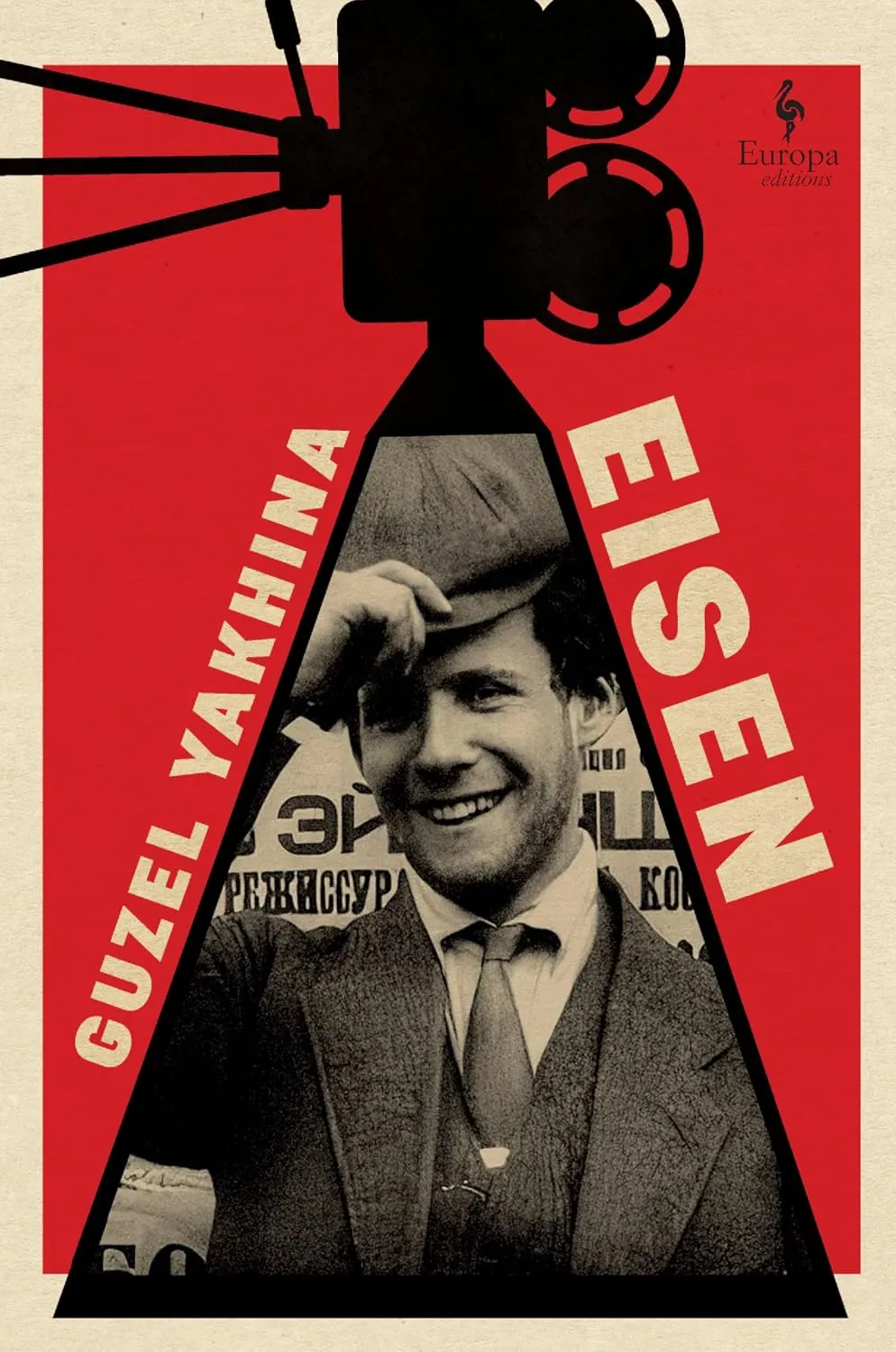
Award-winning Guzel Yakhina’s latest novel is a fictionalised life of the great (and infamous) Soviet filmmaker Sergei Eisenstein (or Eisen as he was familiarly known). Readers’ knowledge of Eisenstein may extend only to his 1925 silent film Battleship Potemkin and the famous scene of the baby carriage careening down the long Odessa Steps. I was shown it in school at a time when it wasn’t quite yet ancient film history; the amount of time that separated my viewing the sequence and its filming was less than the time that separates us today from the first Star Wars film. It was, and remains, remarkable.
It takes well over 500 pages for Yakhina to trace Eisenstein’s life from beginning to end, and what a life it was. Coming of age in the run-up to the Revolution, Eisenstein’s first love is the theatre:
But neither the fall of the Russian monarchy, nor the collapse of the empire, moved him. Rather, he was gripped by the world of the theater. It was Evreinov, Tairov, Meyerhold—and not the Romanovs or the Ulyanov-Lenins—who enthralled him.
Not just any theatre then, but revolutionary, avant-garde theatre. His predilections and skills lead him almost inevitably to film. Yakhina details his initial forays into the medium, Strike and most notably Battleship Potemkin, and the rapid international acclaim that follow. The narrative turns on Eisenstein’s failed sojourn in Hollywood and the ambitious aborted film project in Mexico, marking a major shift in both his style and his relations with the Soviet government. The final chapters cover his return to the Soviet Union, his struggles with state censorship, his work on major historical epics like Alexander Nevsky and Ivan the Terrible in the shadow of World War II, and his premature death.
Taking the novel at face value, there is much that is illuminating. For those conditioned to Cold War views of the USSR, it comes as something of a shock to have a Soviet film director engaged to make a Hollywood film and to be funded by Americans to make a film in Mexico. The past, as they say, is a different country. But this is a novel after all, not a biography, and Yakhina’s liberties extend beyond re-imagined lost scenes from the films and, of course, the considerable novelistic dialogue. Rather than being an ever-present intervention in his professional life, Eisenstein’s mother had in fact decamped to Paris. Neither did Americans (as far I was able to determine) send Kodak film to Kazakhstan under Lend-Lease for the filming of Ivan the Terrible.
What interests Yakhina, however, is the man, quite explicitly, as she writes in an author’s note:
This book is my hypothesis about Eisen’s personality. It is the protagonist himself who determines its structure, language, and style. The registers shift constantly, swinging from tragic notes, to humor, satire, and the grotesque. From dynamic, cinematic scenes, to meditative ones.
Whether the character she has created is accurate or not, it is certainly compelling, and grotesque. But Yakhina (who went to film school after a stint in PR) seems just as interested in film-makers and filmmaking. The portrait of cinematographer Eduard Tisse is almost as detailed at that of Eisenstein:
The camera loved light more than anything else on earth. Therefore, Tisse loved it, too. All the cameraman’s work came down to hunting for light: diffused, penetrating, or overflowing. He sought out individual rays, sculptural sheaves, or projectiles of light. How much light there was in the world! And how difficult, at times, to catch it, to imprint it. But Tisse knew: even in the darkest room, there is light. You just have to know how to see it.
Cinematography and film-studies extend to the novel’s structure. Yakhina writes that she has
Eight “Eisen” chapters—the same number as the number of films created by him, albeit not all preserved in their original form. The chapters of the book (nine altogether) take their names from cinematic milestones (corner-stones?) of the last century.
The writing, meanwhile, is meant to mirror Eisenstein’s celebrated cinematic “montage” technique of cuts and contrast.
Chopping up the celluloid, cutting out chunks of someone else’s work to make it his own, was captivating. So many things were suddenly at his fingertips: actors, whose figures flickered in the squares of the frames, scattered under the table like so much rubbish.
The result is a vibrant, unstable narrative that often has the feel of a pin-ball machine, or, indeed, one of Eisenstein’s early films. All has been ably translated by Polly Gannon, who has even made the poetry rhyme.
Nimble and loud
amid the wood,
the extras on stage
trampled it good.
Eisen is also—how could it not be?—a story of totalitarianism. Eisenstein is himself both a victim and a collaborator. He is allowed to make the films he wants only insofar as they, and he, are useful to the state. This is occasionally absurd: the highly popular anti-German allegory Alexander Nevsky had to be withdrawn soon after its release due to the signing of the Soviet-German non-aggression pact in 1939.
Soon after the treaty was signed and Nevsky was withdrawn from screens, Eisen was approached with an offer to stage Richard Wagner’s opera The Valkyrie, in the Bolshoi Theater… Without a second thought, Eisen agreed.
One suspects that Eisenstein retains more resonance in Russia today than he does internationally, and Russia has an increasingly complicated relationship with its Soviet past. Yakhina herself publicly opposed Russia’s invasion of Ukraine and left for Kazakhstan (where, coincidentally or otherwise, Eisenstein was evacuated during World War 2 to film Ivan the Terrible).
In the interests of transparency, I’ll note that I met Yakhina when I was flown out to the Moscow Book Fair in 2016, ie well before the invasion at a time when Russian publishing seemed relatively free. Today, given Eisen’s portrayal of Soviet authoritarianism, one is somewhat surprised to find the book published and reviewed (sometimes favorably, sometimes not); even more surprising is that Yakhina was able to visit her home town of Kazan (she is of Tatar extraction) for a book talk in December of last year. Eisen is a reminder that even black and white films have shades of gray.

