Old post
This post was published before January 2026. Some links, images or other content may no longer display or work as originally intended.
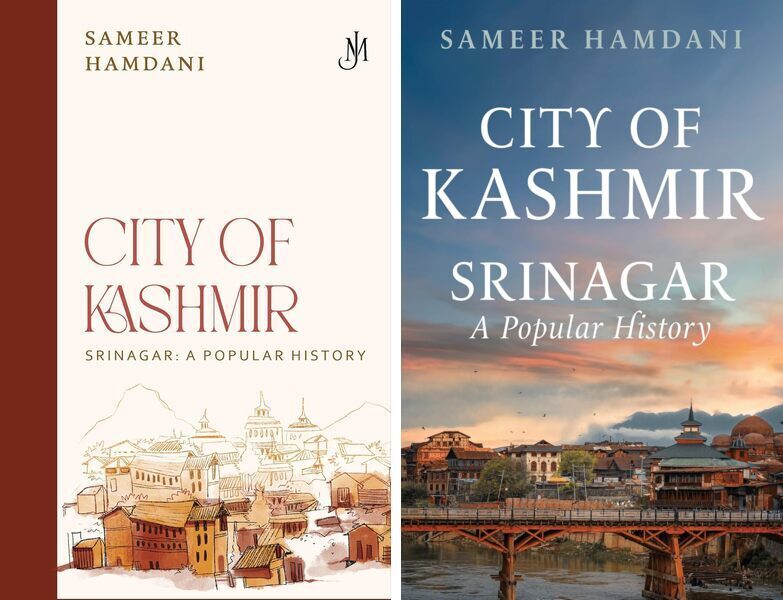
“City of Kashmir: Srinagar, A Popular History” by Sameer Hamdani
Ringed by a snow-coated massif, the Dal Lake shimmers under the bright sun as the shikara canoes skim over its iridescent waters: this snapshot of Srinagar is almost ubiquitous on the Internet. Millions of vacationers who visit this place every year to unwind probably imagine this city as little more than a summer retreat.
Occasionally, when strife escalates in this deeply contested region, journalists might fly in to report on the violence, racing through the city’s warren-like neighbourhoods, amid checkpoints, military bunkers, and the seaweed-green Cassipers mounted with turret guns.Few have had the time or resources to contemplate the city beyond these jarring binaries.The highly dense, if compact, portrait of Srinagar illuminates the historical cosmopolitanism of the city,
But “there is another side to Srinagar,” writes art historian Sameer Hamdani in his new book City of Kashmir: Srinagar, A Popular History. “It is also a city that thrives and promotes cultural and social synthesis and sustains a vibrant community life.” Going beyond the broad brushstrokes of war and peace, the book reintroduces readers to one of South Asia’s major cities, one that sits astride major civilisational nexus in the region: China in the Northeast, vast steppes of Central Asia to the North, the Pamirs in-between, and the Indian plains further South.
Being at the crossroads of many major empires of the past, has allowed Srinagar to absorb cultures, ideas and traditions that have travelled great lengths across diverse geographies.The Srinagar that Hamdani reassembles is steeped in the interlaced histories: a city that witnessed the horrors of the marauding Mongol armies in 14th century, borrowed its art and architecture from the Hellenistic world of ancient Bactria between 1st and 4th centuries, paid tributes to the Tang Emperor in China in 8th century, and built great stone temples in the early medieval period that rivalled those of the Gangetic plains.Moving back and forth between written literature, memory and testimonies, Hamdani’s narrative brings this layered history alive. He punctuates his account with detailed descriptions of the major historical monuments, and draws on the information harvested from the rare manuscripts pining away in the musty shelves of the Srinagar libraries. The book is replete with anecdotes he collected through his work as a heritage consultant in the city for more than twenty years.Hamadani’s narrative doesn’t just linger around the city’s Muslim past.
The result is a highly dense, if compact, portrait of Srinagar that illuminates the historical cosmopolitanism of the city, the evidence for which can come, among other things, from the many medieval-era funerary steles of which there are many strewn randomly across the city. The author has translated their Persian inscriptions; one of these discusses a scholar of (Ottoman) Lebanese ancestry, whose grandfather was a high-ranking official with the Shah of Safavid Iran, and is later employed by the Mughal Empire of India, before he resettles in Kashmir. The author is tempted to see this as an example of the journey of knowledge across “three of the greatest Muslim empires of the early modern age” and of which Srinagar became a recipient.
During his research, Hamdani also chanced upon a rare illustrated folio of a 19th century Chinese bill, likely a pamphlet for a silk merchant in Suzhou in China, upon which has been scrawled Persian verses from the divan of Hafiz Shirazi, the lyric poet of 14th century Persia, exemplifying Srinagar’s mercantile connections with regions as far off as China.Hamadani’s narrative doesn’t just linger around the city’s Muslim past but also looks further back through the period when Kashmir was overwhelmingly Hindu. He describes the rise of Vaishnava Hinduism in Kashmir under the Karkota dynasty in the 8th century and how its kings created a “Hindu habitus” in the region, driven by the arrival of Brahmin priests from the Gangetic plains down South. The Karkotas’s military expansion of the Kashmir kingdom brought them into conflict with the Tibetans, and later the Abbasids, forcing them to seek a military alliance with the Tang dynasty in China under Emperor Xuanzong (reigned 712–756), a development which the author interprets as their becoming a vassal.Among the Hindu priests who found home in Srinagar, and turned the city into a Brahmanical heartland, are the ancestors of the Hindu sage Abhinavagupta, who recorded their experiences in Tantraloka, a celebrated 10th century treatise on Hindu ritualism, in which he calls Srinagar, the “city of the God of wealth”.Hamdani writes about a discovery in the early 20th century when efforts to link the city—being redeveloping under British auspices—to a clean water source, led diggers to uncover a large mound of bricks at Harwan, the large expanse of hills and forested ridges abutting the city. These turned out to be the remains of a Buddhist apsidal temple, a stupa and a monastery. Those excavations yielded terracotta tiles with ancient motifs, neatly sculpted busts, and more, supplying, for the first time, “a life-like representation of the features of those mysterious people”, the Kushanas, who ruled large parts of Asia, from the Aral Sea in what is now Uzbekistan to Sanchi in India between the 1st and 3rd centuries.These discoveries affirmed Srinagar’s important role in Buddhist missionary activities along the historic Silk Route. Hamdani writes about the peripatetic Kashmiri monks travelling to China and “serving as translators of major Buddhist texts.” One of them, Gunavarman (367–431), went to Java, and secured the conversion of its Hindu ruler to Buddhism before being invited to China by Emperor Wen (r. 424–453) of the Liu-Song dynasty, where he became a translator.The City of Kashmir brings to life the vibrant cosmopolis that Srinagar once was.
Hamdani’s non-linear narrative zips back and forth between past and present, often centred on a particular place, artefact, or person, an approach which no doubt reflects his background as an art historian.
Politics, of course, intervenes. For decades, the memories of Mughal rule over Kashmir had been of subject heated disputes, with 20th-century Kashmiri leaders such as Sheikh Abdullah having characterised the period as the origin of Kashmiri “servitude” to the larger Hindustan empire—a point that still echoes in arguments over Kashmir’s current status. Hamdani, however, appears to wish to steer clear of these politicised narratives. Instead, he calls the Mughal period a “unique cultural time” for the city.