“Handkerchief” by Memduh Şevket Esendal
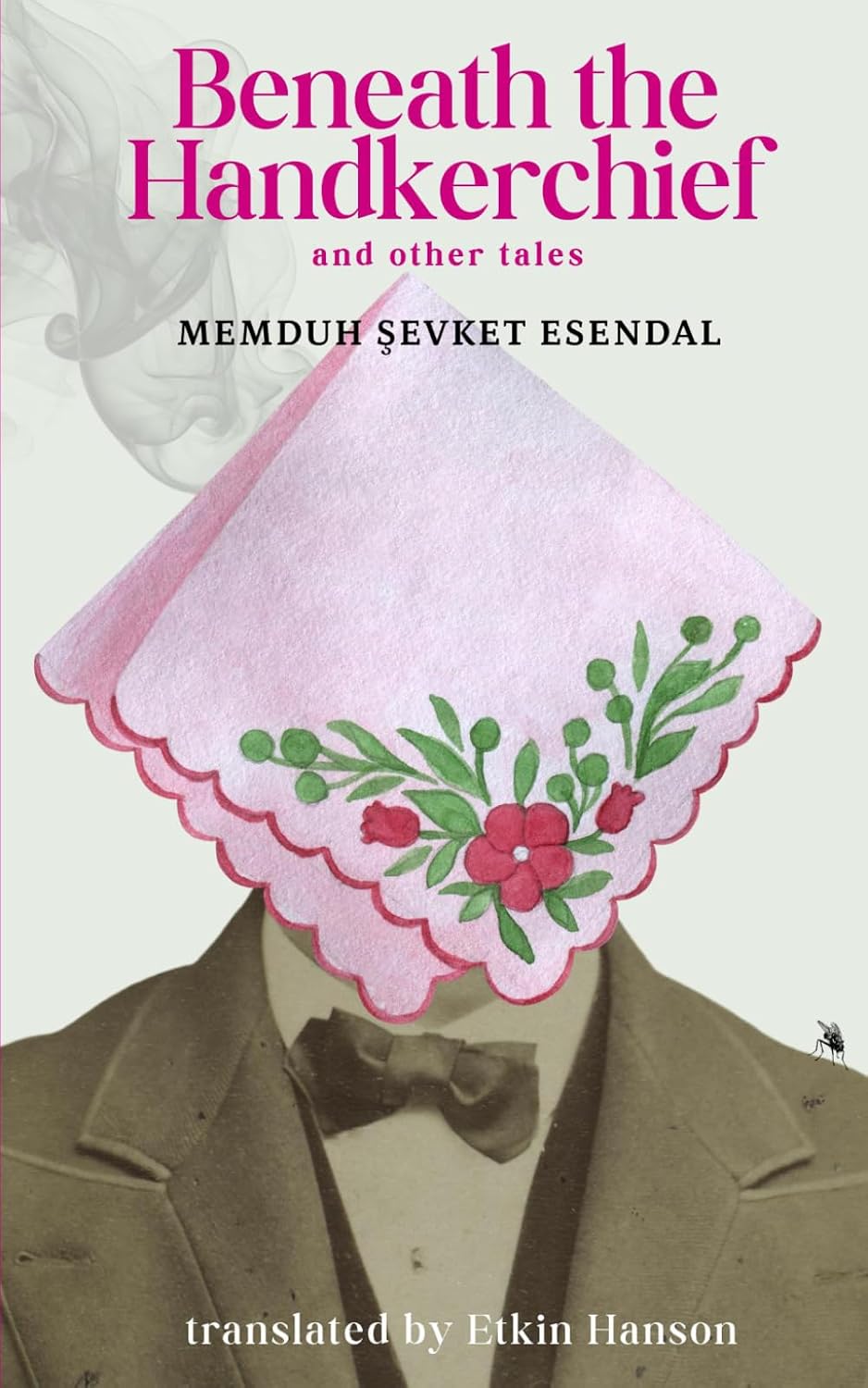
Memduh Şevket Esendal may be the most famous Turkish writer most English speakers (including this one) have never heard of. In Turkey, however, people will have come across him in school where he has long had a secure place in Turkish textbooks. This has not however always worked in his favour: to paraphrase from translator Etkin Hanson’s introduction, the curriculum is where writers go to die. “For most of the twentieth century,” she writes, “Esendal lived in this curious half-light: a name everyone in Turkey knew and very few read, the textbook ghost.”
The short stories collected in Beneath the Handkerchief date from the 1920s to the 1940s. Not all are dated; those that are tend toward Turkey’s first decade as a republic after the fall of the Ottoman Empire. They are of a time (and in Turkey, a very specific time), and Hanson has maintained a period tone in her translation, a sort of literary equivalent to a Beyoğlu antique store.
A hot summer’s night outside a neighborhood coffeehouse. A stone terrace out front, set up like a little garden. In the middle, a small pond surrounded by a bit of grass and henna plants, with soda bottles cooling in the water. At the windows, moonflowers and strings that stretch between panes for telegraph vines to climb up. Ledges are lined with shallow, white-washed tin cans planted with geraniums.
The volume is most likely to appeal to readers with some familiarity with that milieu. More than a few stories deal with the issues unique to the period, such as the requirement that all Turks take a surname, Turkish language reform (which aimed to purge the Turkish of Arabic and Persian-derived words and grammatical rules) and the new country’s new borders and republican order. Most are humorous, making fun of social mores and hypocrisy, but Esendal is usually gentle rather than sharply satirical.
A good number of the stories are very short indeed, just a handful of pages, vignettes really, too short for much of a narrative arc, even if Esendal intended one. His focus, says Hanson, was to set down “slices of life”. The stories are about a situation, an idea, a passing feeling rather than plot or dramatic development. For this, Esendal has been labeled “Chekhovian”, a comparison that can in fact be rather hard to discern. Hanson herself notes an affinity with “Nasreddin Hodja, the Anatolian folkloric wise fool who rides his donkey backwards and delivers parables in the form of jokes,” something which the author himself alluded to.
Esendal himself had a spell with Young Turks before the First World War, at the end of which he fled to Rome. He soon returned to take part in the Turkish War of Independence, and in 1920 was appointed as the new Government’s first diplomat; he served in posts in (Soviet) Baku, Tehran and Kabul. During his time in the USSR, he learned Russian and read Chekhov; any similarities, therefore, are not coincidental. One of the stories in this volume, “Madame Kuruner”, is set in the Soviet Caucasus, a result of his time there.
The title story is of a bureaucrat:
August. Friday afternoon. Cavit Bey, the Director of the Registry Office, finishes his lunch at home. Keen to nap, he stretches himself out on a floor cushion. The houseflies keep buzzing about and what flashes in his mind is the image of villagers stretched out against walls, handkerchiefs over their faces, sound asleep. Cavit Bey envies them. He reaches out to the chair, finds his jacket pocket, takes out a white linen handkerchief, and places it across his own face. Not caring how stifled he feels, he waits for sleep to descend.
It does not, however, and Cavit Bey instead descends into a stressful reverie about money and office politics.
“Two Visits” is one story which—in length and complexity—resembles more what readers might expect of a short story. It tells of two visits, nine years apart, by a mother and her two children, to the home of a retired military doctor, an old acquaintance of the woman’s husband. Not very much happens in the story, nor is there really any denouement to speak of; instead the doctor observes the changes in the visitors between World War I and the early Republican period, and touches on a number of topical issues: social uncouthness, changes in priorities, the fluidity of names (when people were choosing their own due to new regulations). The longer length of the story—it is by some margin the longest in the book—and lengthened chronology allows for deeper characterisation.
Beneath the Handkerchief can be read as a Turkish counterpart to other masters of the short story, or to help fill in the blanks left by later Turkish novelists and understand whence they emerged. This is a collection that should have been published long ago.