“To Rule All under Heaven: A History of Classical China…” by Andrew Seth Meyer
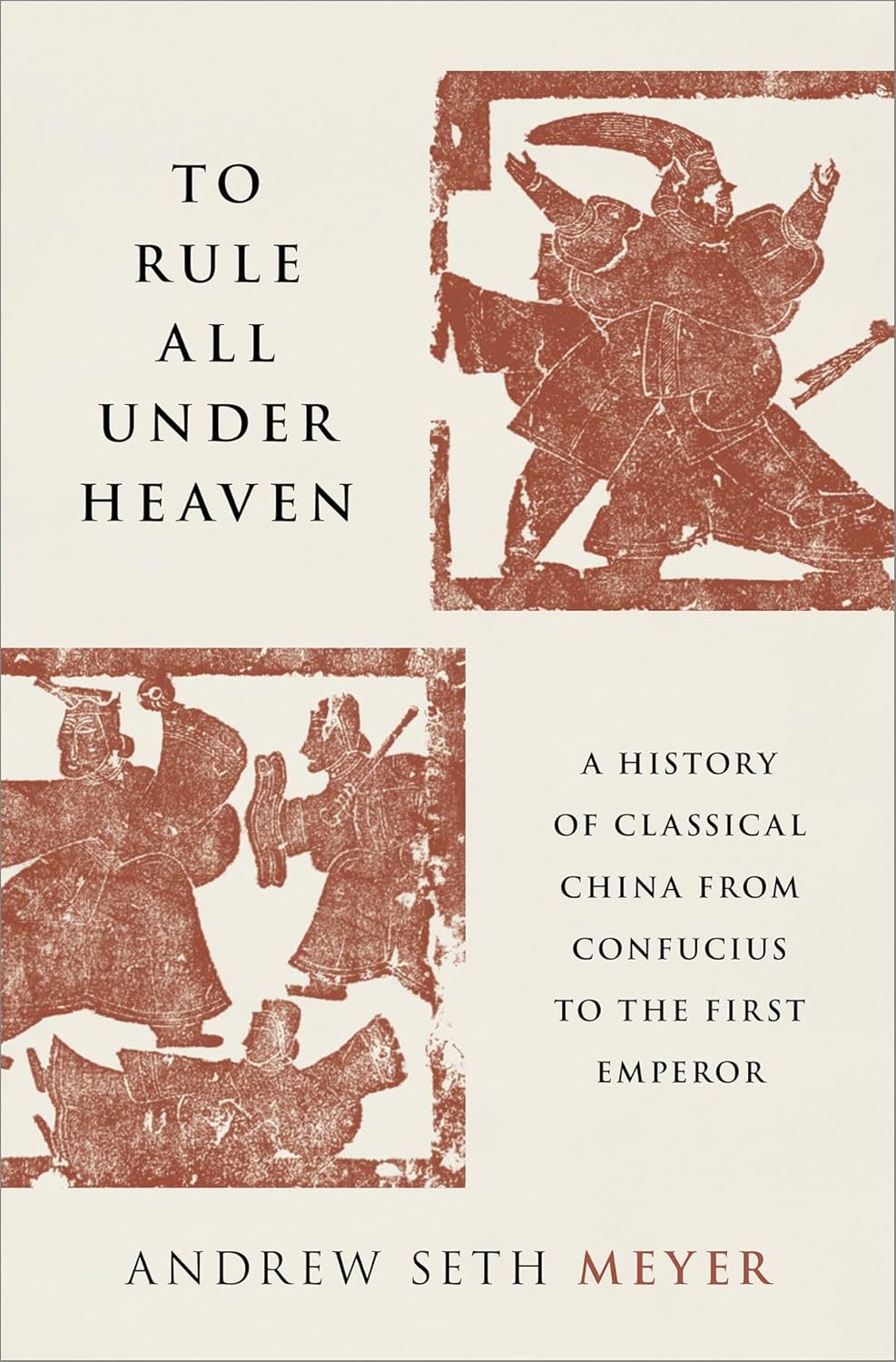
Many books about ancient Chinese history are written for those already in the know; there is a dearth of accessible narratives for the general reader. Happily, Andrew Meyer’s new book fills this gap. He skilfully recounts the Warring States Period (ca 470-221 BC), a chaotic era that followed the “slow moving crisis” of the Springs-and-Autumns Period (ca 770-475 BC), when eight hundred years of rule by the Zhou kings petered out to an inglorious end as “a loosely-organised oligarchy of warrior-priests” turned on their suzerain and then on each other. The last one standing, King Zheng, better known to history as Qin Shi Huang, then reorganised China into a massive empire and made himself the First Emperor in 221 BC.
Meyer tackles a complex story of rival clans and courtly intrigue in a clear, fluent style. While staying grounded in rigorous scholarship, he peppers the text with lurid details, from the assassin who dispatched a duke during a banquet with a sword hidden inside a giant steamed fish, to the mad King Yan, who kept carved figurines of his rivals inside his latrine for target practice. Meyer has been studying and teaching Classical China for nearly forty years, and his passion for the subject is evident.
He begins by explaining that “there is no single moment that can properly be called the beginning of the Warring States.” Instead, Meyer chooses the assassination of the Duke of Qi in his garden during a coup in 481 BC: an act that would have been shocking in earlier decades but was instead wearily accepted by an exhausted Zhou court, who by then had no army to give weight to their decrees. The duke’s death gave the green light for further coups, plots and murders across China, and the aristocracy jumped at the chance. Within a few decades, China descended into a general war of all against all as rival houses jockeyed for power.
China was much smaller then: the Yangtze marked its southern reaches, beyond which were only crop-haired, tattooed “barbarians” who neither ate wheat nor wore silk and therefore placed themselves beyond the pale to the literati of China proper; while to the north of the Yellow River valley was the nomad-haunted steppe, from which trouser-wearing horsemen regularly thundered. Though the decay began at the fringes, it quickly made its way to the heartland. The Zhou kings soon squandered what credibility they had left by elevating rough provincials to high office, legitimising usurpers, and then sitting by when in 334 BC, under the influence of a proto-hippie called Hui Shi (whom Meyer incomparably describes as the Timothy Leary of fourth-century BC China for his psychedelic mutterings), the Marquis of Wei made himself a king in a direct challenge to their authority, leading others to follow suit. Meyer draws a troubling picture of an aged system no longer fit for purpose slowly but irresistibly spinning out of control, as power-brokers probed to see what they could get away with and then recklessly enjoyed the fruits of their efforts, while their nemesis lurked just over the horizon.
In the case of the Warring States, it was the kingdom of Qin. A totalitarian state in the upper reaches of the Yellow River valley, Qin was at least partially barbarian in origin, and its early history was intentionally obscured by its rulers to disguise this, while their court upheld ancient rites on a grandiose scale, long after they had fallen away elsewhere, in the way that only overcompensating arrivistes could. Under the tutelage of the court philosopher Shang Yang, Qin perfected a fearsome surveillance apparatus that kept order with ferocious punishments, and grew rich off its colonies in Sichuan. It was an uncompromising system: even Shang himself eventually fell foul of his own decrees and was executed. Initially, the other states of the North China Plain looked askance at Qin, but just as 19th-century Europe, menaced by Prussia—also a new challenger from the frontiers, simultaneously aristocratic, militaristic and bureaucratic—could only become more Prussian, so they took on Qin’s trappings as its power grew and the zeitgeist shifted. Many aristocrats came to sticky ends when they found themselves on the wrong side of new military laws. Meyer singles out the knight in the state of Qi who came late to troop exercises because his farewell banquet ran over and was promptly beheaded for his tardiness pour encourager les autres. He was hardly alone: the Warring States rivals Byzantine history for the sheer number of inventively gruesome deaths, and it is easy to lose count of them in this book.
Eventually, the demands of constant warfare were too much. By the second century BC, all of the Warring States had been annexed or subverted by Qin, or had simply imploded. In the end, the Zhou dynasty died not with a bang but with a whimper, as its final sliver of territory was absorbed by Qin, much as the Holy Roman Empire was put down by Napoleon. As the last man standing, King Zheng overcame his scandalous past—he was probably the illegitimate spawn of a merchant, and his mother carried on a dangerous affair with a phenomenally well-endowed court jester who was later torn apart by horses–-and united China under his rule. He reorganised the heartland into new provinces, then added Sichuan, Hunan and Guangdong to his realm; standardised currencies and measurements; and introduced a universal script (modern Chinese is not far off). Finally, he moved the surviving aristocrats to his court in Xi’an, where he built palaces in the style of each conquered kingdom as a reminder of his achievement. Such accomplishments, he felt, were beyond the work of a mere king. Instead, he devised a new title for himself: huangdi. Typically translated as “emperor”, Meyer argues that this is an inaccurate transposition from western tradition, and suggests the somewhat clumsy hybrid phrase “August Thearch” instead, explaining its etymology and roots in Chinese mythology. But whatever the man born as Ying Zheng called himself—King of Qin, First Emperor, or August Thearch—his was a paranoid, brutal rule, and the Qin Dynasty survived barely five years after his death (from drinking mercury in an attempt to achieve immortality) before civil war returned. Yet afterwards, his successors would maintain the empire he forged and the institutions he created. Modern China is, in many ways, still made in his image.
The Warring States was a colourful, bloody, confusing time, yet it is also China’s own “Classical” age, seen by Chinese audiences the way the Golden Age of Athens is by Greeks. Its famous names and stories have been cultural touchstones for millennia, and frequently crop up in speeches by today’s leaders. It is certainly a period worth studying, and Meyer’s book is a fine place to start.