“The Seekers of Deer Creek” by Thao Thai

Inter-War Paris was a mecca for artists from around the world, including East Asia and, in particular, the then French colony of Indochina. Thao Thai’s new novel, The Seekers of Deer Creek, centers around a fictional Vietnamese painter and a portrait he created decades ago. The story is part mystery, part family drama, but it’s Thai’s writing on place and that art sets the book apart.
As the story begins, sisters Vivi and Calla are mourning the sudden death of their father after he suffered a fatal car crash. This loss is especially difficult because their mother disappeared when the girls were very young, so for many years their father was their sole parent. Children of Vietnamese immigrants, Vivi and Calla grew up in a small Wisconsin town called Deer Creek. After studying at a fictional liberal arts college in the Midwest, both sisters go into the fine arts, Vivi as an art conservator and Calla an art historian. After their father dies, Calla learns that he kept reproductions of every painting from an early 20th century surrealist painter named KP Lý. Coincidentally, the Chicago gallery where Vivi works recently acquired a Lý painting titled Blue Mirror. Vivi understands the significance of this painting of two women, one Vietnamese and one European.
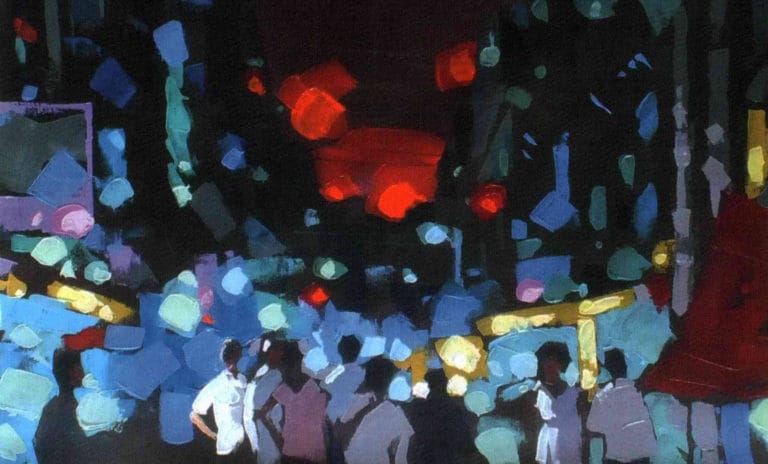
Blue Mirror was the first and only work of portraiture by Lý, named by historians for the tactile streaks of blue dominating the painting. The blues were broken by an ominous trail of red dividing the women’s faces. Scholars guessed that Blue Mirror was painted sometime in the 1930s, before Lý’s final disappearance in 1943, making it one of his last—and most inscrutable—works.
Calla also finds a sketch of this painting in her father’s barn, along with an unsigned letter that is not addressed to anyone specific. But it’s clear that the letter dates from Lý’s time and was most likely written by him. Meanwhile, an incident at work leaves Vivi facing a period of administrative leave just as she and Calla learn about their father’s interest in Lý. The two sisters decide to set off to Europe to learn more about the mysterious Lý and why their father, who never exhibited any interest in art, seemed so interested in his work.
In any event, Vivi and Calla are each experiencing relationship troubles, so it seems a good time to leave it all behind and fly to France to look for clues about Lý’s work there. They find that Lý spent time in Arles to visit the sister of his Paris agent. The scenes in Arles are particularly evocative.
It was evening and the bats were clicking in the trees, the sharp points of their wings slashing against moonlight. In the distance, cathedral bells rang. Nine, ten, eleven. She peered past the edge of the gates to the empty road beyond. The trees were a scribbled mass.
The final stop in the sisters’ search for the meaning behind the painting and Lý’s final days takes place in Vietnam, starting in Ho Chi Minh City. It’s the first time Vivi and Calla visit the country and they take to it as if it were home.
Calla thrived within the slurry of chaos and activity at the market. The hall was packed with locals and tourists reaching over one another for the best wares, small dogs weaving between their legs. The tall ceilings were vaulted, the lighting glaring. Plastic fans were affixed to the frames of each stall, whipping about the smells until it was impossible to distinguish them.
The main purpose of their trip is to visit their parents’ home city Long Xuyên, which provides many more answers to their family history. Thai doesn’t tie up all loose ends by the end, which seems a refreshing way to conclude a story that often reads like a fairytale well before it became formulaic.