“Exquisite Things and Strange Wonders” by Amir Khusraw Dihlavi
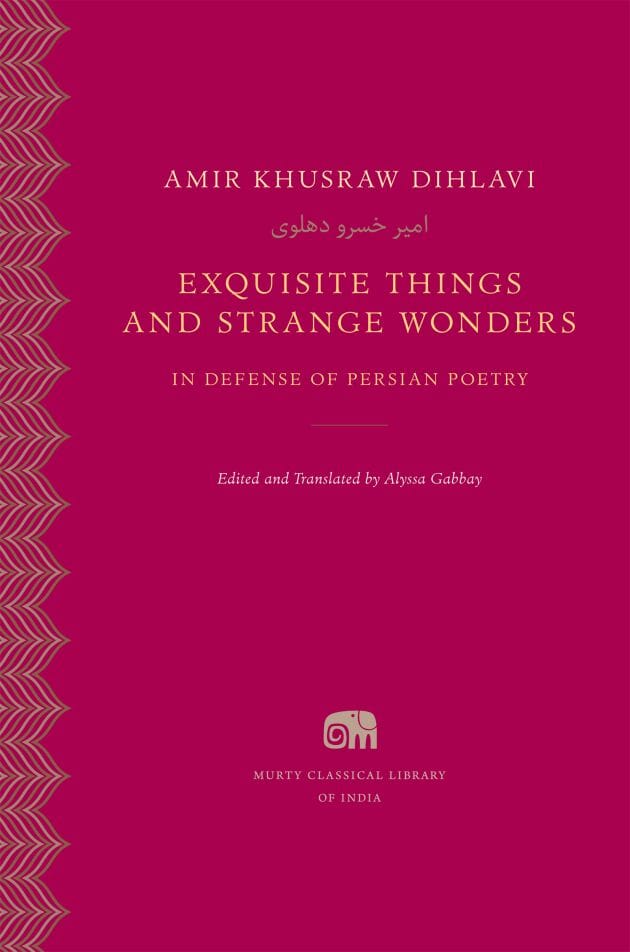
Classical Persian literature offers very few autobiographies. We tend to admire the works of great poets in that tradition, in this case Amir Khusraw, without knowing much about them as individuals. If Khusraw’s poems are like flowers, “Exquisite Things and Strange Wonders” shows the gardens where the flowers grew. Alyssa Gabbay’s fluid translation brings to life the Indian song bird, as he called himself, letting us judge him on our terms or his.
The 13th-century Delhi Slave Sultanate (so-called because its rulers rose from the ranks of enslaved Turkish military personnel) enjoyed a period of peace and prosperity while the rest of the Islamic world suffered the depredations of the Mongols. Badghdad went into eclipse, and Delhi rose up like a new moon. Persian had been the language of its court already for three centuries, and would remain so for another five or more.
In the febrile atmosphere full of refugees from the Mongols, a nine-year old boy extemporized a poem for a princely audience. “While losing my baby teeth I spilled pearls of eloquence from my mouth,” Khusraw recalled. Patrons rewarded him for his praise poems. He gravitated to ever higher-ranking protectors, until finally the sultan himself made the 34-year-old Khusraw his boon companion, a post he enjoyed under several rulers for the next 35 years.
Never resting on his laurels, the poet produced a huge catalogue of works, praise poems, mystical and exotic epics, and amatory poetry. While unconfirmed, tradition also credits Khusraw with inventing new musical modes and composing poetry in an early form of Hindi. All this production made him almost single-handedly the founder of Indo-Persian literature. This tradition lasted until the 20th century, embracing practitioners of every faith and race on the subcontinent.
For Khusraw, literature is not simply a means of prising rupees out of the good and the great. Speech, he writes, is what distinguishes men from animals. Simple people risk animality, lacking mastery of (elegant) speech. Scholars need years to acquire wisdom from scientific prose. Only the poet encapsulates wisdom in a pleasant and memorable form (with rhyme and rhythm), making it accessible to everyone. This formulation will hit home to anyone who has heard a taxi driver in Tehran quoting Sa’di, or a tuktuk man in Delhi quoting Ghalib. Khusraw also sets his poems to music, to make them even easier to retain. In particular Khusraw asserts the value of Persian literature over Arabic, despite offering honorable mentions to the great poets of that tradition.
He proceeds to reveal his art in a series of dazzling examples of word play, acrostics, numerology and visual puns based on the letters of the Persian-Arabic alphabet. This part of the book is heavy going in English, because the fireworks are confined to the Persian text on the facing page. Gabbay soldiers through this by providing as many explanatory notes as possible.
When Khusraw takes up the thread of his autobiography, the mask of the master word magician slips off. He reveals, first, unbounded ambition and supreme self-confidence. He is the greatest poet Islamic India has ever known. His detractors are likened to dung beetles. He vaunts his work ethic, and contrasts it with the dilettante efforts of poetasters who show up to literary gatherings with half-baked and unoriginal compositions. He warns:
“If all could judge their poetry/ they’d call themselves all Sa’di
The diver finds pearls in the sea/ the jeweler determines its rarity.” [reviewer’s translation]
His self-acclaim comes very close to blasphemy when he compares himself to Jesus and asserts that Meccah should circumambulate Delhi, the new holy city. Then suddenly, as though he feels he has gone to far, he belaunches into an extensive autocritique, confessing some underlying hypocrisy:
I, Khusraw, who am a merchant of little capital in this bazaar full of writing, have offered up for sale some of the base goods that I had in my leathern bag. In accordance with the custom of attracting buyers, I called a Zanzibari a houri, and darkness light.
To ward off divine disfavor, he proclaims devotion to and seeks protection from the great Sufi saint of Delhi, Nizammuddin Awliya (whose shrine is still revered and where Khusraw’s praise poems are still recited). One might have hoped for some biographical insight into how the poet and the saint met, but this is lacking. He closes his autobiography on a note of penance, confessing the futility of glory and poetry, disowning the grand claims he made earlier in the book.
Oh God, in this book of lies I have made bold with your words of truth, and I know that I have done an ignorant thing.
He hopes, in closing, to be united after death with the righteous.
Amir Khusraw comes across as a protean fellow, changing moods and modes like the waxing and the waning of the moon. For students of Medieval India, this is as close as one can get to the court of the Slave Sultans, with all its verbal and visual splendor, the shoots and ladders of social ascent and disgrace, and the bitter competition for favor. Out of this frenetic atmosphere, the song bird of India found his voice.