“Female Life on Planet Earth” by Laleh Khadivi
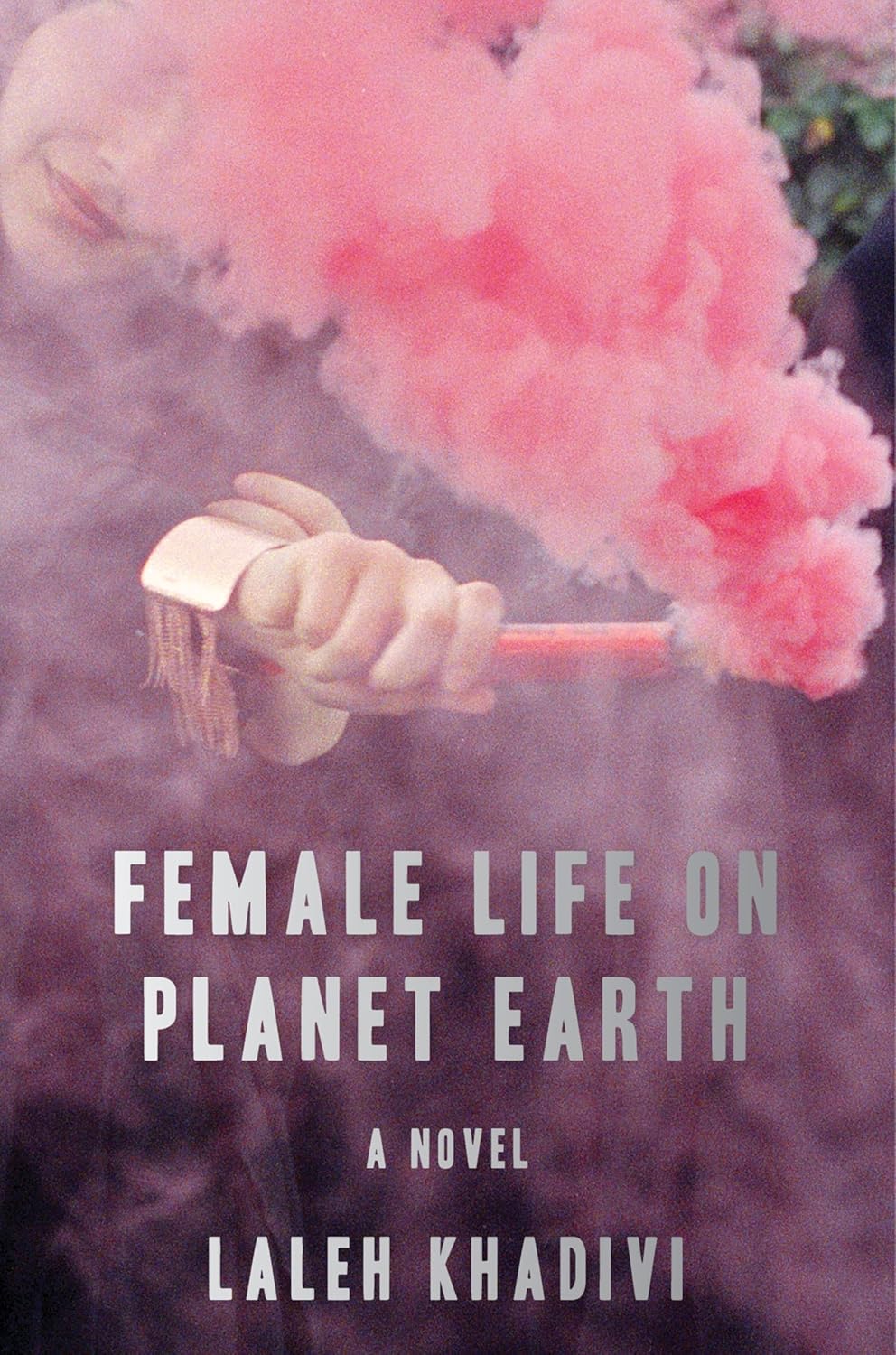
Author Laleh Khadivi is best known for her “Kurdish Trilogy”—The Age of Orphans, The Walking and A Good Country—which explores the lives of three generations of migrant men and their experiences in the United States. The Iranian-Kurdish-American writer describes them as “books written in the voice of men about men’s worlds”. Her new novel, set among the Iranian diaspora in Los Angeles, is an abrupt change; it instead investigates female diasporic experience and the many worlds of women, their secrets and silences.
Heti, a comfortably off accountant, with a supportive, well-meaning husband and two daughters, is faced with the death of her beloved mother, Anahita (Ana). Heti is so well-integrated into secular America, she struggles with traditional Iranian customs for mourning, but her aunt Lily insists:
One year after the death you throw a party. They say grief needs a turn of seasons—one summer, fall, winter and spring—before the sadness lets go. If you survive the year, you celebrate… People have to see that it’s you honoring your mother’s memory. She was my sister, but she was your mother.
This traditional year of Iranian mourning (Sâl-e Marg) supplies the four seasons that divide this book into sections: Spring; Summer; Fall and Winter.
However, if Heti already feels lost over how to mourn, then any normality is shattered when she receives a mysterious package of photographs of her late mother from England, sent anonymously by someone called “A.” Two photographs and a newspaper clipping of Ana in her youth destroy all Heti’s assumptions. In one, Heti’s mother wears a black chador (the traditional full-body cloak and head covering worn by Shia Muslim women in public), while “a machine gun is slung easily over her shoulder”. In the third, a newspaper clipping, Ana, similarly attired, is shown with her gun terrifying a “half dozen women gathered in disorder before her, their miniskirts uneven on their hips, rips in their tight sweaters, their hands bound behind them in handcuffs”, while “a single body lies in a lump, turned away from the camera”. The fate of these Iranian women remains unknown.
Heti faces a terrible possibility. Was her kindly, law-abiding mother, who in America worked for a jewellery store, once a member of the “Basji Sisters” militia (Basij-e Khaharan), the feared Iranian revolutionaries, established by Ayatollah Khomeini in 1979 to enforce theocratic and misogynist rule against Iran’s women? Did Ana terrorise and perhaps even murder other Iranian women deemed too Western? Why did she flee Iran with a tiny Heti in tow? If so, is Heti mourning a woman that she barely knows, an enemy to those very female rights that Heti herself takes for granted? That the photos from “A.” are intended for Ana’s commemorative table at the party only adds to Heti’s discomfort.
This early narrative twist not only deprives the reader of sympathy for the dead Ana, but also refuses stereotypes of Iranian women as simply the passive victims of patriarchy, religion and misogyny. In exploring womanhood, Female Life on Planet Earth, does not shy away from the problematic participation of women in the public realm. When Heti’s daughter is punished unfairly at school, Heti admonishes the American female school principal, reminding her that in the public stoning of women, the grandmother must always throw the first deadly stone to show “she’s maintaining the honour of the family.”
Apart from Heti’s emotionally “inaccessible” husband Hassan, there are few male characters, and Heti was told that her father died in Iran before she could remember. Heti suggests a man “just lives his life straight, like an arrow from start of the record to the end” while for women
the needle skips. We are repetitions within repetitions, with infinite variations, some in our single lifetime, some in the lifetimes before or beyond.
It is Heti’s interactions with other women which shape her journey towards coming to terms with loss. Heti’s aunt Lily and her mother’s best friend Avaz play significant roles. There’s a soccer mom keen to eschew traditional femininity, “People used to talk about how tough I was, and it made me so proud.” Her LA cousin Mina takes her to an improvisational comedy club where Mina performs uproariously on stage. Inez, a Latino restaurant manager who respected Ana and who tells Heti:
First it’s sad, and it stays sad for a long time, but then, after a while, there is something freeing about it… A place that’s more you, less daughter, more … person.
Heti also encounters a thoughtful refugee poet, who hosted a radio programme for women in a country near Iran and fled due to subsequent death threats. Heti commissions her to write a poem for her mother’s commemorative party. On first arriving in America, the poet was taken by the host family’s mother to visit a female dance class in Pasadena. The poet observes wryly to Heti:
In my country we covered our bodies, hid our forms, but our spirits, especially when we were around women, were free to fly. It seems like here it is the opposite. The body does all the flying.
The novel reaches its thrilling, poignant climax in Ana’s mourning party, where under pressure Lily and Avaz reveal Ana’s story and secrets to help Heti. Avaz her mother’s childhood friend argues:
Isn’t that what these gatherings are for? To talk about the things we hide away from men, from children, the secrets that keep women together?
Ana’s hidden story is at once more chilling, complicated and nuanced than the reader could have expected.
Female Life on Planet Earth is a finely crafted, elegantly written and moving portrayal of a daughter’s difficult mourning for a mother who has passed away, framed by the complexity of Iranian immigrant experience in the United States. Heti’s life is caught between two different cultural worlds and overshadowed by the traumatic legacy of the 1979 Iranian revolution which engulfed and destroyed so many. Despite everything, Heti, over four seasons, learns how to grieve for her mother and gains a deeper understanding of the resilience and silence required to be a woman:
