“The Young Die Old” by Nguyễn Bình Phương
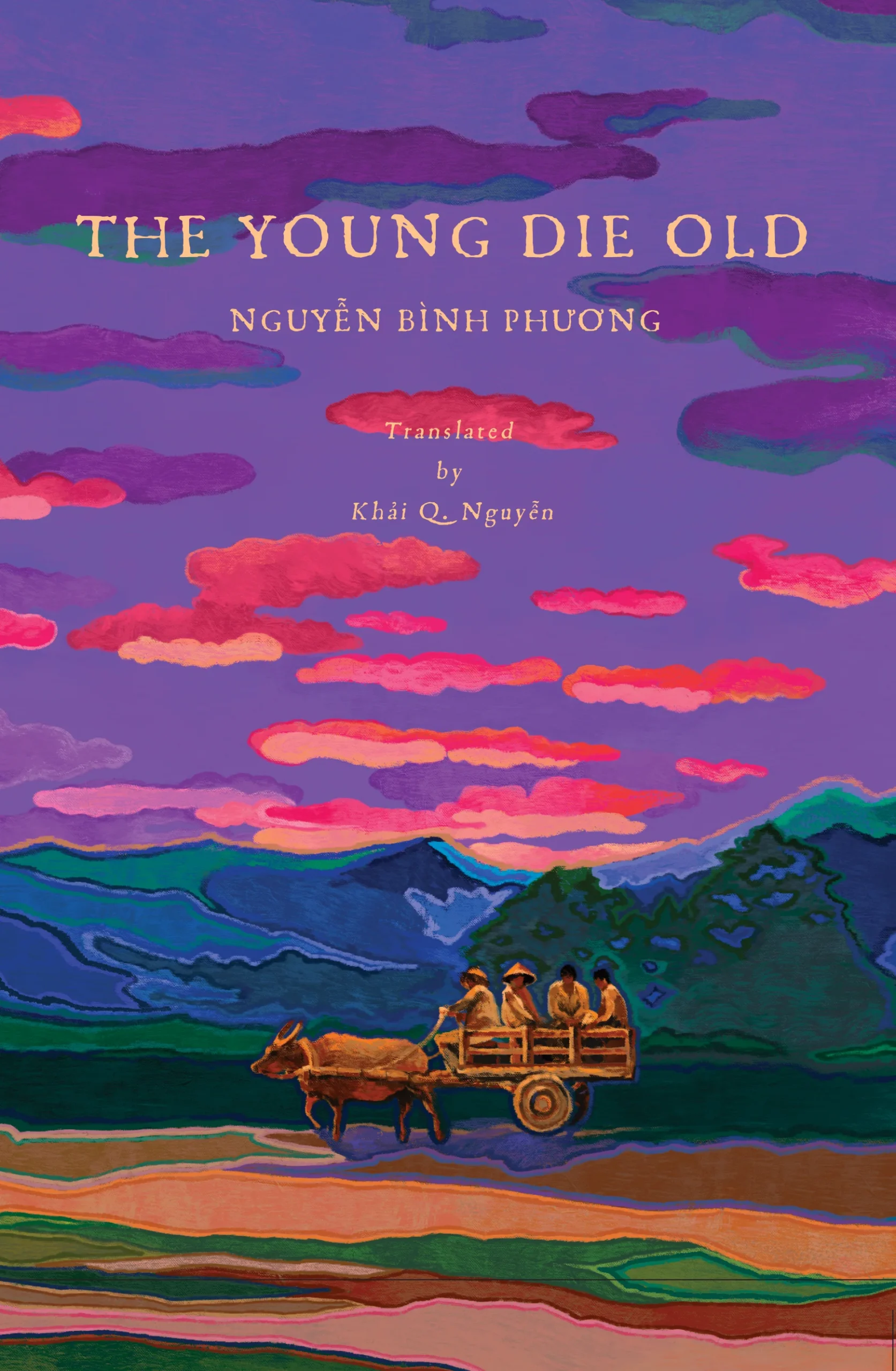
The Young Die Old is Nguyễn Bình Phương second novel and was published in 1994 to great acclaim in his homeland where it is considered a modern classic. After having been previously published in French and Korean, it is now also available in English, translated by Khải Q Nguyễn. The novel marks a radical departure from other works from the period available in English translation, such as A Time Far Past by Lê Lựu, who like Phương worked for Military Arts and Literature Magazine, or No Man River by Dương Hướng. The Young Die Old radically subverts the rules of the realistic novel with an experimental, disjointed and occasionally puzzling narrative that oscillates between the stark reality of depictions of rural life and a richly-realised supernatural world steeped in Vietnamese myth.
The story is told in two alternating narrative strands. The first is set in the village of Phan and at its core concerns the rivalry of two families, one represented by wealthy Liêm, the other by Trình, the martial arts teacher. The villagers suspect that Liêm’s wealth is based on a treasure found by his father, the family patriarch Trương, a long time ago. The rumour is that more riches can be unearthed in a vault near the two Liêm family graves in the hills behind the village. Both Liêm and Trình are in possession of instructions about how to access the vault: for it to open, a third grave needs to be dug on the night the three-eyed Nhgê—a mystical creature, half lion, half dog, believed to protect against evil spirits—appears in the village.
The second narrative strand is entirely set at the back of an ox-cart, following a nameless man on a journey with an indeterminate end, through a soundless landscape. Time is suspended and we do not know who the man is, except that he once was in the army and started the journey in a “crisp, oversized green uniform”, and that he is connected to the village. The oxcart is following a train which “moving without a sound brings him back to another world that once was his village, the world of shadows.” He belongs to the war generation, cut loose from his past by the death of those close to him — fellow soldiers, his aunt Lâm, his friend Biển. Phương portays him as doomed to wander this silent world for an eternity, his life in the village becoming a memory only.
In Vietnam, author Nguyễn Bình Phương is considered a military writer. After four years of serving as a soldier, rising to the rank of Colonel, followed by a stint at the Nguyễn Du writing academy, he has been part of the national army’s cultural institutions for most of his creative life, as an editor with the People’s Army Publishing House and, since 2010, as editor-in-chief of the Military Arts and Literature Magazine. Born in 1965 in the mountainous northern province of Thái Nguyên, which provides the setting for much of his writing, Phương came of age after the end of the American War, as it is referred to in Vietnam, in 1975 and the brief, but brutal Sino-Chinese border war in 1979. He grew up in the Bao Cáp era, the so-called Subsidy Period when two thirds of the population lived below the poverty line in a country reeling from the destruction after almost 40 years of wars and crippled by the American economic embargo.
The novel presents a unique vision of the post-war period in Vietnam which is both illuminating and aesthetically challenging.
The novel presents a unique vision of the post-war period in Vietnam which is both illuminating and aesthetically challenging. The interior worlds Phương creates mirror the grim context from which they sprang, with the title The Young Die Old referring to the depredations in the aftermath of war robbing the country’s youth of its future, in the novel often quite literally. I cannot recall ever having read a book in which so many children were still-born or accidentally drown in rivers and village ponds. The village of Phan is imbued with death, past and present. Its Banyan tree near the entry gate—traditionally a symbol of protection and the home of ancestral spirits—becomes the location for a number of mysterious fatalities. It is also the site where bodies of “villagers who had died far from home many years ago” suddenly appear intact to be given a proper burial.
The characters are imprisoned by both a sense of imminent catastrophe and their greed, with Liêm telling his son that “money is the most important thing” to justify his intention to kill another man for the third grave required to open the treasure vault. In the society described by Phương, violence between family members is rife, human interactions are rough and sexual desire transactional, best exemplified by Liêm’s promiscuous daughter who gives up her studies at the teacher’s college in the city and becomes a sex worker before falling pregnant and returning to the village.
Phương evokes the collective psychological devastation in the aftermath of war by means of introducing the fantastical to the realistic elements of the plot. This has over the years invited comparisons with the work of Gabriel García Márquez. Yet, The Young Die Old lacks the folkloric whimsy and narrative coherence that characterizes much of Latin American magical realism, and also South-East Asian magical realism, such as the books by Indonesian writer Eka Kurniawan. Instead, the narrative in Phuong’s novel is associative and fragmented, and projects an atmosphere of dread and despair. The chapters about the nameless man in the ox-cart feel more like Beckett than Marquez, with the sparse, lyrical intensity of the man’s memories and his absurd conversations with his two fellow passengers a contrast to the brutish dealings of the villagers. What connects both realms is that they show a world that is out of kilter, where life is ruled by unspoken memories which return as monsters, real and mythical.