“Guts, Glory and Empire” by Selma Carvalho
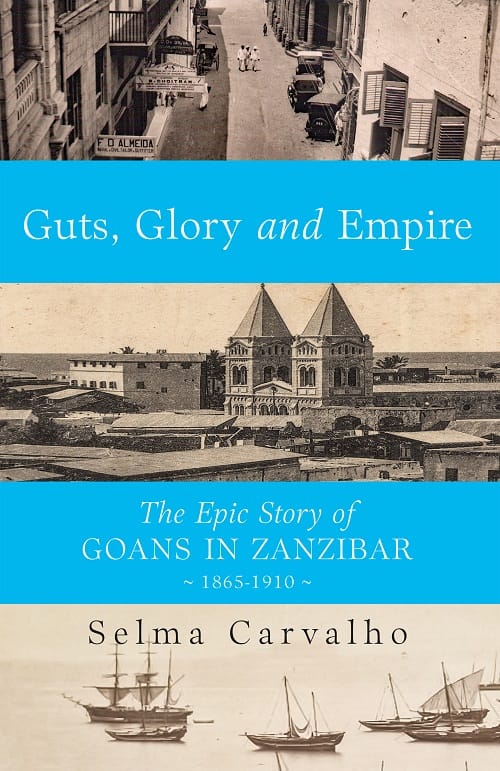
Long hidden in private papers is the account of the revolver shots that rang out in Stone Town on an October night in 1886, but the man who died was quickly forgotten. Dismissed by the Portuguese consular court as merely “an unnamed African man”, the victim’s erasure captures exactly the system of moral compromise that Selma Carvalho uncovers in Guts, Glory and Empire. This cold description, used to help a Goan clerk walk away with a light sentence for the shooting, serves as a window into a community stuck in a strange middle ground. Often looked down on by the British as “half-caste Portuguese”, the Goans of Zanzibar navigated a cultural limbo—neither fully European nor entirely local. In writing their story, Carvalho seeks to perform an act of historical justice, reclaiming the complicated lives of a Goan community whose century of triumphs and struggles in Zanzibar had been quietly buried in the archives.
Carvalho, who has spent close to fifteen years researching the East African Goan diaspora, beginning with Into the Diaspora Wilderness (2010) and continuing through A Railway Runs Through: Goans of British East Africa, 1865-1980 (2014), arrives at Zanzibar as the culmination of that project, and as former head of the Oral Histories of British-Goans project, whose collected recordings are now archived at the British Library, she brings an unusually granular command of consular records, mission-hospital registers and court transcripts to bear on it. Her argument, stated plainly in the introduction, is that this is “not a narrative of subjugated people” but the story of “one uppity South Asian community” that infiltrated the sultanate’s every register (medical, mercantile, musical) while Britain permanently labeled these residents as “half-caste Portuguese”.
To fully grasp this narrative, however, one must first understand the complex landscape of nineteenth-century Zanzibar. A British protectorate rather than, strictly speaking, a colony, the island was fundamentally an Omani Arab Sultanate where Arab elites retained considerable authority and controlled lucrative commercial networks. For the indigenous majority, imperial power was multi-layered, with Omani rulers and British imperialists functioning as competing, overlapping forces. Within this volatile theatre, Goans formed a microscopic enclave—barely 300 individuals in a total population of 200,000—yet they punched extraordinarily above their weight as the indispensable soft infrastructure bridging the chasm between Omani sultans and European consuls.
The first major theme Carvalho explores is the fragile balance between protection and vulnerability. Operating within the sovereign al-Busa’idi Sultanate of Zanzibar —long before it was formally declared a British protectorate in 1890—these Goans navigated a tense geopolitical tightrope. While the Sultan held nominal rule and local Arab elites maintained considerable agency, British imperial officials steadily exerted informal dominance, particularly through the pressures of controlling maritime commerce. For Goans, holding Portuguese papers meant they were subjects of a rival European crown, which often kept British overreach at bay. Yet, this hybrid identity was a double-edged sword. In the eyes of British colonial and consular officials, Goans remained permanently suspect—praised one day as “law-abiding and industrious” partners in trade, and dismissed the next as “natives needing supervision” who slipped outside neat imperial categories.
However, Carvalho refuses to frame this purely as a story of endurance. Instead, she confronts her subjects’ complicity in the darker sides of the empire. Goan doctors and merchants occupied a compromised middle ground: they depended on the patronage of wealthy Arab elites and a slave-driven plantation economy, yet operated under a British power officially committed to its abolition. Sheltered by Portuguese citizenship and British administrative networks, Goans could profit from an elite lifestyle built on slave wealth without being the explicit faces of the trade—exposing a history where survival often demanded quiet moral accommodation.
The second major theme shifts from the anxiety of survival to the steady, patient labor of building a home. This is where Carvalho’s work sets a new standard for diaspora history. While previous historians often lumped South Asian migrants into a single, faceless administrative category, Carvalho insists on tracking real people. She follows individual Goan families through consulates, cathedrals, and community halls, charting their incredible transformation from traveling cooks and sailors into wealthy merchant princes and philanthropists.
Carvalho traces the community’s rise and fall through CR Souza’s retail empire, the “English Stores.” Operating as the “universal provider” for the Omani court and European expatriates from 1865 onward, the business offers a window into the diaspora’s internal “civil wars” over inherited wealth and tangled estate legal battles.
By the final chapters, the narrative turns elegiac as the community fractures and dissolves after 1910. This decline stemmed from three major shifts: the consolidation of British Protectorate rule, which stripped away the Goans’ jurisdictional leverage; a flight of economic gravity toward mainland hubs like Mombasa and Nairobi; and, not least, the abolition of slavery, which finally gutted the plantation wealth these mercantile networks had long depended on, scattering the Goan patricians across the broader British Empire.
Where Carvalho truly shines is in her deep respect for the archive and her absolute refusal to flatten her subjects into simple archetypes. The Goans of Zanzibar were astute opportunists driven by economic survival and ambition rather than grand ideological loyalties. The book is remarkably strong because it embraces this unresolved complexity. By piecing together old hospital logs, mission records, and consular files, she gives the story a gritty, factual grounding that popular historical narratives often lack.
Guts, Glory and Empire is an act of profound historical healing, recovering a community that the empires of the time could never bothered to acknowledge, and standing as a testament to what patient, dedicated research can achieve when mainstream history fails. In a time when migrant histories are too often oversimplified into stories of pure triumph or total victimhood, Carvalho does something far rarer and more honest: she lets her subjects be human. In these pages, the Goans of Zanzibar are exactly what they were in life—chameleon-like, opportunistic, brave, and morally compromised all at once. They emerge not as a neat, closed chapter of the past, but as an open, fascinating question that the archives are still answering.