“Exit 8” by Genki Kawamura
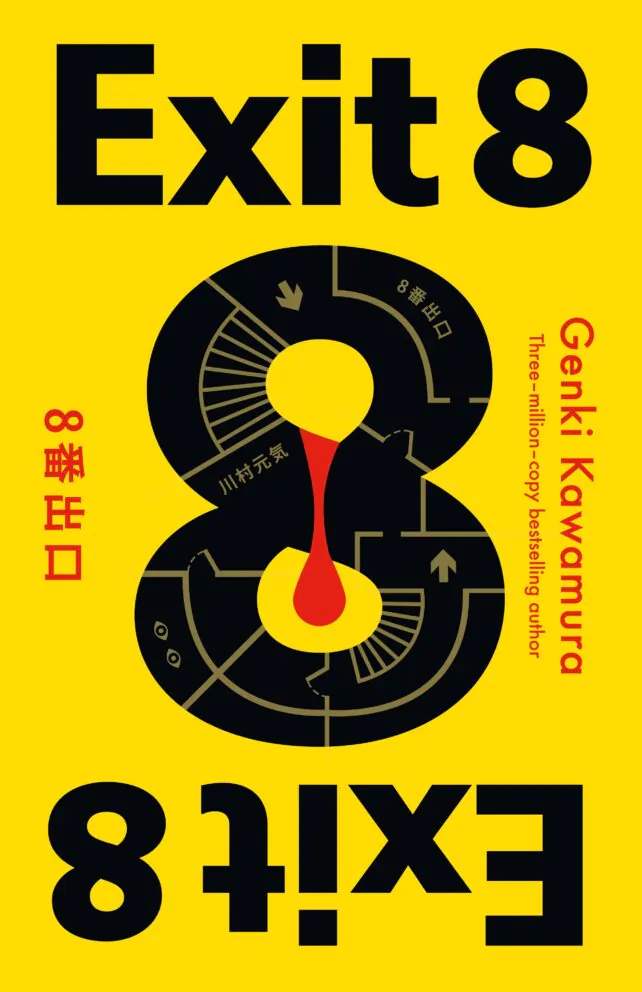
“Do not overlook any anomalies… If you find an anomaly, turn back immediately… If you do not find any anomalies, do not turn back… Go out through Exit 8”. Guided only by these cryptic instructions, the unnamed narrator of Genki Kawamura’s Exit 8 attempts to break free from an underground loop. Wandering through the same passage over and over, he is forced to confront both the endless maze and the tricks his own mind plays on him.
Inspired by MC Escher’s art, the decorations of the hallway are deceptively straightforward: a corridor lined with posters, a door, a man passing by with his eyes glued to his phone. However, as the narrator soon learns, it is much less mundane than it seems. A series of hallucinations or “anomalies” is waiting for him to notice, and if he fails to do so, he is forced to start over from the beginning. The inexplicability of the loop soon begins to test the narrator’s sanity as he faces his deepest fears and past mistakes.
Exit 8 was, unusually, first an indie game, then a movie and is now also a book, a trajectory not unlike ‘Assassin’s Creed’. So while Japanese audiences have had more time to engage with all three interpretations, from English-language readers, the book is more of a stand-alone, made available thanks to Sameeha Anwar’s translation.
The book raises plenty of uncomfortable questions, but provides no answers: is the maze the protagonist’s personal hell, or can the story be read as an allegory for life itself, forcing everyone to repeat the same actions time and again? Is it meant to torture the characters or help them become better people? Is the maze a purgatory, a hallucination brought on by a sleepless night or something entirely different?
Exit 8 offers an interactive experience of both following the narrator on his maddening journey and examining the photos scattered throughout the book. The photos themselves, modelled after archetypal underground passages in Japanese subways, enhance the eerie atmosphere. Nothing seems wrong and yet something, some small detail, is slightly off:
I turned right again, and a tall yellow sign with an arrow came into view. It pointed towards Exit 0. ‘Zero?’ I murmured in puzzlement. The number felt off. Beneath it were names of places I didn’t recognise: Nanbu Park, Mizuse Junior High School, Yonago Temple, Narihara Building, Happongi Crossing. It made no sense – how could all these places be ones I’d never even heard of?
Just as the protagonist finds himself uneasy at the sight of the names that sound almost right (for instance, Happongi Crossing, a distorted version of the famous Roppongi Crossing) but not quite, the mundane in the text slowly gives way to the surreal.
Combining soft horror with allusions to the 3/11 Triple Disaster (earthquake, tsunami, and reactor meltdown) Kawamura explores the implications of a choice many may face: to passively accept life as it happens or actively participate in it. The protagonist, who once chose to look away from the disaster in his hometown, comes face to face with it, with no easy way to escape the loop of guilt in which he is trapped.
Ultimately, the only thing left for the narrator is to believe that the redemption, the Exit 8, must exist somewhere ahead, even if it takes an eternity to reach it:
‘It’s going to be fine,’ I murmured to myself as I started walking slowly, deliberately, towards the next corner. That was all I could do; keep putting one foot in front of the other, no matter how long it took. Hours. Days. I didn’t know, but I knew I would eventually reach Exit 8.
Exit 8 becomes part of a media mix in which the book is closely tied to the movie, which in turn is closely tied to the game, encouraging to experience the story as a reader, viewer, and player. And no matter which option one might choose to start with, it is bound to reveal how even the most ordinary settings, such as the subway, can lead to a journey of self-reflection: perhaps not always accompanied by literal anomalies, but always equally uncomfortable.