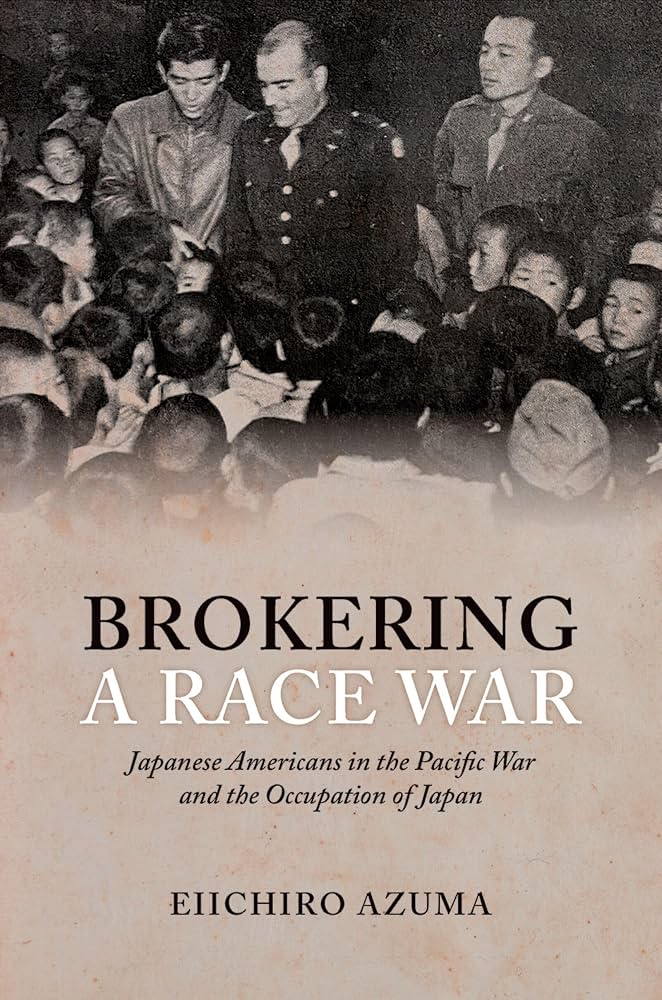
“Brokering a Race War: Japanese Americans in the Pacific War and the Occupation of Japan” by Eiichiro Azuma
Historians writing of Japanese Americans (also known as Nisei) in the Second World War have produced more books on their fighting in Europe as soldiers of the US Army’s 442nd Regimental Combat Team (RCT) than they have on how the Nisei gathered intelligence and produced propaganda for US civilian agencies and the Army in the years from Pearl Harbor to the end of the Allied Occupation of Japan (1941-1952). Moreover, also missing in action have been histories in English of the Japanese Americans who served the Empire of Japan against the land of their birth.
Eiichiro Azuma, helps to fill in some of the gaps with his new book, Brokering a Race War: Japanese Americans in the Pacific War and the Occupation of Japan, a history of Japanese Americans as “brokers”, trading on their understanding of the English and Japanese languages as well as the cultures of the United States and Japan. Azuma also looks at how Tokyo and Washington made Japanese Americans objects of propaganda. The book, with its focus on the Nisei, is a sequel to his 2005 work, Between Two Empires: Race, History, and Transnationalism in Japanese America which put their immigrant parents, the Issei, at the center.
Tokyo from the start made Nisei a focal point of its wartime propaganda. After Japan attacked Pearl Harbor on 7 December 1941 and declared war on the United States, Washington expelled numerous Japanese and ordered the mass relocation of those Issei, who became enemy aliens following Japan’s declaration of war, along with their Japanese-American children, then residing on the West Coast to camps in the American interior. Propagandists in Japan repeatedly pointed to their removal in accusing Washington of racism against Asians as part of Tokyo’s campaign to paint the conflict with the United States as a race war in which Tokyo was fighting for an Asia for Asians.
Japanese authorities permitted the thousands of Japanese Americans then resident in Japan to remain at liberty while detaining under harsh conditions Americans in Japan who lacked Japanese ancestry. Tokyo propagandists presented Nisei, all of them American citizens by birth, as loyal Japanese eager to serve their ancestral land in the war against the United States.
Japan’s declaration of war against the United States cut the flow of remittances from Issei parents to their Japanese-American children in Japan, many of whom were studying in Japanese high schools and universities. Without resources and under police surveillance, most Nisei collaborated to survive. Azuma recounts how salvation came by way of membership in the Nisei Association of Nippon (NAN). Under government supervision, the NAN offered Japanese classes for Nisei who were more proficient in English than in the language of their parents, instructed those who had renounced their Japanese citizenship on how to restore it, and, as Azuma writes in his book, “played a central role in steering resident Nisei” into intelligence and military service.
Almost a year into the war, Washington moved to make use of Nisei residing in the United States. In February 1943, President Franklin D. Roosevelt declared that, “Americanism is not, and never was, a matter of race or ancestry.” The Army activated the following month a Nisei combat unit, the 442nd RCT, and sent its members to fight in Europe. Washington made heroes of them for the rest of the war and held their record aloft in the Cold War as evidence of the United States as a colourblind democracy.
The US Army, desperate for Japanese interpreters and translators, recruited Japanese Americans from the camps, elsewhere in the United States, and in the Territory of Hawaii for its Military Intelligence Service. The Foreign Broadcast Intelligence Service (FBIS), which monitored Japanese radio broadcasts, the Office of War Information (OWI), which produced radio propaganda aimed at Japan, and the Office of Strategic Services (OSS), which conducted analysis and carried out covert operations, also brought Nisei into their ranks.
Azuma in the second and third parts of his book turns to the activities of Nisei in Occupied Japan. He writes of the Nisei as gathering intelligence, executing covert operations, and performing other duties under the General Headquarters of the Supreme Commander for the Allied Powers (GHQ, SCAP). He also recounts episodes in which Washington included Nisei in propaganda to encourage a pacifist postwar Japan to rearm as America’s “junior military ally in Cold War East Asia”.
Other historians and some readers may regret the relatively few supporting details. He writes little of the military, intelligence, and propaganda operations and organisations in which the Nisei were “brokering”. He makes brief references to the service of Japanese Americans in the OSS, OWI, and US Army but offers almost no corroborating facts.
Azuma names Iva Toguri, one of several Japanese American women nicknamed “Tokyo Rose”, as an announcer for Radio Tokyo’s propaganda without however noting that she was at bottom of a chain of command with Lt Gen Arisue Seizo, the Imperial Japanese Army’s intelligence chief, at the top and which included other Nisei participants such as Dr Masayoshi Morino, a political scientist from California. Missing from Azuma’s account are the numerous Nisei who “brokered” for Imperial Japan in such fields as communications intelligence, prisoner interrogation, and radio monitoring.
Some readers may find the book’s language tough going due to the academic jargon and jarring terms in it . They may scratch their heads over such jargon as “gendered citizenship rights”, “racialized minority” and “foreignized Nisei”. Readers may find offensive in some cases the author’s language, such as his choice of “white overseers” to describe US officials and military officers in command of Nisei linguists. Readers may also puzzle over such a blanket term, given the presence of Nisei as well as of European Americans in the chains of command that managed Nisei linguists at the working level.
Such shortcomings aside, Azuma’s history of Nisei as “brokers” between Tokyo and Washington during the War in the Pacific and the Allied Occupation of Japan sheds new light on the history of that period. I found particularly illuminating the author’s juxtaposition of the NAN in Japan and the Japanese American Citizens League (JACL) in the United States as organizations promoting Nisei interests. The book is commendable for presenting Japanese Americans as individuals. It stands as a corrective to the propaganda in Tokyo and Washington that painted them as super patriots for each side while they “brokered” for both nations.