“Music Sets You Free” by Ryuichi Sakamoto
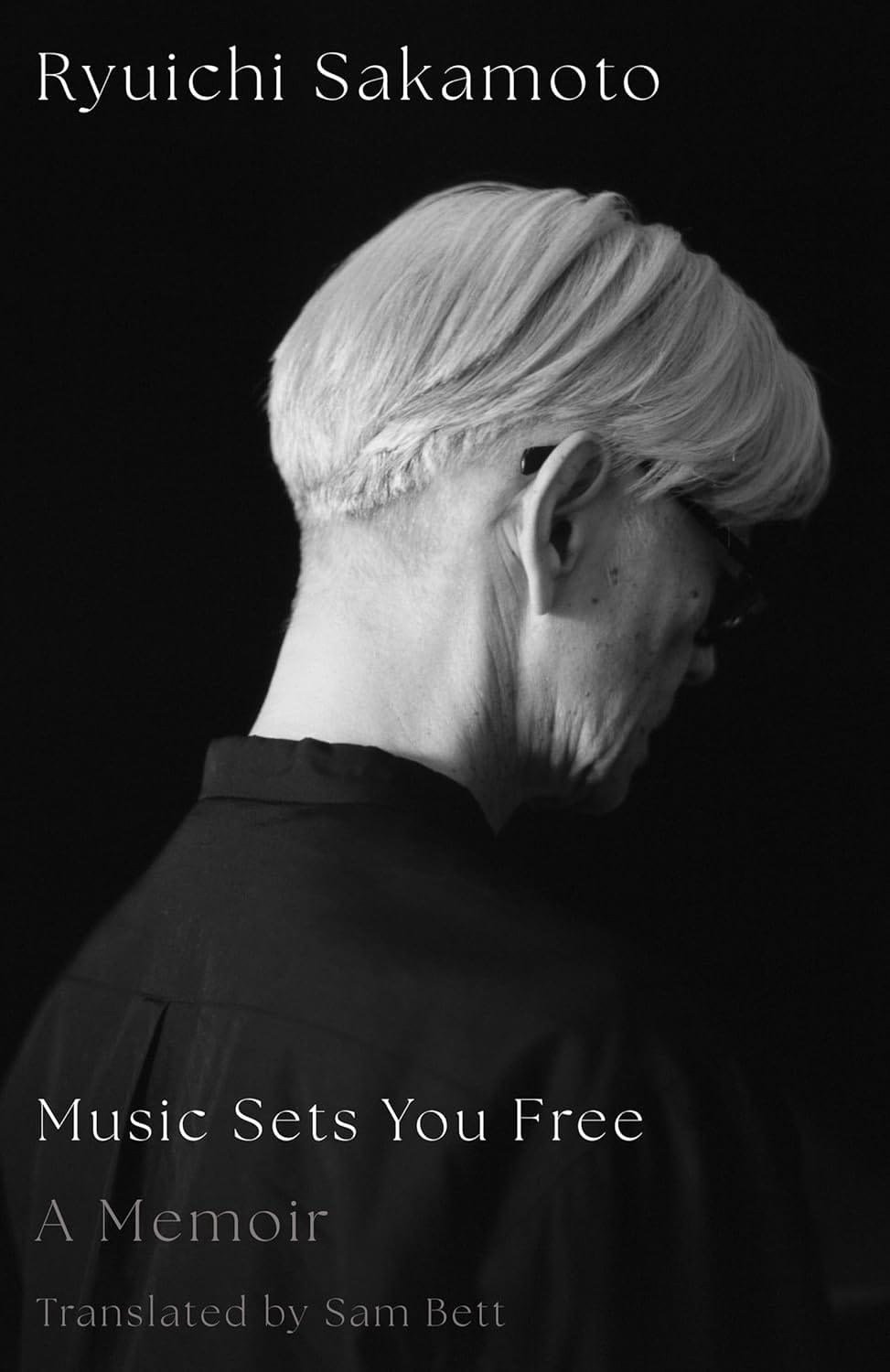
First published in Japan in 2009, then followed by a second volume in 2023 written in the shadow of a terminal diagnosis, these two books appear here together in English for the first time, translated by Sam Bett.
When Ryuichi Sakamoto was asked as a child what he wanted to be when he grew up, he wrote “nothing.” Not from nihilism, he explains, but because the question made no sense to him. He was already something. It is a strange and perfect opening note for a memoir that refuses, across nearly seven hundred pages, to turn its subject into a legend.
There are no war stories about trashed hotel rooms, no feuds milked for drama, no mythology carefully constructed around the artist’s genius. Instead, Sakamoto talks the way a very smart, very honest person talks when they’ve finally stopped trying to impress anyone. Which, given that he was dying when the second book was written, makes a certain kind of sense.
The first book covers 1952 to 2009. It began as a serialized interview, Sakamoto speaking into a recorder over months and years, and it reads that way—conversational, compressed, occasionally impatient with its own nostalgia. The chapters are short. Some run barely a thousand words. He moves fast through a childhood in postwar Tokyo, a mother who dressed him in a white blazer for his elementary school entrance ceremony when every other boy wore black, a father so absorbed in books he was essentially a ghost. The first composition Sakamoto ever wrote was a song about a class rabbit that died over summer break. He wrote it numbly, on request, with no particular feeling. He would later win an Academy Award for film scoring, but the rabbit song is where it started.
The book’s best chapters cover his teenage years in Shinjuku, which in the late 1960s was a different city from the one tourists visit today. Jazz cafes on every corner, student radicals with thick books and cigarettes, the New Left burning through its last years of idealism. Sakamoto absorbed all of it. He went to protests the same way he went to jazz clubs—hungrily, aesthetically, and in his own telling, sometimes as a romantic strategy. He would ask girls about Vietnam, maneuver them into crowds, and position himself nearby when the riot police moved in. The politics were also real, though. He was out there because he believed in something, even if he’s now willing to admit that belief was tangled up with youth and appetite and wanting to seem cool.
This is also where John Cage enters the story, and Cage never really leaves it. Sakamoto first encounters him as a teenager at small concerts held in American Embassy offices in Tokyo, sitting alone because nobody he knows shares the interest. What Cage offers is not just music but a philosophical exit from the European classical tradition that Sakamoto’s conservatory training had been pointing him toward. Where that tradition demanded increasing control and complexity, Cage proposed the opposite: indeterminacy, chance, the relinquishing of the composer’s will. He used dice to write songs. He built chance operations into the score. He arrived at these ideas partly through Zen Buddhism, which to a young Japanese listener was both a provocation and a homecoming.
The influence runs deeper than method. Cage gave Sakamoto permission to hear the world as music. Field recordings, ambient sound, silence itself as compositional material. When Sakamoto enters Tokyo University of the Arts in 1970, he immediately abandons the music department for the fine arts building on the other side of campus, where the painters doing butoh dance are, where rock bands practice and nobody wears clean clothes. His formal teacher is Akira Miyoshi, one of Japan’s finest academic composers, but the real education is Cage’s. And Fumio Koizumi’s—the ethnomusicologist whose lectures Sakamoto never missed, who spent a third of every year recording folk music in jungles and remote regions and came back with recordings that rewired how Sakamoto understood what music could be. Koizumi convinced him that Western classical music was a few-hundred-year parenthesis in a much longer human story. Cage had already convinced him that even that parenthesis was optional.
The YMO (Yellow Magic Orchestra) chapters are where the book catches fire. Three men arrive at the same musical language by completely different routes—Haruomi Hosono and Yukihiro Takahashi through a lifetime of absorbed rock and pop, Sakamoto through conservatory training and avant-garde obsession—and the collision produces something none of them could have made alone. Their first album barely sold. Musician friends told them the sound was too cold. Then they played London in 1979 and a young couple in new wave clothes started dancing to Sakamoto’s music, and he felt electricity running through his veins. It was the first time, he says, that he consciously chose a direction.
Fame arrived back in Japan and Sakamoto hated it immediately. He couldn’t walk down the street. He started resenting the band, then made an entire solo album against them in secret, which they absorbed in silence before writing a revenge track of their own. Reading this, you understand that YMO functioned less like a band and more like a sustained creative argument between three people who respected each other too much to walk away. The band has been described as “the original cyberpunks” and their early work has been described as “proto-techno” music. By the 1990s, YMO were also frequently cited as pioneers of ambient house music.
The film work follows almost by accident. When director Nagisa Oshima comes to his office and asks him to act in Merry Christmas Mr. Lawrence alongside David Bowie and Beat Takeshi, Sakamoto’s response is instantaneous and unrehearsed: only if he can also compose the score. He had never written a film score in his life. He returns from filming in Rarotonga, sits down to write, and has no idea how to begin. He watches Citizen Kane on a producer’s recommendation and takes from it not instrumentation or melody but something structural—which scenes get music and where it disappears. The melody itself comes to him spontaneously in thirty seconds.
Four years later, Bernardo Bertolucci casts him in The Last Emperor and asks him to write the score on location in Changchun, in two weeks, on an ancient piano hauled to his room over potholed roads. He pulls it off. When the film swept the 1988 Oscars, Sakamoto accepted the Best Original Score award onstage in a state of shock, becoming the first Japanese composer to win the prize. A Golden Globe and a Grammy follow. He is offered Hollywood. He turns it down.
Then September 11 arrives. He is at his new home in Manhattan when his housekeeper runs in crying. He turns on the television, watches the second plane hit the World Trade Centre, grabs his camera, and walks to Seventh Avenue to photograph the smoke. What follows is one of the most arresting passages in the book.
He defends, carefully and at length, Karlheinz Stockhausen’s notorious remark that the attacks were the greatest work of art ever made. Not to endorse them. To be honest about their aesthetic power. Those attacks were a performance, he writes, one that held the world in a state of suspended horror, and holding an audience in exactly that state has always been among the goals of art.
After September 11, he argues, art as it had existed went to pieces, because the attacks had done something art aspires to but rarely achieved at that scale. The city went silent for days. No car horns. No jets overhead. When the first person picked up a guitar in public, he notes, they risked getting punched in the face. Only at the candlelight vigil three days later, when New Yorkers flooded the streets to mourn, did music begin to come back. He calls that moment a glimpse of the very root of creativity.
The second book is a different kind of writing entirely—longer, slower, circling ideas rather than narrating events. It opens with a line from Bowles that Sakamoto had set to music decades earlier without fully hearing it: how many more times will you watch the full moon rise? Perhaps twenty. He was dying when he wrote this book. The question was no longer rhetorical.
The album async, released in 2017 after his first cancer treatment, begins from a deliberate act of erasure. He throws away everything he knows. He records rocks rubbing together on New York streets. He captures cicadas in the Kyoto mountains. He visits a Manhattan museum to record Harry Bertoia’s sound sculptures. The guiding concept is to write a score for an imaginary Tarkovsky film, and from Tarkovsky he borrows a precise idea: that film already has sound, the world already has sound, and a score must work against that ambient reality rather than confirm it.
He writes about The Revenant with a candour that’s almost brutal. He was recovering from chemotherapy when the call came from Alejandro Iñárritu’s office. His partner told him he had to score the film even if the cancer came back and killed him. He went to his New York studio and started building layers of sound—not melodies, layers, which is what the director wanted—and then discovered that his body would give out after six hours. He’d been used to sixteen. He pushed to eight and still couldn’t finish some tracks. He got a taste of failure for the first time in his life, and says so without self-pity.
He was still asking, near the end, whether he would ever write something that surpassed “Merry Christmas Mr. Lawrence.” Bach went blind three months before he died and was still dictating. Debussy wrote one of his final pieces for his coal merchant, who kept delivering coal to a sick man’s house during the First World War. Sakamoto wanted to follow that example. Keep writing until the body stops.
He died in March 2023, still at the piano.