“The Book of China: A Persian Merchant’s Description of the Ming State for the Ottoman Court”
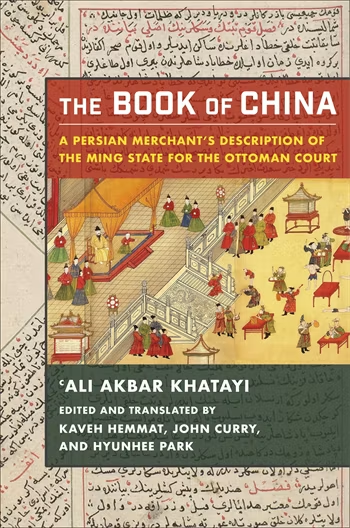
Marco Polo got the nickname “Millione”, not so much for the riches he brought back to Venice, but for the number of lies readers perceived in his description of distant Cathay. A man from Transoxiana named Ali Akbar gave himself the surname “Khatayi” (“Chinese” in Persian) after travelling there for six years and writing, in Istanbul in 1516, a compendium of information about that fabled country. Was Ali Akbar’s description any more accurate than Polo’s 200 years earlier? At least the latter gave an accurate description of the Great Wall, whose absence from Polo’s account skepticism of the Venetian (notwithstanding the argument that the wall in Polo’s era may not have been impressive enough to merit his mentioning it.)
The main difference between the two travelers’ accounts is that Khatayi is quite comprehensive. Much of Polo’s account includes routes and names of cities, about which we don’t learn a great deal, except that they are rich and famous for such and such a commodity. Khatayi, on the other hand, contains much more social and cultural information. It is less of a handbook for caravanning than an attempt to understand Ming China within the frame of reference of early 16th-century Istanbul. He wrote down his account once in Persian, and once in Turkish. We assume he was a Central Asian Sunni Muslim, and a merchant, though this is speculation. The book reveals a man of great curiosity and judgement.
Political legitimacy, for example, looms large as a theme for Khatayi. To China’s west, Muslim states claimed legitimacy from defense of the faith (early Ottomans, Mamluks), or from universal conquest (Timurids, later Ottomans). The Ming, says the author, derive their legitimacy from 4,000 years of uninterrupted rule by the emperors, as well as their meticulous application of the law, which is above the emperor. Khatayi and his readers would have meditated on the contrasting merry-go-round of rulers, and hence the fragility of rule of law in the realms of Islam. Whether Khatayi or his informants really believed that China had never been invaded, and that they had always upheld the same unchanging law, the message was a seductive one, because both the Ottoman dynasty and the Muslim clergy sought to build a more stable polity on the foundation of law.
The author gives a whimsical explanation for the importance of rule of law in China, with an anachronistic story about how the one woman empress of China (8th-century Wu Zetian of the Tang) asked the sage Confucius (6th-5th centuries BCE) for help restoring order to her reign. By implication, the law has the power to legitimize even the rule of a woman.
Khatayi accurately emphasized Chinese Islamophilia. In contrast to the realms of the Christians, where Muslims were enslaved, the Ming welcomed central Asian merchants and allowed their communities to thrive across the country, alongside indigenous Chinese Muslim populations. This led the author into a Poloesque exaggeration when he depicted the Zhengde emperor praying in a mosque. This passage is, however, enhanced by a wonderful description that is worthy of Yang Zhimou’s staging of Turandot:
[The Emperor] sits upon a litter… So many thousand foot soldiers, all drenched in iron, weapons, and armaments drawn and set over their shoulders, are walking before the emperor of China, and trains of elephants pull gold-chased wagons in front of emperor of China, upon which are litters dressed in multicolored satin decorations… There are a thousand musicians, more or less, playing strange and marvelous instruments in lines to the left and right of the emperor, and the emperor and his close companions who lifted up his throne, carried it between the lines of musicians, and instruments were played such that every soul would depart its body. There were two of the Muslim eunuchs seated on horses advancing toward the throne, with the utmost grandeur and respect…
Where Khatayi really goes off the rails is when he recounts the supposedly exclusive scoop that the Zhengde emperor is secretly a Muslim, and is waiting for an opportune moment to convert the country to Islam. (This reminds me of optimism among my Afghan friends in the 1970s that Cat Steven’s conversion to Islam would signal a wider victory for the faith.)
Such stories must have made the book an agreeable read for Khatayi’s Ottoman public. I do not find it surprising that Khatayi is relatively uninformed about Chinese religion. I would imagine that his informants were Chinese Muslims, who spoke both Chinese and Persian. Also the role played by religion in China was very different from that of Islam in the Ottoman lands, complicating its interpretation by foreigners.. On the accuracy side of the balance, Khatayi highlights the important role of the turban-wearing Muslim eunuchs in the Forbidden City. One such influential eunuch, the admiral Zheng He, had commanded the Ming flotilla in the reign of the Yongle emperor.
Another example of Khatayi’s mixed accuracy is his treatment of China’s institution of female entertainment. He emphasizes the beauty of the performers, their skill and virtuosity, describing how they study music and dance.
The throng of women singing with their barbats [lutes]
play David’s refrains, and it pleases the soul.
When those idols draw out a note,
reason bids the soul farewell, and life the body.
So far so good. But then he claims that the entertainers had responsibility for making rain during droughts, and that if their efforts failed they faced execution. Likewise he writes that government officials risked death sentences for fraternizing with singing girls. Given what we know about the congenial relation between the literati and the meiren, one wonders what could have given rise to this statement.
Khatayi conveys much information that would have been wonderful and notable to his audience, even when it’s imperfectly explained. He reports that the emperor distributed thousands of identical calendars throughout the realm, in order to ensure the simultaneous observance of the festivals. But as he either didn’t see or didn’t understand block printing, he informs us that they made multiple copies by letting the ink drip through from one sheaf of silk paper to another. How history might have been different if the Ottomans had adopted block printing in the 16th century?
The current edition is the first to utilize all four original manuscripts (two in Persian, two in Turkish). The translation is easy to read, and while the poetic embellishments to the text, designed to beguile the reader, offer pure enjoyment. The extensive introduction and critical notes provide plenty of insight into the author, mysteries surrounding his identity, and the impact that his book may have had on the courts of Sultans Selim the Grim and Suleyman the Magnificent.