“Murder in Byzantium” by Julia Kristeva
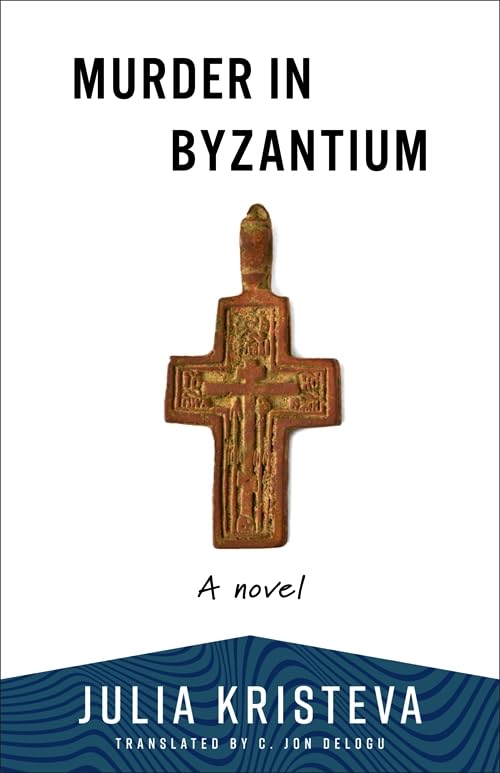
Julia Kristeva is one of the most formidable minds in contemporary literary and cultural theory, the Bulgarian-born, Paris-based intellectual who gave us Powers of Horror, a 1980 study of abjection that remains a landmark of psychoanalytic criticism, who coined the term “intertextuality”, who spent decades making psychoanalysis and semiotics speak to each other in increasingly rarefied registers. Which raises an obvious question when picking up Murder in Byzantium: what is she doing in the mystery section?
The novel is set in Santa Varvara, a fictional Eastern European city-state rotting with mafia networks, petroleum money, and apocalyptic cults. A serial killer known as Number Eight is systematically murdering the leadership of one such cult, the New Pantheon, leaving blood-numbered shirts at crime scenes as signatures. Stephanie Delacour, a sardonic Parisian journalist, is dispatched to cover the story and reconnects with her lover, Police Commissioner Northrop Rilsky, whose Anglo-Saxon first name in a Balkan setting Kristeva leaves unexplained. Their investigation runs in parallel with the disappearance of Sebastian Chrest-Jones, a migration historian whose private notebooks reveal a consuming obsession with the First Crusade and Anna Comnena’s Alexiad, the 12th-century chronicle in which the Byzantine princess recorded her father Emperor Alexius’s reign. By the end, the killer’s identity converges with a drowned body, a DNA puzzle, and a shootout in a cathedral cloister that kills Sebastian and leaves Stephanie shaken and back in Paris, filing a copy for an editor who wants the facts and nothing else.
The short answer to what Kristeva is doing here is that she isn’t writing a mystery novel, quite. The genre trappings are present, body count, police procedural, wisecracking journalist-detective, but they are largely a vehicle. What she actually wants to explore is Byzantine theology, the psychopathology of religious violence, and whether Anna Comnena’s Alexiad conceals a secret love affair. The thriller is the excuse, not the project.
What [Kristeva] actually wants to explore is Byzantine theology, the psychopathology of religious violence, and whether Anna Comnena’s Alexiad conceals a secret love affair. The thriller is the excuse, not the project.
This would sit more comfortably if the erudition were better disciplined. Kristeva’s central thesis, that contemporary geopolitics rhymes with the First Crusade, that NATO intervention repeats crusader logic, that Europe today is a decadent Byzantium too proud to see its own twilight, is genuinely interesting and she earns it through detail rather than assertion. The portrait of Anna Comnena has real intellectual force. But the digressions arrive with little regard for momentum, and the thriller mechanics, when Kristeva returns to them, feel perfunctory. A representative example: Stephanie, who has one of the better narrative voices in recent literary crime fiction, sardonic and quick and alive to absurdity, reflects at length on losing herself in a football crowd, finding her truest self in a grainy newspaper photograph as an indistinguishable speck in the stands. It’s a characteristically Kristevan meditation on identity and dissolution, and it’s interesting on its own terms. But it lands mid-investigation and the mystery plot, such as it is, simply waits. The killer’s identity pivots on DNA evidence introduced late. The resolution is rushed. Each time Stephanie threatens to drive the story, her creator reaches for another notebook entry about Byzantine heretics. Kristeva treats the plot as scaffolding, something to hang the ideas on rather than something with its own internal pressure and necessity.
Umberto Eco faced a similar challenge with The Name of the Rose, a novel equally loaded with medieval theology, and solved it by ensuring the erudition moved the story rather than stalling it. Kristeva rarely manages this. French literary tradition has always been more tolerant of the novel as a vehicle for ideas, from Sartre’s fiction to Houellebecq, but regardless here the balance tips too far toward the essay.
Taken as a philosophical novel that happens to wear genre clothing, it has stretches of genuine vitality. The prologue, in which Number Eight walks back across the salt marshes after a killing, imitating cormorant calls as he goes, before climbing into his Range Rover and driving home to watch news coverage of his own crime, establishes a tone that is genuinely unsettling and strange.
The broader question of whether academics can write mystery fiction has a clear enough answer: occasionally, with difficulty, and only when they’re willing to subordinate their expertise to the demands of storytelling. Kristeva is only partially willing, and the novel lands somewhere between two stools. Readers who come purely for the thriller will lose patience. Those with some appetite for ideas will find enough to hold them, even if they finish the book wishing it had committed more fully to being either a novel or an essay.
Originally published in French as Meurtre à Byzance in 2004, the novel appears in a reissue of a Columbia University Press edition that first appeared 20 years ago. Delogu’s translation is clean and confident, handling the tonal shifts between Stephanie’s breezy first-person and Sebastian’s more elevated historical passages with assurance. The sentences stay European in rhythm, which feels right for a novel this steeped in Continental intellectual tradition.
That suits the material, and so does the novel’s final image: Stephanie back in Paris at the Marly Café, another random shooting erupting around her, violence casual and unresolved and already becoming a copy. It’s the most novelistic moment in the book, and it arrives, characteristically, just as the story is ending.