“The Corpse Collector”
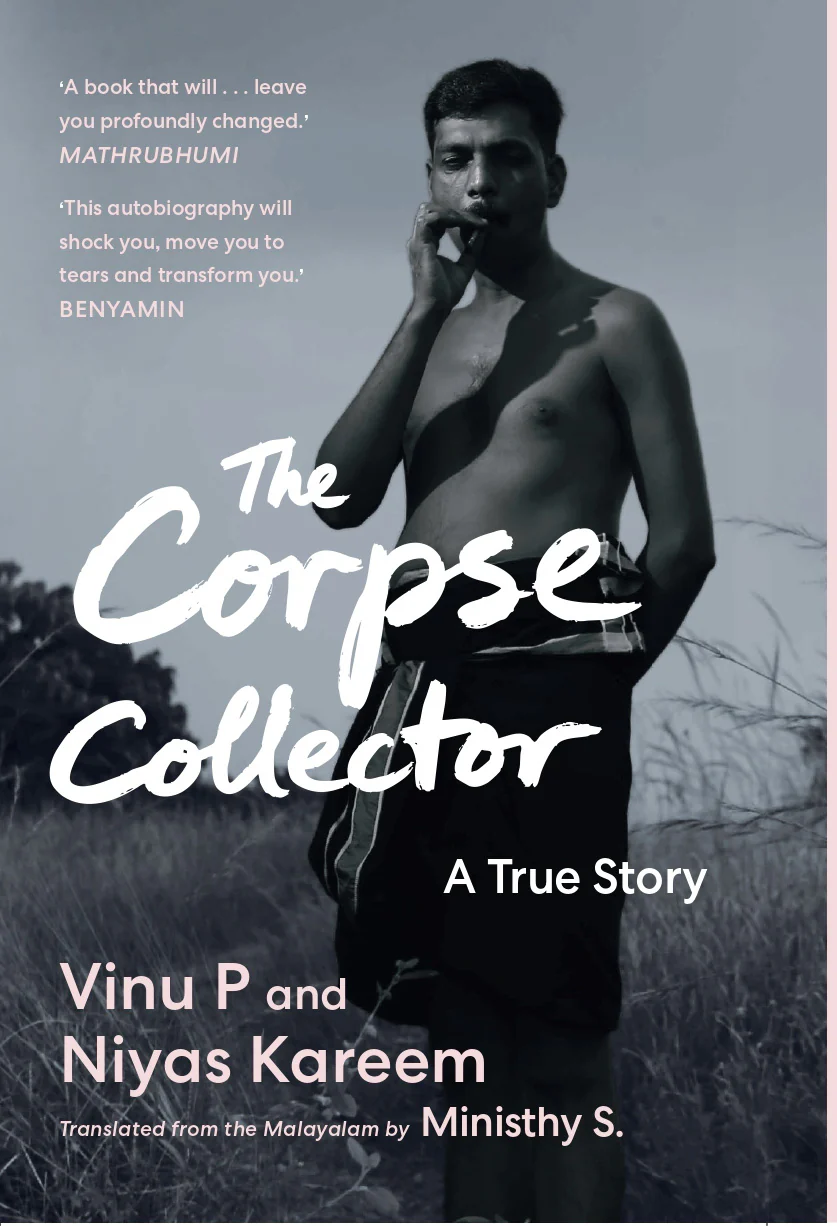
Vinu P is a “corpse collector”; that is, he retrieves the bodies of those who die “unnatural” deaths—victims of accidents, suicides, and abandonment, and so on—and assists the police in the enquiries that follow. This being India, where Vinu lives and works in Kerala, what might elsewhere be considered the duties of a first responder is here tied up with questions of caste. Despite the stigma that his job engenders, or perhaps because of it, Vinu has written a memoir. The Corpse Collector: A True Story was first written in Malayalam with the assistance of Niyas Kareem. That the acclaimed writer Ministhy S has translated it into English indicates that the book deserves our attention.
Vinu’s entry into the profession is accidental. As a schoolboy, he helps recover the body of a friend who has drowned. While others remain at a distance, he steps forward. “That was the day this profession chose him.”. The work itself is presented in stark, practical terms. Bodies are recovered from rivers, railway tracks, roadside sites, and abandoned spaces. It is physically demanding and often carried out with minimal protection. Over time, Vinu develops a clinical familiarity with the processes of death—how long a body has been exposed, how it has been affected by water or heat, and how it can be handled with the least amount of further trauma. “My job is to collect the dead bodies of those who have met horrible endings,” he says, defining his role with a chilling directness.
My job is to collect the dead bodies of those who have met horrible endings
Unlike in the West, where comparable tasks are carried out within institutional frameworks—by emergency services, medical personnel, or funeral professionals—and are treated as part of recognised public service, in India, such work is not regarded as neither a neutral nor respectable profession. “Slowly, I was getting ostracised by society,” Vinu notes. The distancing is gradual but persistent: shops refuse service, neighbors withdraw, and ordinary interaction becomes a hurdle. “Nobody ever wants to talk to me.” This is a developing condition rather than sudden exile. His father tries repeatedly to redirect him into more conventional work, even buying him an auto-rickshaw in the hope that he will leave what is widely seen as a degrading occupation. The stigma is a contagion that extends to those associated with him.
Vinu learns the work from a group of men he calls the “masters”, figures already living on the edges—near railway tracks and under overpasses—who handle the dead as part of a daily routine. Among them, the work is stripped of its taboo and becomes a technical craft. They teach him how to lift bodies, how to manage decomposition, and how to work in difficult terrain. What appears from the outside as repellent is, within this circle, a specialized skill. This apprenticeship gives Vinu not only competence but also a form of belonging. The “masters” occupy the same social margins that he comes to inhabit; knowledge and dignity circulate even where they are not expected to exist.
At the same time, Vinu’s relationship to the dead is not purely functional. He arranges burials for unclaimed bodies, sometimes at his own expense, and takes on responsibilities that others avoid. The work becomes not only a task but a quiet form of secular priesthood.
Yet the Kerala Police recognize Vinu as necessary. Officers employ him, assist with payments, and at times offer protection. He comes to describe his life in terms of two constants: death and the police. Where society withdraws, the state engages, though in a strictly limited and utilitarian way.
The personal consequences are evident. Vinu’s first marriage collapses under the strain of his work and its social fallout. What follows is a period marked by isolation and uncertainty. “A lonely human needs… only someone to hold close,” he reflects. A second marriage later brings some stability, but it does not remove the conditions that shaped his earlier experience.
Running alongside these events is a quieter, more sustained ambition. Vinu expresses a desire to create a burial ground for those who remain unclaimed. “He dreams of building a graveyard for the dead.” The idea recurs throughout the book and provides its clearest sense of direction. It shifts the narrative from endurance to purpose: from responding to death as it appears to attempting to secure a place of rest for those who would otherwise be forgotten.
The book finds its broader resonance comes from Vinu not being presented as an exception or as a figure set apart by unusual circumstances but rather an example of a more familiar condition: a person whose labour is required but whose presence is not fully accepted.
The effectiveness of The Corpse Collector depends largely on its prose. In translation, the writing remains plain and controlled. It avoids elaboration and allows incidents to accumulate their own weight. The restraint prevents the material from becoming either sensational or abstract.
As a whole, the book is less a commentary on a particular social system than an account of a life lived within a necessary but uncomfortable space. Its interest lies in how it makes that space visible without insisting on interpretation. By the end, Vinu appears not as a figure to be explained, but as one to be recognized: a man who continues to do what is required, and who seeks, within that work, to secure a measure of dignity for those who have none.