“Gooday Nagar” by Maithreyi Karnoor
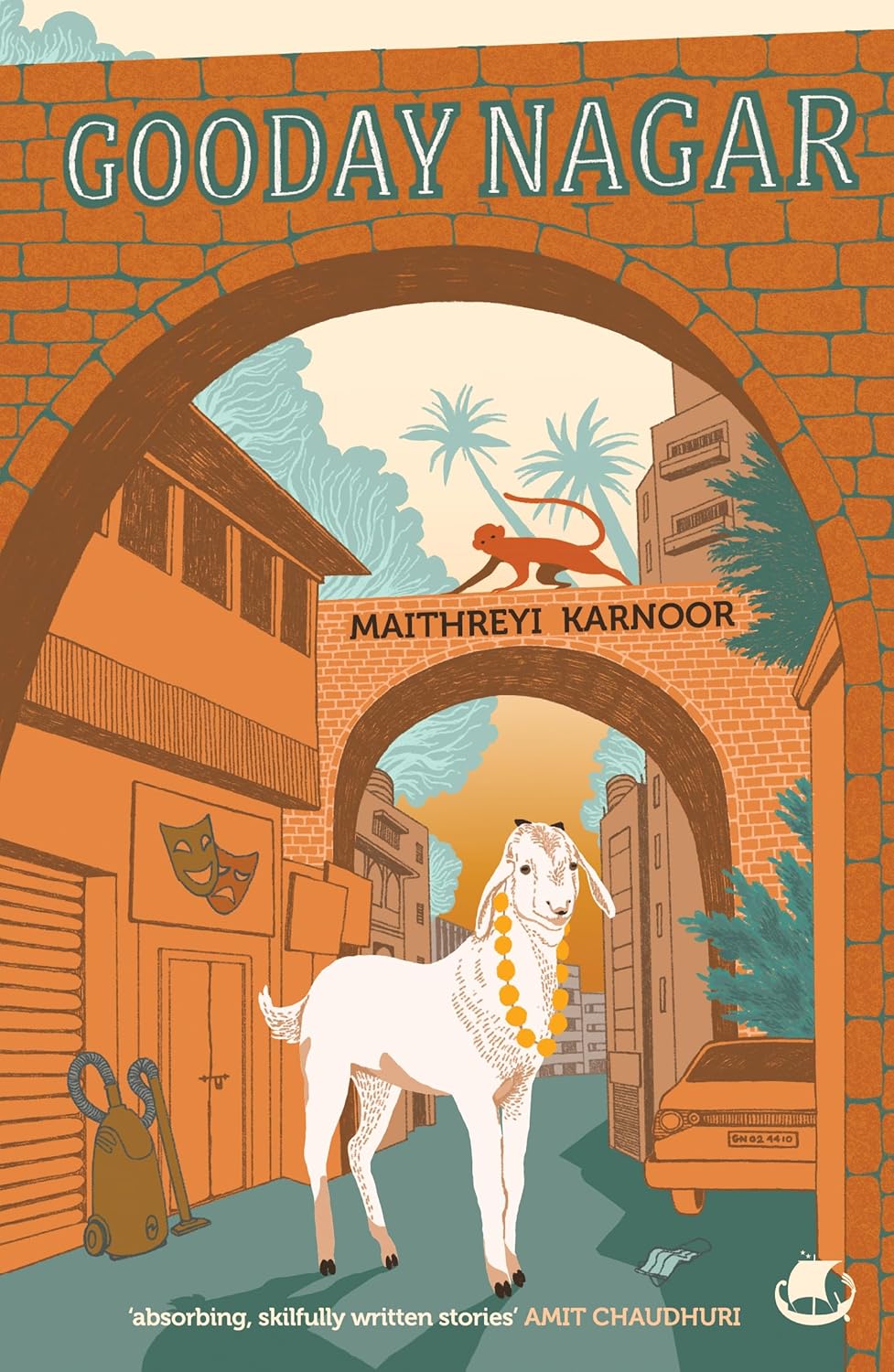
Gooday Nagar is a collection of short stories about the people (or, better, “characters”) of and around the eponymous fictional Indian town. If this sounds a bit like RK Narayan’s classic Malgudi Days, that’s no accident; one of the stories even references it.
As a stylist, author Maithreyi Karnoor is hard to pin down. She is an internationally-recognized poet, a translator from Kannada to English and her first novel Sylvia was structurally and linguistically ambitious. So it perhaps should come as no surprise that her Gooday Nagar is, as a place, also a bit slippery. In the first story, it doesn’t even exist:
The town was yet to be called Gooday Nagar. It was a time when the landscape of the hopes and dreams of the townspeople were still just farmland. Their senses weren’t dulled by the onslaught of new things. And life was innocently oblivious to a future where it would be labelled charming in hindsight. The town took itself as seriously as it always did.
In subsequent stories Gooday Nagar grows, yet its size and function is less than solid; it can seem alternately (or simultaneously) a provincial county seat while at other times almost a metropolis. It soon becomes evident that Gooday Nagar is more concept than actual place—everywhere and nowhere, perhaps; one suspects the “Gooday” might be a riff on the English greeting (think Lake Wobegon) while “nagar” means town or city.
Karnoor is a versatile writer, a master of tone and the bon mot, a sharp observer who can wield an even sharper pen: sarcasm, satire and irony are deployed, and not always gently. In the first story, “Return of the Salesmen”, Karnoor seems to be channeling HH Munro (aka Saki). A vacuum-cleaner salesman (a trope of yesteryear if there ever was one), arrives in town
dressed in a smart white shirt tucked neatly into blue-grey trousers with razor-sharp creases, highly polished black leather shoes, and a dark blue necktie… In a town where the only neckties—stitched knots threaded with strings—were worn by school boys and grooms, the young man, who was neither, drew attention to himself.
Karnoor shows her characters little mercy. She has the family patriarch writing a letter to his boss:
Greetings! I humbly request to be granted one-day personal leave in order to perform my duties as host to esteemed guest tomorrow (Thursday). Hope you will kindly do the needful.
The guest in question is Arun, the (bemused) salesman. Much of the town shows up for the demo. There’s an erstwhile English professor who starts quoting Shakespeare to Arun because he speaks English. The matriarch of the family tells him off:
Hemalatha interjected. ‘Uncle, this is a high-tech machine. Your literature-giterature is of no use to anybody. Our Arun is an engineer from IIT. Shruthi is also going to study there,’ she said authoritatively.
‘Barbarians! Barbarians all,’ the old professor muttered as he slunk away from the crowd and exited by the front door.
‘No one is a barber, here, uncle. We are all upper-caste,’ Gopal called after him and everyone giggled.
The story, as do most here, ends rather unresolved.
By the time we get to the next story, “the Bachelor of Artsy -Fartsy”, Gooday Nagar has come of age and has been named. A young man, who fancies himself a playwright but has a day job in a factory, travels home to visit his mother in her village. She more or less ignores him and so Jayesh finds himself attending an outdoor play, which he finds exceedingly trying. But it inspires him to write an avant-garde play of his own to be performed for the workers in the factory. His breaking of the fourth wall results in a riot.
The scales of artistic aspiration fell from Jayesh’s eyes. He gave away all his books, sold what little furniture he had, packed his clothes, and left Gooday Nagar for good to return to the village whose bucolic peace no longer fooled him. It would be a place to get cheap labour, and he would ensure his workers never performed plays.
The stories move closer to the present day (Covid appears in several), with modern pop-culture references like TED-talks and “Chicken Soup for Soul” (albeit not applied here due “ardent vegetarianism”). Straying from the model of Malgudi Days, the stories also become increasingly absurdist and surreal as the book goes on, with large dollops of magic realism thrown in. While interesting, Karnoor is a very effective, and quite funny writer, even—or perhaps especially—when she just sticks to her wry observations of the human condition and the inconsistencies (if not stupidities) of modern existence.